



Hyundai’s future mobility bets post $2.2 billion loss in five years
May 29, 2026, 08:35 am


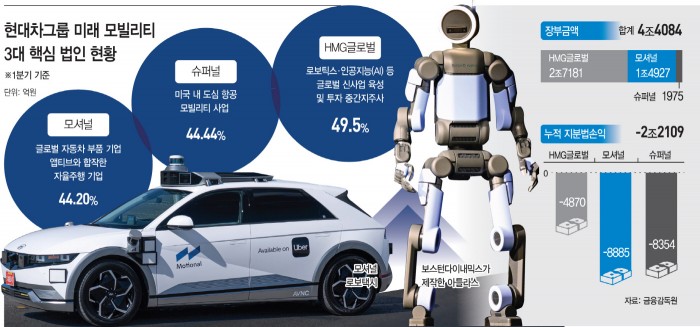 |
Hyundai Motor Group’s three core future-growth businesses — robotics, autonomous driving and advanced air mobility (AAM) — have accumulated more than 2.2 trillion won ($1.6 billion) in losses over the past five years, highlighting the scale of its investment push to secure leadership in next-generation mobility markets.
According to regulatory filings, the combined book value of Hyundai Motor’s key future-mobility affiliates stood at 4.41 trillion won as of the end of the first quarter. The holdings include HMG Global, valued at 2.72 trillion won, Motional at 1.49 trillion won and Supernal at 197.5 billion won.
The companies have generated cumulative equity-method losses totaling 2.21 trillion won, including 487 billion won from HMG Global, 888.5 billion won from Motional and 835.4 billion won from Supernal. The losses amount to more than half of their combined carrying value.
Despite the losses, Hyundai executives and industry analysts view the investments as necessary long-term spending aimed at securing future competitiveness rather than short-term profitability.
HMG Global, established in the United States in 2022, serves as Hyundai Motor Group’s global control tower for robotics and artificial intelligence businesses. The company is jointly owned by Hyundai Motor Company, Kia Corporation and Hyundai Mobis, and holds a 56.25% stake in Boston Dynamics, the developer of the humanoid robot Atlas.
Boston Dynamics recently unveiled a roadmap to build an annual production capacity of 30,000 Atlas robots by 2028. Hyundai plans to deploy approximately 25,000 of those units across its manufacturing operations, beginning with Hyundai Motor Group Metaplant America in the United States and potentially expanding to Kia’s Georgia facility.
Investor enthusiasm surrounding Atlas has also boosted Boston Dynamics’ valuation. Following the robot’s public demonstrations at CES 2026 in Las Vegas, market estimates for the company’s value have risen to between 30 trillion won and 60 trillion won, with some analysts suggesting it could eventually exceed 100 trillion won.
Industry observers believe a potential Boston Dynamics initial public offering as early as next year could provide Hyundai with substantial capital for future investments.
Autonomous-driving venture Motional remains unprofitable but is advancing toward commercialization. Established in 2020 by Hyundai Motor Group and auto-parts supplier Aptiv, Motional develops Level 4 and Level 5 autonomous-driving technologies.
In March, Motional and Uber Technologies launched a robotaxi service in Las Vegas using Hyundai’s Ioniq 5 vehicles. The service currently operates with onboard safety supervisors, but the company aims to deploy fully driverless operations by the end of the year.
Supernal, Hyundai’s AAM subsidiary established in 2020, faces the greatest uncertainty among the group’s future businesses. The company has already recorded losses exceeding its book value and underwent management restructuring last year, followed by significant workforce reductions in March.
Despite concerns over the commercial viability of the urban air mobility sector, Hyundai maintains that AAM remains a critical pillar of its long-term mobility strategy and says it will continue developing commercially viable aircraft.
Industry experts argue that Hyundai’s losses should be viewed as the cost of securing a foothold in future transportation markets.
Lee Hang-gu, a researcher at the Korea Automobile Research Institute, said Hyundai’s expanded investment efforts are understandable given slowing production growth at global rivals such as Toyota Motor Corporation and Volkswagen Group, although he cautioned that Supernal still faces significant business uncertainty.
Lee Ho-geun, a professor of automotive engineering at Daedeok University, said Hyundai continues investing in robotics, autonomous driving and AAM despite ongoing losses because future mobility competition is ultimately a battle for technological leadership.
“In future mobility markets, securing data, internalizing technology and establishing ecosystems are more important than generating short-term profits,” he said.
#Hyundai Motor Group #Hyundai Motor #Kia #Hyundai Mobis #HMG Global
Copyright by Asiatoday
Most Read
-
1
Kia Sportage outperforms Mazda CX-5 in German auto..

-
2
Houthis launch successive attacks on Saudi airport..

-
3
Saudi Arabia, Iran hold first diplomatic talks to..

-
4
U.S. deploys carrier, 10,000 more troops to Middle..

-
5
Saudi airport in Riyadh struck again, leaving at l..

-
6
Putin's ally visits China on the 8th ahead of APEC..

-
7
Chinese military support and training center opens..

PEOPLE






HEADLINE NEWS

-
Address : In-Young Bldg., 34, Uisadang-daero 1-gil, Yeongdeungpo-gu, Seoul
Copyright by ASIATODAY CO., LTD. All rights resereved