



[New Book] AI shifts hospital management
May 28, 2026, 09:37 am


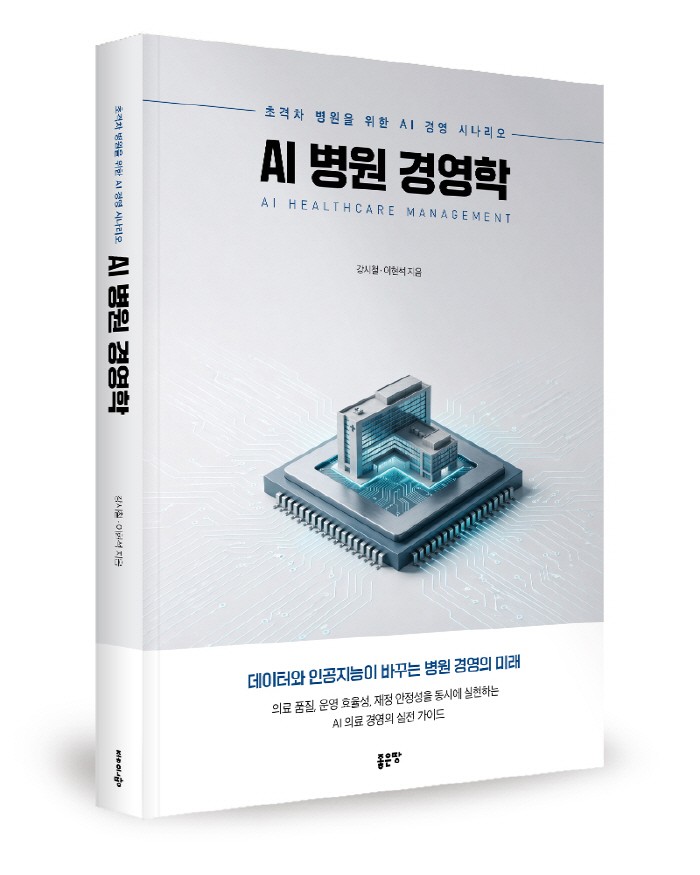 |
| The front cover of the book "AI Hospital Management." / Photo courtesy of Books-Ground |
Artificial intelligence (AI) is expanding its footprint in the healthcare sector, moving beyond clinical diagnostics to become a cornerstone of hospital management. While initially confined to medical services such as image interpretation, diagnostic assistance, and chatbot consultations, AI is increasingly recognized as a core infrastructure technology that influences overall hospital operations, including revenue frameworks, bed management, and staffing optimization. Against the backdrop of this shift, a practical manual titled "AI Hospital Management," which systematically integrates AI into hospital administration, has been published.
Books-Ground has released "AI Hospital Management," co-authored by Dr. Kang Si-chul, an AI and business convergence expert, and Dr. Lee Hyun-seok, Director of the Seoul Medical Center. The publisher introduced the volume as the world's first practical guide to AI-driven hospital administration, illustrating how discussions surrounding healthcare AI are shifting from clinical diagnostic rooms to the strategic heart of hospital operations.
The book frames healthcare AI not merely as an advanced technical amenity, but as a critical managerial infrastructure that dictates a hospital's long-term sustainability. The authors diagnose that contemporary hospital crises do not stem from a deficiency in medical expertise, but rather from multifaceted operational hurdles involving profitability, structural efficiency, workforce management, and patient experience. They argue that AI serves as a strategic tool to resolve these structural bottlenecks and will ultimately dictate future institutional competitiveness.
In particular, the publication addresses the concrete realities confronting domestic hospitals, such as restrictive health insurance reimbursement caps, the financial burden of high-cost medical equipment, intensifying competition to secure medical staff, and escalating administrative overhead. Furthermore, the analysis highlights that systemic fatigue in healthcare environments has reached a critical threshold, compounded by chronic patient friction points including long outpatient wait times, emergency room overcrowding, and inefficiencies in bed allocation.
To mitigate these challenges, the authors propose AI-driven data analytics and operational optimization. This approach entails forecasting patient flows to reduce wait times, accelerating bed turnover rates, and efficiently distributing staff workloads. The book also introduces tangible use cases for AI across hospital administration, including operating room utilization analytics, inventory and administrative automation, and the enhancement of emergency response frameworks.
Co-author Dr. Kang Si-chul is a strategy professional specializing in AI and digital transformation. For over three decades, he has analyzed the industrial evolutions of the internet, the Internet of Things (IoT), and artificial intelligence while executing projects across various enterprises and institutions. His research centers on how technological breakthroughs reshape industrial frameworks, with a recent focus on AI-driven management innovation and digital healthcare. The publisher characterized Dr. Kang as an AI-business convergence expert who translates technological shifts into actionable management strategies.
Co-author Dr. Lee Hyun-seok is a healthcare administration expert currently leading the Seoul Medical Center, the nation's largest municipal public hospital. A thoracic surgeon by training, Dr. Lee is regarded as a hands-on leader with extensive field experience spanning public healthcare systems and institutional administration. He previously commanded public hospital response frameworks on the front lines of the COVID-19 pandemic. The publisher noted that the primary distinction of the book lies in how an AI technology specialist and a public healthcare field expert collaborated to bridge the languages of technology, clinical practice, and management.
Rather than merely presenting abstract future projections, the text approaches the subject from a pragmatic operational perspective, detailing how to deploy AI in live hospital environments and drive structural change in organizational culture. It also confronts realistic hurdles that arise during AI integration, including resistance from medical staff, data governance complexities, and shifts in internal decision-making frameworks.
Furthermore, the authors emphasize that as the digital transformation of the healthcare industry becomes irreversible, hospitals can no longer maintain competitive viability solely through conventional medical services. The outlook posits that patient experience, operational efficiency, and data-driven decision-making architectures will dictate the future competitiveness of healthcare institutions.
"AI is now moving past its role as an auxiliary tool inside the examination room to redefine the very survival strategies of hospitals," the publisher stated. "This volume will deliver a fresh perspective and practical pathways for hospital executives, medical professionals, and digital healthcare industry stakeholders alike."
Jeon Hye-won
Most Read
-
1
Celltrion’s Omlyclo gains ground in major European..

-
2
Trump demands rates fall below 1% as Fed hikes for..

-
3
Hyundai Motor Group breaks ground on integrated st..

-
4
U.S. strikes 3 Iranian oil tankers, Iran vows reta..

-
5
Trump makes $1 trillion bet ahead of midterm elect..

-
6
Iran resumes ballistic missile production, assembl..

-
7
Samsung Electronics, Mistral AI to jointly develop..

PEOPLE







-
Address : In-Young Bldg., 34, Uisadang-daero 1-gil, Yeongdeungpo-gu, Seoul
Copyright by ASIATODAY CO., LTD. All rights resereved