



N. Korea dumps water from Hwanggang Dam without notice
Jul 22, 2026, 09:23 am


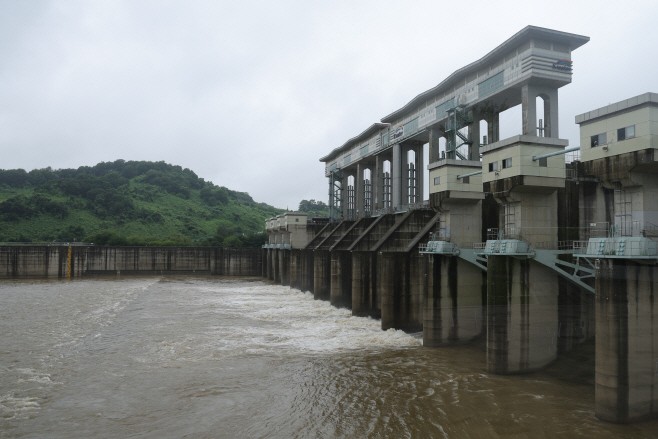 |
| Water is discharged from the Gunnam Flood Control Dam along the Imjin River in Yeoncheon County, Gyeonggi Province, on the morning of July 15, as the water level at Pilseung Bridge exceeded 1 meter—the threshold for evacuating riverside visitors. / Courtesy of Yonhap News |
The Ministry of Unification expressed regret on July 21 over North Korea opening the spillway gates of the Hwanggang Dam upstream on the Imjin River without prior notice, stating that "mutually responsible cooperation is necessary."
Meeting with reporters on the same day, a Unification Ministry official made the statement, adding that "joint responses to natural disasters are a humanitarian matter."
North Korea agreed back in 2009 to give South Korea prior notice when discharging water from the Hwanggang Dam, after an unannounced release resulted in the deaths of six residents in Yeoncheon County, Gyeonggi Province. However, Pyongyang has failed to provide prior notice except for just three occasions—twice in July 2010 and once in July 2013. Even during last year's monsoon season, North Korea repeatedly opened the gates of the dam without advance warning.
The ministry official stated, "Considering practical constraints such as the current severance of inter-Korean communication lines, we are monitoring relevant developments using satellite imagery and scientific technology in cooperation with relevant agencies." The official added, "The government will closely track related movements through tight inter-agency coordination to prevent any harm to residents in border areas."
Earlier, the Ministry of Climate, Energy and Environment confirmed North Korea's unannounced discharge based on satellite images captured around 8:47 p.m. on July 20. The ministry checks satellite data two to four times a day to monitor whether water is being released from the dam.
Heavy rains hit North Korea from July 17 to 19, and with further downpours forecast through July 21, North Korea is presumed to have opened the gates of the Hwanggang Dam without notice.
The Imjin River is a shared inter-Korean waterway that requires joint management, including advance notifications of dam discharges and exchanges of meteorological and hydrological data. Since roughly 60% of the Imjin River basin lies in North Korea, prior notice from Pyongyang is essential for South Korea to prepare effectively for floods and heavy rainfall.
The Unification Ministry official reiterated that "prior notification regarding the release of water from the Hwanggang Dam is an item agreed upon between the two Koreas on multiple occasions," urging North Korea to honor the agreement whenever opening the dam gates.
Mok Yong-jae
Most Read
-
1
Celltrion nears additional contract with major U.S..

-
2
Putin proposes trilateral U.S.-China-Russia summit..

-
3
U.S. weighs dropping MOAB, world's most powerful n..

-
4
"Aren't those foreigners on welfare?": M..

-
5
Attention centers on APEC for possible Trump-Xi-Pu..

-
6
Saudi Arabia, Iran hold first diplomatic talks to..

-
7
China tightens grip on boosting domestic demand an..

PEOPLE







-
Address : In-Young Bldg., 34, Uisadang-daero 1-gil, Yeongdeungpo-gu, Seoul
Copyright by ASIATODAY CO., LTD. All rights resereved