



Will 800 trillion won mega projects rescue construction employment after four-year slump?
Jul 22, 2026, 10:20 am


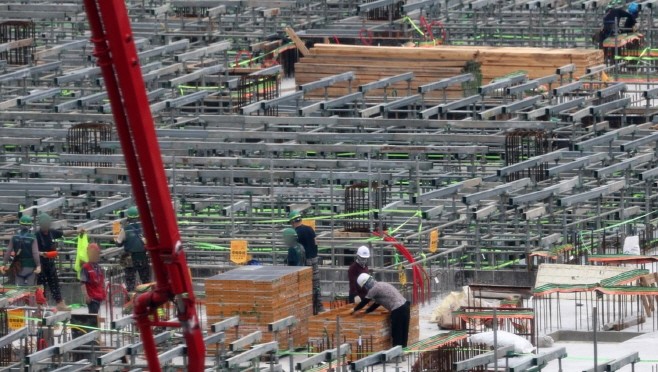 |
| Laborers perform their work at a construction site. / Photo by Yonhap News Agency |
Declining for four consecutive years, the construction employment market is drawing industry attention over whether it can bound back through major government mega-projects. As real estate stagnation and a slumping influx of young workers combine, the persistent shortage of construction labor is watched closely to see if large-scale national initiatives will mark a structural turning point.
According to industry sources on July 21, the number of employed individuals in construction has continued a clear downward trend in recent years. An analysis of the National Data Agency’s Economically Active Population Survey by the Korea Construction Policy Institute showed that construction employees stood at 1.92 million as of last May, down by over 260,000 compared to May 2022, when employment peaked. The share of construction workers among all employed individuals also shrank from 7.7 percent to 6.6 percent over the same period. Compared with general employment gains in other industries, the sluggishness in construction employment appears particularly pronounced.
The industry considers this drop in personnel difficult to explain by a simple downturn in construction activity alone. Construction investment recorded negative growth for five consecutive years starting in 2021, and the slump dragged on, dropping 9.8 percent year-on-year last year. A defining feature of this downturn is the overlapping issue where orders and permits fail to lead to starts, and starts fail to translate into completed work.
Financing burdens caused by the project financing (PF) crunch and surging construction costs have deepened this mismatch. On top of this, aging in the workforce is worsening severe imbalances: workers in their 20s and 30s account for just 16.2 percent of technical construction personnel, whereas those aged 50 and older make up 56.9 percent. Furthermore, as changes in field conditions—such as the rising number of foreign workers—are not fully reflected in domestic-centered statistics, the gap between perceived labor shortages and official statistics is widening.
However, signs of change are emerging in the stagnant construction job market as the government consecutively rolls out mega-projects encompassing semiconductor production hub expansions, nuclear power plant construction, and data center developments. Following the Pyeongtaek and Yongin semiconductor clusters in Gyeonggi, an 800 trillion won semiconductor production base in the Southwestern region is being pursued, while candidate sites for large-scale nuclear plants and Small Modular Reactors (SMRs) have been selected in Yeongdeok, North Gyeongsang, and Gijang, Busan.
Because these projects entail civil engineering, housing facilities, and power/water infrastructure beyond merely creating industrial complexes and energy infrastructure, expectations are rising that they will significantly expand previously shrunken construction workloads.
However, many note that it remains to be seen whether such expectations will translate into an actual employment rebound and qualitative structural transformation of the workforce. Given that the key driver of the recent decline in construction employment was the failure of orders and starts to translate into completed work, analysts point out that if these mega-projects repeat the same issue, the employment improvement effect will inevitably be limited.
In particular, concerns are raised that if the still-shrunken PF market fails to lead to actual investment execution, major projects may end up as one-off events stuck in the planning phase. Observers explain that only when plans consistently lead to starts and completions will companies have the incentive to stably hire and nurture skilled technical talent.
Accordingly, voices within the industry suggest that these mega-projects should serve as an opportunity for construction to shift away from a fluid, simple-labor-centered workforce structure and reorganize into an industry focused on skilled professionals. Specifically, experts advise recovering starts and completions in the short term through PF normalization, structural improvements in construction costs, and enhanced efficiency in social overhead capital (SOC) budget execution. For the mid- to long-term, they suggest creating a working environment where young people can enter and settle down through clear career paths, skill-grade incentives, and improved working conditions. Furthermore, they emphasize shifting policy goals away from quantitative metrics focused on employee counts toward qualitative metrics reflecting productivity and skill levels, alongside establishing an employment statistics infrastructure that encompasses both nationals and foreigners to formulate policies based on field demand.
"In the short term, securing workloads through the recovery of starts and completions is the top priority," said Park Sun-koo, head of the Economic and Financial Research Division at the Korea Construction Policy Institute. "For this trend to extend beyond a one-off event into a long-term influx of young people and a qualitative transformation of employment, recovery in starts and completions must go hand-in-hand with workforce restructuring based on accurate statistics for construction employment to enter a path of stabilization."
Kim Da-bin
Most Read
-
1
Celltrion’s Omlyclo gains ground in major European..

-
2
Trump demands rates fall below 1% as Fed hikes for..

-
3
Hyundai Motor Group breaks ground on integrated st..

-
4
U.S. strikes 3 Iranian oil tankers, Iran vows reta..

-
5
Trump makes $1 trillion bet ahead of midterm elect..

-
6
Iran resumes ballistic missile production, assembl..

-
7
Samsung Electronics, Mistral AI to jointly develop..

PEOPLE







-
Address : In-Young Bldg., 34, Uisadang-daero 1-gil, Yeongdeungpo-gu, Seoul
Copyright by ASIATODAY CO., LTD. All rights resereved