



[Exclusive] Illegal ads creep into youth center websites
May 28, 2026, 09:16 am


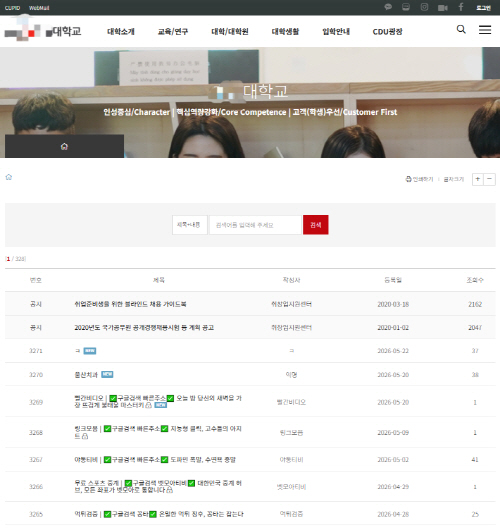 |
| A simple search of specific keywords on major search engines reveals that official websites—spanning universities, youth organizations, and private corporations alike—are frequently compromised with illicit advertisements. The image captures an official South Korean university website flooded with spam posts promoting illegal gambling sites. / Captured from the website's message board |
"Sign up for online Toto casino now and receive a 30,000-won voucher."
"Same-day delivery of prepaid burner phones."
"Stream the latest adult releases for free."
"Microloans available for immediate payout."
Astonishingly, these are actual advertisements published from July of last year through this month on the official website of a municipally run youth center. Public bulletin boards of youth-related public institutions are being inundated with spam posts containing links to illegal gambling, predatory private lending, pornography, and burner phones. This infiltration of illicit advertisements is expanding beyond public entities into the abandoned message boards of private corporate websites. Despite these ads actively steering users toward criminal platforms, enforcement remains fragmented across various government ministries, leaving even basic blocking measures ineffective. Compounding the issue, specialized "illicit advertising agencies" are operating aggressively on social media networks and Telegram.
According to an investigation by Asia Today on May 27, a youth center in Gangwon State belatedly deleted over 100 illegal advertisements after discovering they had been routinely posted for the past 10 months on a message board titled "A Precious Word." From July of last year until May 25, the board was flooded with promotions featuring links to burner phones, prepaid USIM cards, unregistered private lending, and illicit filming websites, alongside the operators' Telegram handles. These posts were indexed seamlessly by search engines like Google, with some fetching view counts as high as 250,000.
The reason these illicit advertisements could thrive undetected for nearly a year on a public, youth-focused platform stems from the exploitation of legacy message board URLs. The specific board recently purged by the youth center was a webpage used officially until 2020. When the center migrated to a new message board address, they simply hid the legacy link from the main user interface rather than deleting the back-end page entirely. While ordinary visitors cannot access the page through the homepage layout, it remains accessible via direct URL entry or specific keyword queries on search engines. Because the board is invisible on the surface, it naturally slipped out of the web administrator's monitoring scope.
Illicit advertising rings quickly weaponized these abandoned message boards. Previously, spammers relied on gorilla-style posting tactics on active, official boards, which were rapidly flagged and wiped. However, by targeting legacy URLs that remain live but are entirely excluded from routine monitoring, bad actors can sustain their advertising campaigns over extended periods. This method allows them to run promotional campaigns on authoritative domains without hosting their own platforms, driving up view counts and maximizing illicit revenues. Consequently, a parasitic ecosystem has taken root, with illegal ad boards hitching a ride on the official websites of public educational institutions and private corporations alike.
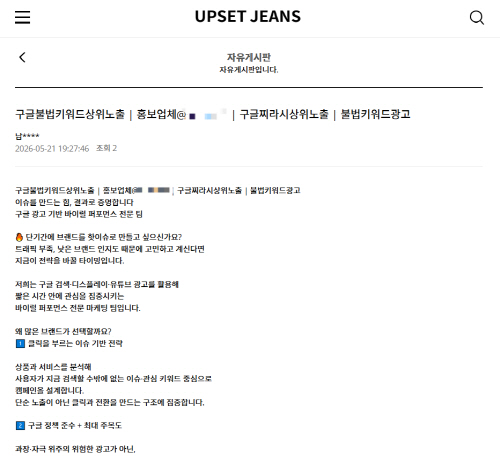 |
| An advertisement promoting an illegal ad agency is visible on the open community board of an online clothing store. / Captured from the website's message board |
Entering specific keywords into major search engines immediately yields dozens or even hundreds of illicit advertisements hosted on the official websites of public institutions and private corporations. Crucially, promotions for agencies that facilitate this exact form of advertising are also readily encountered. A representative from an illicit advertising firm, contacted via Telegram, explained, "Once you settle on a keyword, whether it's illegal or not, we can ensure it continuously ranks at the top of Google results." The representative added, "We operate on monthly contracts at around 1 million won per month, and if a contract is not renewed, the exposure priority may drop." With established industry networks and standardized market pricing already in place, a self-sustaining illicit advertising ecosystem has clearly materialized.
Despite the proliferation of these advertisements, which serve as conduits for criminal activities such as the distribution of sexual exploitation material and the sale of burner phones, government-level crackdowns remain largely ineffective. The fundamental issue is the absence of a centralized control tower. When a single agency posts multiple categories of illegal ads on the exact same message board, the monitoring responsibilities are fragmented across different ministries depending on the subject matter. For instance, predatory private lending ads fall under the Financial Supervisory Service, drug-related promotions under the Ministry of Food and Drug Safety, and adult content under the Ministry of Gender Equality and Family. Each ministry individually refers its findings to the Korea Communications Standards Commission (KCSC), which then evaluates the content and instructs web administrators to delete or block the pages. This fractured approach restricts enforcement to isolated monitoring, which remains stuck in legacy crackdown methods centered heavily on social media and mainstream online communities.
"As it stands, the most realistic solution is for website administrators to routinely audit legacy data and delete these pages independently," a KCSC official remarked. "However, in many cases, it appears administrators are not even aware of the issue until they receive our formal review notifications."
Kim Hong-chan
Most Read
-
1
Celltrion’s Omlyclo gains ground in major European..

-
2
Trump demands rates fall below 1% as Fed hikes for..

-
3
Hyundai Motor Group breaks ground on integrated st..

-
4
U.S. strikes 3 Iranian oil tankers, Iran vows reta..

-
5
Trump makes $1 trillion bet ahead of midterm elect..

-
6
Iran resumes ballistic missile production, assembl..

-
7
Samsung Electronics, Mistral AI to jointly develop..

PEOPLE







-
Address : In-Young Bldg., 34, Uisadang-daero 1-gil, Yeongdeungpo-gu, Seoul
Copyright by ASIATODAY CO., LTD. All rights resereved