



Local extinction sidelined in South Korea’s election battle
May 28, 2026, 08:20 am


 |
With just days remaining before South Korea’s June 3 local elections, concerns are mounting that the issue of “local extinction” has been pushed aside amid fierce national political battles. Critics say key livelihood issues closely tied to residents’ daily lives — including shortages of doctors and lawyers in rural communities — have received little attention from candidates.
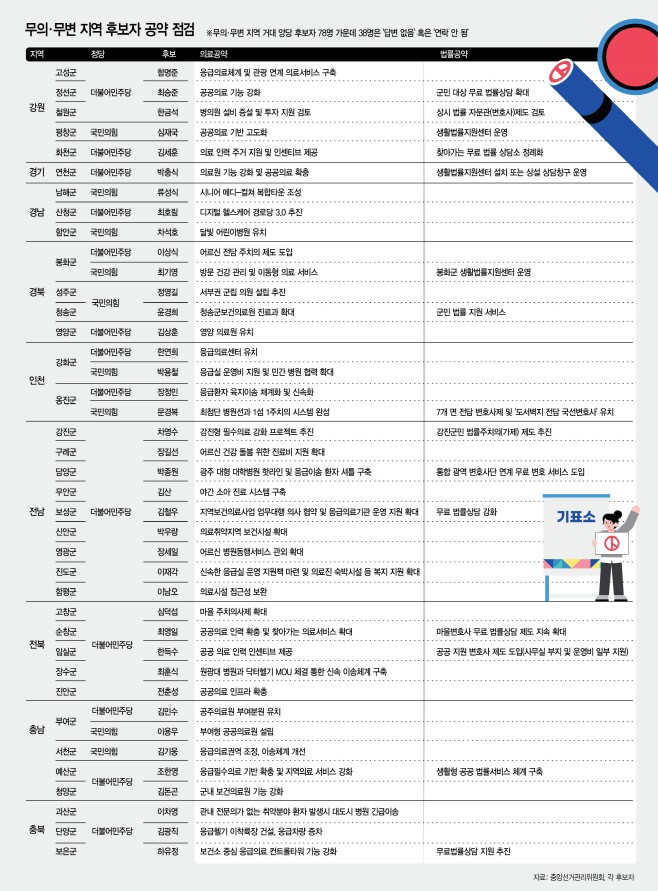
According to an investigation conducted by Asia Today on Tuesday, nearly half of the 78 candidates from the ruling and opposition parties running in 48 medically and legally underserved regions failed to present meaningful policy pledges addressing shortages of physicians and legal professionals.
The survey examined candidates from the Democratic Party of Korea and the People Power Party. Among the 38 candidates who either failed to provide policy proposals or declined to answer questions, 16 belonged to the Democratic Party and 22 to the People Power Party.
Some of the candidates represented remote islands and mountainous regions where residents must travel for hours to access doctors or lawyers in nearby cities. Several candidates reportedly avoided giving direct answers, saying they were still reviewing detailed measures or that the issue was beyond their authority to resolve.
Some campaign offices reacted defensively to repeated media inquiries, reportedly saying the matter was “too sensitive” to discuss immediately. In several cases, reporters were unable to reach campaign staff despite repeated attempts using official contact information submitted to the National Election Commission.
Even among candidates who disclosed policy proposals, many offered only broad and repetitive responses such as expanding emergency medical infrastructure or strengthening public healthcare systems. Proposed solutions for legal service shortages were similarly limited to measures like legal support centers and free legal counseling — policies critics say have already circulated unsuccessfully for years at the national level.
Detailed implementation plans involving budget allocation or workforce recruitment incentives were largely absent, prompting criticism that many pledges amounted to little more than symbolic campaign promises aimed at winning votes during election season.
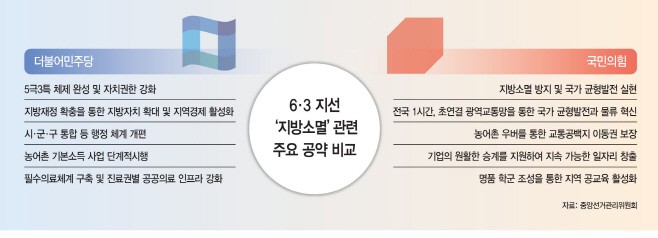 |
Observers argue the election has increasingly turned into a proxy battle for national politics, sidelining urgent local issues. They say party leaders from both major camps have focused primarily on high-profile political conflicts, including fallout from the Dec. 3 emergency martial law controversy, special counsel investigations and by-elections involving major political figures, while neglecting the survival concerns of residents in rapidly declining rural areas.
Civic groups have also criticized the disappearance of the local extinction agenda from the election discourse. Citizens' Coalition for Economic Justice said both major parties frequently talk about balanced regional development, but in practice remain fixated on large-scale construction projects and top-down development initiatives rather than essential community services that directly support residents’ lives.
The organization warned that population decline and the collapse of essential infrastructure create a vicious cycle: people leave because services disappear, and dwindling populations make it even harder to sustain infrastructure.
It called for immediate and practical measures, including establishing public medical schools under state responsibility, strengthening essential healthcare networks and expanding local government-led public legal support systems to prevent the acceleration of regional collapse.
#local extinction #regional collapse #local elections #healthcare shortage #lawyer shortage
Copyright by Asiatoday
Most Read
-
1
Celltrion’s Omlyclo gains ground in major European..

-
2
Trump demands rates fall below 1% as Fed hikes for..

-
3
Hyundai Motor Group breaks ground on integrated st..

-
4
U.S. strikes 3 Iranian oil tankers, Iran vows reta..

-
5
Trump makes $1 trillion bet ahead of midterm elect..

-
6
Iran resumes ballistic missile production, assembl..

-
7
Samsung Electronics, Mistral AI to jointly develop..

PEOPLE







-
Address : In-Young Bldg., 34, Uisadang-daero 1-gil, Yeongdeungpo-gu, Seoul
Copyright by ASIATODAY CO., LTD. All rights resereved