



Gov't to strengthen expanded welfare programs
May 26, 2026, 05:06 pm


 |
The government is pursuing a sweeping transformation of its overarching social security policies, marked by efforts to reinforce regional and essential healthcare services and restructure the high-risk emergency medical system. The pivot signals a departure from the conventional selective welfare model focused primarily on vulnerable groups, moving instead toward a framework where the state guarantees well-being for all citizens. As tangible steps materialize across the welfare delivery infrastructure—including artificial intelligence-driven proactive welfare outreach and the expansion of automatic applications for the basic pension—a universal welfare framework is shifting into high gear.
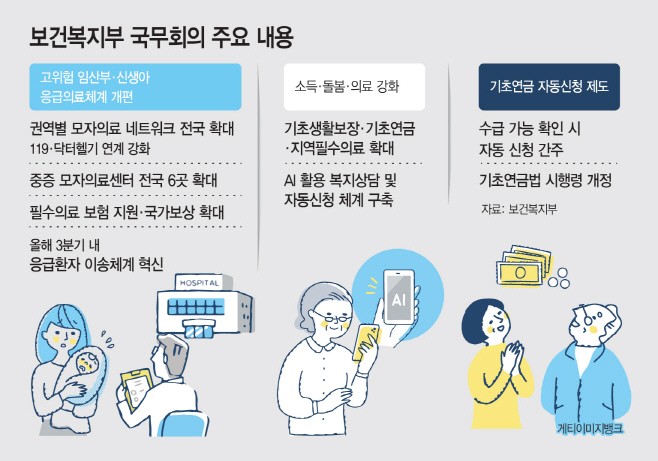
The Ministry of Health and Welfare presented and passed a succession of items during a Cabinet meeting on May 26, including the revised Third Basic Plan for Social Security, measures to improve the medical response system for high-risk pregnant women and newborns, and an amendment to the Enforcement Decree of the Basic Pension Act. In this latest social security blueprint revision, the government departed from its prior "vulnerable-first, meticulous care" doctrine to unveil a new vision: "Universal Welfare, a Society of Shared Prosperity." The administration now views income, care, healthcare, and housing as fundamental universal rights of citizens, vowing to step up state responsibility across the entire lifecycle.
First and foremost, the government placed heavy emphasis on bolstering regional, essential, and public healthcare. The ministry outlines plans to establish a regional, self-contained essential medical network centered around national university hospitals, while securing indispensable medical personnel through a regional physician system and the establishment of public medical schools. This restructuring targets chronic issues like overcrowding at major metropolitan hospitals and localized blind spots in obstetrics, emergency care, and pediatrics, ensuring patients can receive timely treatment within their own locales. To execute this, the ministry will expand its "Maternal and Neonatal Medical Care Cooperation Pilot Project"—currently operating across 12 collaborative systems in 9 regions—to include the Chungcheong, Jeonbuk, and Jeju regions, finalizing a nationwide cooperative network within the year. When an emergency strikes, patients will be accommodated within their respective regions to the greatest extent possible. If a local resolution proves unattainable, the Central Maternal and Neonatal Medical Center will interface with the Central 119 Emergency Medical Situation Center to swiftly track down available hospital beds on a national scale.
Transportation protocols for high-risk expectant mothers and newborns will also undergo significant upgrades. The government will triple the personnel of the transfer-dedicated team at the National Medical Center's Central Maternal and Neonatal Medical Center from 5 to 15 members. Furthermore, a new Maternal and Neonatal Medical Information System will launch in June, allowing transfer requests to be submitted to multiple hospitals simultaneously. The physical transport methodology will pivot as well: when a pregnant woman contacts 119, she will initially be routed to her regular hospital; if that facility cannot accept her, the regional maternal medical center network will activate instantly. Long-distance transfers will leverage an interconnected fleet of 8 doctor helicopters, 33 fire department helicopters, and 7 military helicopters. The proactive deployment of 119 ambulances for inter-hospital transfers is also expected to shave down transit times for emergency obstetric patients.
Additionally, the critical maternal and neonatal medical centers, which currently operate in just two locations in Seoul, will expand to a six-site national network by adding one center each in the Southeast, Daegu-Gyeongbuk, Central, and Honam regions. The overhaul of the emergency patient transport system will likewise scale nationwide, with the "Innovative Transport Model"—tested during a pilot run from March to May—slated for nationwide rollout within the third quarter. Alongside these measures, the Cabinet passed the amendment to the Enforcement Decree of the Basic Pension Act. Moving forward, if the government verifies eligibility through routine income and asset cross-checks, individual pensions will be treated as automatically applied for without requiring citizens to file separate paperwork.
Over the long term, the government plans to engineer an AI-based proactive welfare infrastructure. This framework will deploy AI to seamlessly link welfare consultations to actual application filings in a single loop, while upgrading predictive data systems to detect households in crisis ahead of time.
"Amid the grand AI transition and shifting demographic structures, constructing a social safety net that alleviates anxieties in public life and guarantees basic living standards for everyone is vital," remarked Minister of Health and Welfare Jung Eun-kyeong. "We will consistently drive forward policies that citizens can tangibly feel in their daily lives across core domains like income, care, and healthcare."
Lee Sae-mi
Most Read
-
1
Celltrion’s Omlyclo gains ground in major European..

-
2
Trump demands rates fall below 1% as Fed hikes for..

-
3
Hyundai Motor Group breaks ground on integrated st..

-
4
U.S. strikes 3 Iranian oil tankers, Iran vows reta..

-
5
Trump makes $1 trillion bet ahead of midterm elect..

-
6
Iran resumes ballistic missile production, assembl..

-
7
Samsung Electronics, Mistral AI to jointly develop..

PEOPLE







-
Address : In-Young Bldg., 34, Uisadang-daero 1-gil, Yeongdeungpo-gu, Seoul
Copyright by ASIATODAY CO., LTD. All rights resereved