



Gov't to overhaul 164 rules in normalization drive
May 22, 2026, 05:32 pm


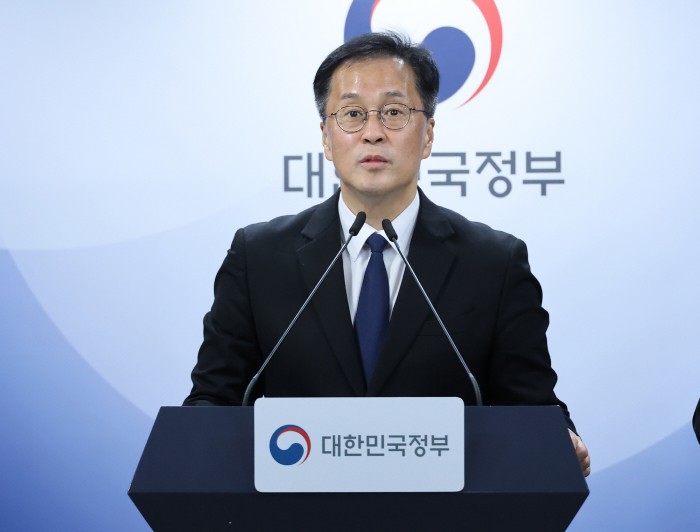 |
| Shim Jong-seop, Director General for Government Operations at the Office for Government Policy Coordination, briefs reporters on the first batch of national normalization projects at the Government Complex Seoul in Jongno District on May 22. / Photo courtesy of Yonhap News Agency |
The South Korean government officially finalized the first batch of 164 initiatives under its "National Normalization Project" on May 22, launching a sweeping regulatory overhaul designed to eradicate deeply entrenched, anomalous practices across society. By prioritizing everyday livelihood issues—such as rationalizing school zone speed limits, enhancing the transparency of officetel maintenance fees, and curbing the illicit trafficking of Onnuri gift certificates—the administration aims to deliver tangible, highly perceivable results to the general public.
"Stabilizing public welfare begins with normalizing the abnormalities that have accumulated in the daily lives of our citizens," said Shim Jong-seop, Director General for Government Operations at the Office for Government Policy Coordination, during a press briefing held at the Government Complex Seoul.
The preliminary lineup of initiatives was cultivated through a government-wide task force comprising 50 central administrative agencies. Out of an initial pool of approximately 500 candidate cases, the government carefully screened and selected 164 high-priority tasks based on their urgency and potential social efficacy.
The chosen initiatives lean heavily toward pressing matters directly connected to localized, real-world environments. The administration's baseline strategy is to fix existing blind spots and systemic inefficiencies that have long been a source of public inconvenience.
The 164 projects are broken down into five distinct categories based on their underlying operational nature: 20 targets addressing structural corruption and malpractice; 47 targeting legal loopholes and expedient evasions; 27 dealing with unjust enrichment facilitated by government oversight or neglect; 44 focused on outdated statutes and regulations detached from reality; and 19 aimed at reforming institutional systems disconnected from public sentiment.
The overarching normalization drive also absorbs the absolute eradication of what the government classifies as the "seven major social evils." These include illicit narcotics, voice phishing financial scams, illegal real estate transactions, stock market manipulation, high-value tax evasion, catastrophic industrial accidents, and the unlawful pocketing of state subsidies. The government emphasized that these fields will not be treated as short-term fixes but will remain under permanent, rigorous state surveillance.
The administration plans to aggressively front-load highly relatable tasks—such as standardizing umbrella rental fees at public beaches—where everyday citizens can instantly witness immediate structural improvements. Administrative pathways that do not require legislative approval, such as modifying enforcement decrees, ministerial regulations, or internal directives, will be executed immediately.
For high-stakes issues involving structural corruption, the Office for Government Policy Coordination will directly intervene to conduct independent inspections and situational audits. For complex matters where multiple ministries intersect, the prime minister's office will centralize leadership to maximize administrative momentum rather than relying strictly on the autonomy of individual agencies.
However, a definitive timeline for the completion of all 164 tasks has not been strictly locked in. "Individual ministries have already finalized their internal task selections via dedicated sub-task forces and are actively moving forward with implementation," Director General Shim explained. "This will operate as an ongoing, iterative 'rolling process' rather than a one-off administrative event."
Park Young-hoon
Most Read
-
1
Trump shares map on social media labeling Strait o..

-
2
Kia Sportage outperforms Mazda CX-5 in German auto..

-
3
Houthis launch successive attacks on Saudi airport..

-
4
U.S. deploys carrier, 10,000 more troops to Middle..

-
5
Trump rejects Iran's offer to open Strait of Hormu..

-
6
N. Korea conducts first swarm attack drill with dr..

-
7
U.S.-China summit falls short on substance as Trum..

PEOPLE






HEADLINE NEWS
- Seoul dismisses Ukraine's claim of 'S. Korean support for Russia' as "inaccurate and inappropriate"
- S. Korea, Japan race to develop nuclear-powered submarines
- Henri Kagan, Kenso Soai win Nobel Prize in Chemistry for uncovering how mol..
- Vance says Alaska LNG cooperation will move forward with Seoul's current or..

-
Address : In-Young Bldg., 34, Uisadang-daero 1-gil, Yeongdeungpo-gu, Seoul
Copyright by ASIATODAY CO., LTD. All rights resereved