



Card issuers on edge over fallout from Starbucks' 'Tank Day' fiasco
May 22, 2026, 04:19 pm


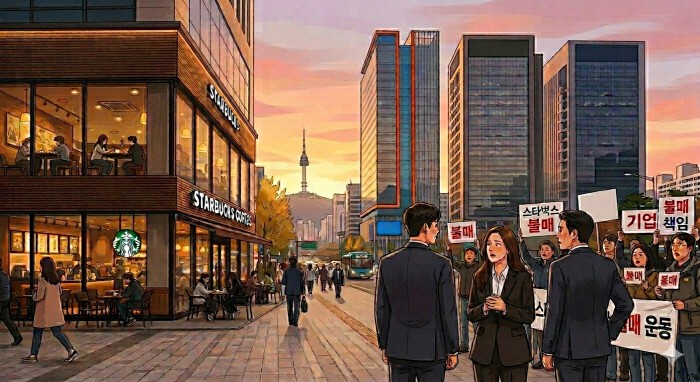 |
| An image generated by AI. |
The fallout from Starbucks Korea’s "Tank Day" marketing controversy is spilling over into the credit card industry, plunging partner card issuers into a deep dilemma. While these financial firms aggressively forged partnerships to capitalize on Starbucks' famously high brand loyalty, the actual influx of new customers has fallen short of expectations—a situation now compounded by severe reputational risks.
Most notably, Shinhan Card, which had been actively preparing to roll out a new Starbucks-branded card next month, has pushed back its launch timeline to monitor public sentiment. Meanwhile, Samsung Card and Woori Card, which already have active partnerships in the market, are keeping a low profile but remaining on high alert. Industry insiders point out that the rarity of a standalone Starbucks private-label credit card (PLCC) has already diluted, and a sustained drop in coffee chain traffic will inevitably deal a direct blow to the transaction volumes of these co-branded cards.
According to credit card industry sources on May 22, Shinhan Card will not be launching its Starbucks partner card within the first half of this year. The issuer had originally aimed for a first-half release and was deep into product development. A Shinhan Card official commented, "Assessing the overall pace of product formulation, the launch will not materialize within the first half."
Samsung Card and Woori Card maintained that they are closely evaluating market conditions. A Woori Card official remarked, "While we have not detected any alarming shifts in usage metrics so far, we are carefully tracking customer feedback and continuously monitoring the situation."
Historically, the Starbucks PLCC landscape was effectively a monopoly held by Hyundai Card, which introduced the pioneering "Starbucks Hyundai Card" in 2020. However, following the expiration of that exclusive contract last year, major competitors like Samsung, Woori, and Shinhan cards fiercely jumped into the Starbucks partnership market.
Samsung Card introduced its "Starbucks Samsung Card" last September, and Woori Card rolled out the "Star Travel Woori Card" just last month. Shinhan Card was poised to be the next contender before the current delay. These financial institutions initially pivoted toward these alliances under the strategic assumption that tapping into Starbucks’ powerful brand affinity would act as a reliable driver for acquiring high-value, recurring customers.
Yet, some corners of the industry assess that the performance of these newer Starbucks partner cards has been underwhelming. Unlike the era when Hyundai Card held exclusive domain, the simultaneous expansion of partnerships across multiple issuers has drastically chipped away at the product's exclusivity and appeal.
Against this backdrop, the "Tank Day" backlash has significantly amplified anxieties across the sector. Because the financial viability of a coffee-branded card relies entirely on how frequently consumers visit the chain, any degradation of the brand’s image translates directly to a reduction in transaction fees and outstanding balances. Consequently, the card industry views the longevity of the consumer boycott as the critical variable moving forward.
"With the boycott movement showing signs of spreading, we have no choice but to wait and see how the dust settles," an industry insider noted. "At this juncture, there is very little that partner card companies can do proactively to mitigate the damage."
Lee Sun-young
Most Read
-
1
Celltrion’s Omlyclo gains ground in major European..

-
2
Trump demands rates fall below 1% as Fed hikes for..

-
3
Trump makes $1 trillion bet ahead of midterm elect..

-
4
Iran resumes ballistic missile production, assembl..

-
5
Samsung Electronics, Mistral AI to jointly develop..

-
6
Trump warns countries not helping U.S. must pay re..

-
7
Apple launches first foldable, 1 million won prici..

PEOPLE





HEADLINE NEWS
- Trump to roll out ‘unprecedented welcome’ for Xi with B-2 bombers, F-22 fighters
- S. Korea, U.S., and Japan form united front on Taiwan and economic coercion..
- Trump administration moves to impose sweeping sanctions on International Cr..
- Xi to make state visit to U.S. Sept. 23-25, dispelling rumors over his heal..

-
Address : In-Young Bldg., 34, Uisadang-daero 1-gil, Yeongdeungpo-gu, Seoul
Copyright by ASIATODAY CO., LTD. All rights resereved