



DRC Ebola spread fears grow: Official toll just 'tip of iceberg'
May 22, 2026, 03:25 pm


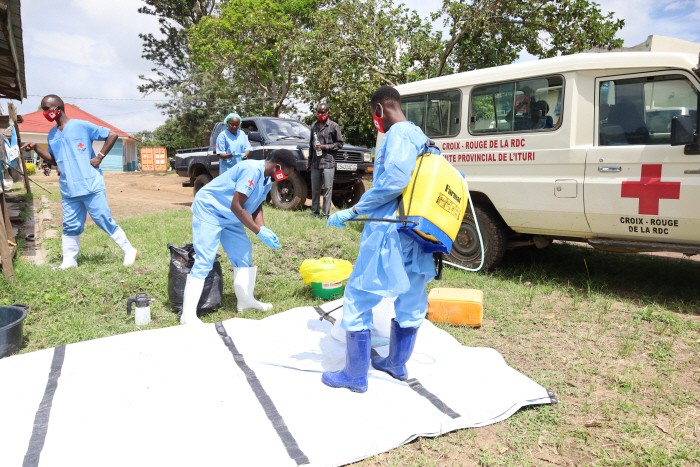 |
| Medical workers disinfect equipment ahead of the burial of a suspected Ebola victim in Bunia, Ituri Province, the Democratic Republic of the Congo, on May 21 (local time). The current Ebola outbreak, first reported in Ituri Province, has now spread to North Kivu and South Kivu provinces, with two confirmed cases also reported in neighboring Uganda. / Photo courtesy of Xinhua-Yonhap |
The World Health Organization (WHO) has declared a Public Health Emergency of International Concern (PHEIC) over the spread of the Ebola virus in the eastern region of the Democratic Republic of the Congo (DRC), while a global vaccine alliance warned that the true scale of infection could be far greater than official tallies suggest.
According to a Reuters report on May 21 (local time), Jane Halton, chair of the Coalition for Epidemic Preparedness Innovations (CEPI), stated during a briefing with the Association of Correspondents Accredited to the United Nations (ACANU) in Geneva that "the outbreak figures identified so far are merely the tip of the iceberg." She added, "While hundreds of suspected cases and deaths have been reported, the actual number of confirmed cases is likely significantly higher."
Currently, suspected Ebola cases in the eastern DRC hover around 600, with the suspected death toll surpassing 130.
CEPI aims to develop safe and effective vaccines within 100 days of an outbreak, but achieving this timeline for the current flare-up is expected to face steep hurdles.
When asked about the feasibility of developing a vaccine within the 100-day window, Halton admitted that "significant challenges are anticipated," though she noted that "it is a fact that the response velocity has accelerated dramatically compared to five years ago." She declined to provide a specific timeline for a vaccine rollout.
The strain currently driving the outbreak is the Bundibugyo ebolavirus, for which there are no approved targeted therapeutics or vaccines. The Bundibugyo variant is understood to have a lower case fatality rate compared to the previously prevalent Zaire strain.
CEPI officials stated they are fast-tracking preclinical safety testing on early-stage vaccine candidates, with plans to initiate clinical trials within the affected regions as soon as community consent is secured on the ground.
Lee Jung-eun
Most Read
-
1
Celltrion’s Omlyclo gains ground in major European..

-
2
Trump demands rates fall below 1% as Fed hikes for..

-
3
Trump makes $1 trillion bet ahead of midterm elect..

-
4
Iran resumes ballistic missile production, assembl..

-
5
Samsung Electronics, Mistral AI to jointly develop..

-
6
Trump warns countries not helping U.S. must pay re..

-
7
Apple launches first foldable, 1 million won prici..

PEOPLE






HEADLINE NEWS
- Trump to roll out ‘unprecedented welcome’ for Xi with B-2 bombers, F-22 fighters
- S. Korea, U.S., and Japan form united front on Taiwan and economic coercion..
- Trump administration moves to impose sweeping sanctions on International Cr..
- Xi to make state visit to U.S. Sept. 23-25, dispelling rumors over his heal..

-
Address : In-Young Bldg., 34, Uisadang-daero 1-gil, Yeongdeungpo-gu, Seoul
Copyright by ASIATODAY CO., LTD. All rights resereved