



CPJ warns of 'invisible control' squeezing press freedom in S. Korea, Japan
May 22, 2026, 01:59 pm


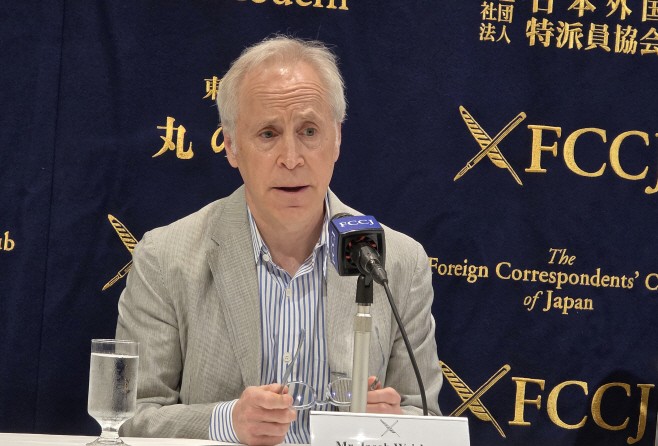 |
| Jacob Weisberg, Chair of the Board of Directors at the Committee to Protect Journalists (CPJ), delivers remarks at the Foreign Correspondents' Club of Japan (FCCJ) in Tokyo on May 22. / Photo by Tokyo Correspondent Choi Young-jae |
"Preventing journalists from doing their jobs, unofficially punishing them, threats, and self-censorship are much more difficult problems that shrink press freedom."
Jacob Weisberg, Chair of the Board of Directors at the Committee to Protect Journalists (CPJ), addressed indirect pressure on the press in democratic countries like South Korea and Japan during a press conference at the Foreign Correspondents' Club of Japan (FCCJ) in Tokyo on May 22. He emphasized that methods such as lawsuits, exclusion from press pools, restricted access to government briefings, and online attacks—even if they do not involve jailing journalists or directly censoring articles—are issues that undermine press freedom if they breed intimidation and self-censorship among reporters. The CPJ is a US-based international press freedom organization that investigates and supports cases of detention, murder, threats, and harassment against journalists worldwide.
During the conference, Asia Today pointed out, "While press freedom issues in Asia are often discussed around extreme cases like imprisonment, censorship, and violence, in democratic nations like South Korea and Japan, the pressure manifests in softer, institutional forms." Citing beat-system-centric reporting restrictions, restricted access to government briefings, defamation lawsuits, and online harassment, the outlet asked, "How does CPJ evaluate situations where press freedom is limited not by direct censorship, but by exclusion, intimidation, and loss of access, and how should foreign correspondents respond?" Weisberg's remarks were made in response to this question.
"The issue of journalists being prevented from doing their jobs, being punished in unofficial ways, and the problems of intimidation and self-censorship are much more difficult matters," Weisberg replied. He added, "This does not mean that CPJ is not concerned about those issues, but to be fair, we are still grappling with how to address these questions."
However, he also made the CPJ's operational priorities clear. "CPJ's primary obligation is to help journalists who are in physical danger," Weisberg said. "We prioritize the cases of journalists who have been jailed, abused, tortured, or killed." Nonetheless, he stressed, "That does not mean we are unconcerned with the more subtle and complex problems surrounding press freedom."
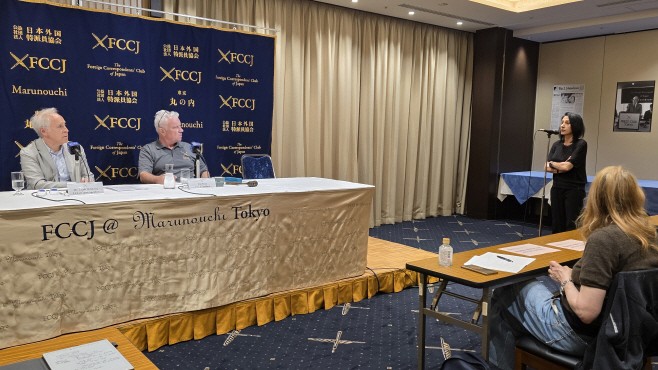 |
| Foreign correspondents affiliated with the Foreign Correspondents' Club of Japan (FCCJ) ask questions to Jacob Weisberg, Chair of the Board of Directors at the Committee to Protect Journalists (CPJ), in Tokyo on May 22. / Photo by Tokyo Correspondent Choi Young-jae |
S. Korea, Japan press faced with indirect, institutional barriers
Regarding press freedom challenges in Japan, Chair Weisberg addressed the institutional constraints of the country's closed press club system, known as the kisha club. While prefacing his remarks by stating that he does not possess exhaustive expertise on Japan, he noted, "I frequently hear about Japan’s exclusive press clubs and the inherent limitations embedded within that structure." Critics have long argued that reporters operating outside these official clubs are denied equitable access to state information, transforming the system into a monopolistic conduit for controlled government briefings.
However, Weisberg explicitly differentiated these structural hurdles from the overt censorship patterns observed in authoritarian regimes. Characterizing the Japanese press club dilemma, he explained, "While it does not constitute outright censorship, it represents a lower-tier systemic issue." The core concern is that even in the absence of direct punitive actions against journalists, structural mechanisms that ration information access or create rigid insider-outsider divisions inevitably degrade the quality and independence of press freedom.
He extended the analysis to include the media landscape in the United States. Weisberg observed that while there have been no confirmed recent incidents of journalists being jailed or assassinated in the US, the broader operational environment for reporters has grown noticeably more precarious and hazardous across multiple fronts. Specifically, he highlighted the rise of "media capture"—where state actors leverage regulatory approvals or corporate mergers as leverage to pressure broadcasters and publishers—alongside the chilling effects of frivolous lawsuits and pervasive self-censorship.
Weisberg further cited the historical precedents of the Trump administration, pointing out instances where specific media organizations were hit with retaliatory White House access restrictions or blocked from attending Pentagon briefings. He pointedly remarked that the government restricting press access based entirely on political or editorial viewpoints is "illegal and unconstitutional." Nonetheless, he noted that reporting on military affairs from within a briefing room carries inherent limitations anyway, and specialized defense correspondents routinely circumvent such blockades by leveraging alternative independent sources to sustain their coverage.
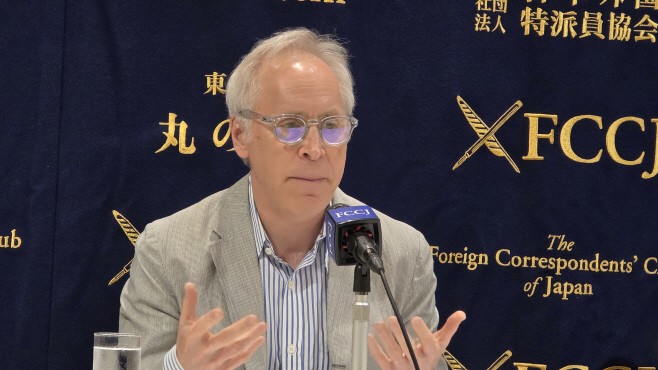 |
| Jacob Weisberg, Chair of the Board of Directors at the Committee to Protect Journalists (CPJ), delivers remarks at the Foreign Correspondents' Club of Japan (FCCJ) in Tokyo on May 22. / Photo by Tokyo Correspondent Choi Young-jae |
He expressed more direct concerns regarding the broader state of press freedom across Asia. Weisberg revealed that according to CPJ metrics as of May 13, a total of 103 journalists were documented as imprisoned across the continent. By country, China accounted for the largest share with 51 incarcerated reporters, followed by Myanmar with 18, and Vietnam with 16.
Beyond direct censorship: Who monopolizes data and loses the right to question?
While no recent incidents of journalists being jailed or assassinated have been recorded in Japan, Weisberg noted that the deteriorating press freedom environment across Asia directly impacts the operational safety and mobility of Japanese journalists reporting abroad. He cited the case of Kawashima Shinnosuke, the NHK Tehran bureau chief who was arrested and subsequently released in Iran but has yet to return home. This underscores that press freedom is not an abstract virtue for Japan, but a practical issue directly affecting the safety, mobility, and reporting capabilities of its own journalists.
Weisberg also suggested that Japan could assume a more proactive diplomatic posture to champion press freedom within the Asian region. His core thesis is that discussions on media freedom must expand beyond nations where journalists are jailed or killed to encompass the subtle mechanisms of exclusion and intimidation occurring within democratic societies.
The press conference offered a fresh lens through which to evaluate the discourse on press freedom in South Korea and Japan. Weisberg emphasized that the absence of journalists behind bars does not automatically equate to a free press. He warned that when a fear of being barred from access, facing frivolous lawsuits, being targeted by online harassment, or losing access to power accumulates, it inevitably fosters a culture of self-censorship on the ground. Consequently, the conversation surrounding press freedom in both South Korea and Japan is moving beyond the binary question of "Does censorship exist?" to ask more fundamental questions: "Who monopolizes information, who is stripped of the right to ask questions, and who is ultimately silenced?"
Choi Young-jae
Most Read
-
1
Celltrion’s Omlyclo gains ground in major European..

-
2
Trump demands rates fall below 1% as Fed hikes for..

-
3
Trump makes $1 trillion bet ahead of midterm elect..

-
4
Iran resumes ballistic missile production, assembl..

-
5
Samsung Electronics, Mistral AI to jointly develop..

-
6
Trump warns countries not helping U.S. must pay re..

-
7
Apple launches first foldable, 1 million won prici..

PEOPLE





HEADLINE NEWS
- Trump to roll out ‘unprecedented welcome’ for Xi with B-2 bombers, F-22 fighters
- S. Korea, U.S., and Japan form united front on Taiwan and economic coercion..
- Trump administration moves to impose sweeping sanctions on International Cr..
- Xi to make state visit to U.S. Sept. 23-25, dispelling rumors over his heal..

-
Address : In-Young Bldg., 34, Uisadang-daero 1-gil, Yeongdeungpo-gu, Seoul
Copyright by ASIATODAY CO., LTD. All rights resereved