



Kazakh court OKs seizure of Gazprom assets by Ukrainian firm
May 22, 2026, 01:26 pm


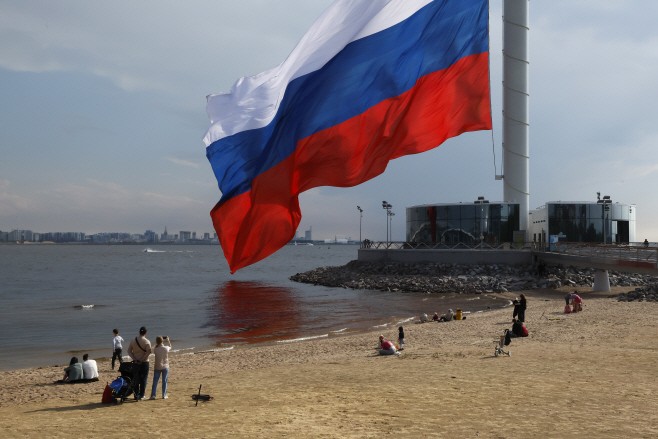 |
| People walk along the embankment as a massive Russian national flag installed by Gazprom is lowered on the coast of the Gulf of Finland in Saint Petersburg, Russia, on May 17. / Photo courtesy of EPA-Yonhap |
Ukrainian state-owned energy conglomerate Naftogaz has secured judicial approval to freeze and recover local assets of Russian state-run gas giant Gazprom in Kazakhstan, escalating a long-standing legal battle over unpaid gas transit fees.
According to a report by German public broadcaster Deutsche Welle (DW) on May 21, Naftogaz announced the previous day that the Astana Court in Kazakhstan cleared the Ukrainian firm to forcefully recoup approximately $1.4 billion worth of Gazprom assets located within Kazakh jurisdiction. The ruling formally executes a prior judgment delivered by the Swiss Chambers’ Arbitration Institution.
Rather than independently arbitrating the commercial dispute between the Russian and Ukrainian state enterprises, the Kazakh judiciary acted to grant domestic enforcement validity to the definitive international arbitration award on Kazakh soil. Faced with Gazprom’s persistent refusal to voluntarily remit the court-ordered compensation despite Naftogaz’s legal victories, the Ukrainian energy company initiated secondary global enforcement actions to seize the Russian firm’s cross-border assets.
The roots of the legal impasse trace back to a five-year natural gas transit agreement brokered between Russia and Ukraine in 2019. Under the long-term contract, which was slated to run until January 2025, Gazprom committed to making fixed transit tariff payments to Naftogaz in exchange for piping Russian natural gas across Ukrainian territory to European markets.
However, the transit network encountered severe disruptions following Russia’s full-scale invasion of Ukraine in 2022. Naftogaz maintained that it continuously provided contractual transit capacities. Conversely, Gazprom withheld payments, claiming it could no longer utilize the complete transit services after Ukrainian authorities shut down a critical border entry point. Characterizing the suspension of payments as a material breach of contract, Naftogaz subsequently filed for international arbitration.
In June of last year, the Swiss arbitration panel ruled in favor of Naftogaz, recognizing Gazprom’s failure to honor its financial obligations. The tribunal ordered the Russian monopoly to pay roughly $1.4 billion, a sum encompassing outstanding transit fees, accrued interest, and legal expenses.
Gazprom subsequently filed an appeal with the Federal Supreme Court of Switzerland, which was dismissed, rendering the arbitration award final and legally binding. As Gazprom continued to dodge the financial penalty, Naftogaz launched an international asset-recovery campaign targeting Gazprom’s overseas holdings, with the latest ruling by the Kazakh court serving as a major milestone.
Gazprom’s footprint in Kazakhstan is understood to comprise minority equity stakes in cross-border joint ventures alongside strategic gas transit and storage infrastructure. In global commercial litigation, when a debtor corporation defies a binding arbitration award, creditors routinely petition local courts to authorize the attachment and liquidation of the debtor's localized assets.
The decision is viewed as highly unusual given Kazakhstan’s deep-seated historic, political, and economic alliances with Moscow.
Legal experts and energy analysts note that the ruling underscores the expanding scope of a global "asset seizure war" triggered by the geopolitical fallout of the Russia-Ukraine conflict.
Kim Min-gyu
Most Read
-
1
Celltrion’s Omlyclo gains ground in major European..

-
2
Trump demands rates fall below 1% as Fed hikes for..

-
3
Trump makes $1 trillion bet ahead of midterm elect..

-
4
Iran resumes ballistic missile production, assembl..

-
5
Samsung Electronics, Mistral AI to jointly develop..

-
6
Trump warns countries not helping U.S. must pay re..

-
7
Apple launches first foldable, 1 million won prici..

PEOPLE






HEADLINE NEWS
- Trump to roll out ‘unprecedented welcome’ for Xi with B-2 bombers, F-22 fighters
- S. Korea, U.S., and Japan form united front on Taiwan and economic coercion..
- Trump administration moves to impose sweeping sanctions on International Cr..
- Xi to make state visit to U.S. Sept. 23-25, dispelling rumors over his heal..

-
Address : In-Young Bldg., 34, Uisadang-daero 1-gil, Yeongdeungpo-gu, Seoul
Copyright by ASIATODAY CO., LTD. All rights resereved