



Gov't to speed up incinerator construction
May 22, 2026, 11:34 am


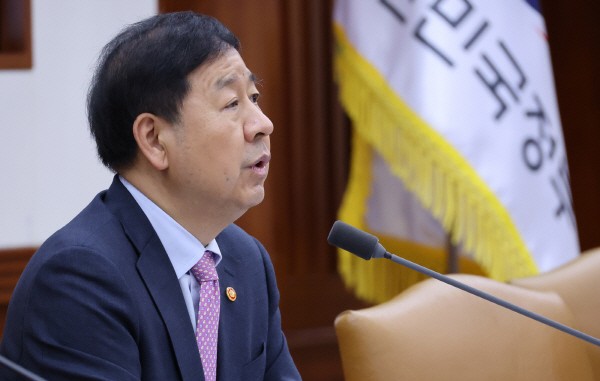 |
| Deputy Prime Minister and Minister of Finance and Economy Koo Yun-cheol delivers remarks during a joint meeting of the Emergency Economic Response Headquarters, the Economic Ministers' Meeting, the National Startup Era Strategy Council, and the Real Estate Ministers' Meeting at the Government Complex Sejong in Seoul on May 22. /Yonhap |
The government will fast-track the expansion of public waste incineration facilities to ensure the seamless implementation of a ban on the direct landfilling of household waste. By cutting the administrative and construction timeline—which typically spanned nearly 12 years from site selection to completion—by up to three years and six months, officials aim to aggressively tackle the nationwide shortage of waste treatment infrastructure.
During a joint meeting of the Emergency Economic Response Headquarters, the Economic Ministers' Meeting, and the National Startup Era Strategy Council chaired by Deputy Prime Minister and Minister of Finance and Economy Koo Yun-cheol on May 22, the government unveiled its Comprehensive Framework for the Accelerated Expansion of Public Incineration Facilities.
The direct landfilling of household waste was banned in the Greater Seoul area this past January, and the restriction is slated for a nationwide expansion to include non-capital regions starting in 2030. While metropolitan areas currently possess the infrastructure to process their entire volume of household waste, regional municipalities suffering from a shortage of public incinerators remain heavily reliant on private subcontractors. This shortfall has forced some waste to be transported across regional borders for processing, sparking severe localized friction. Consequently, expanding municipal incineration capacity has surfaced as an urgent priority ahead of the 2030 non-capital landfill ban.
To expedite this capacity buildout, the government will first streamline site selection protocols. For projects expanding capacity within existing facility footprints, the government plans to revise relevant enforcement decrees to allow project execution based solely on the approval of existing resident support councils, bypassing the mandatory formation of a separate site selection committee.
Financial incentives will also be reinforced to bolster community acceptance. The state will expand local resident support funds by doubling the surcharge on processing fees levied when handling waste imported from outside jurisdictions, raising the ceiling from the current 10% to 20%.
To insulate projects from recurring design modifications and budget overruns, the government will establish standardized operational guidelines covering facility capacity calculations and licensing expenditures. Under this framework, local governments will receive uniform blueprints for facility capacity projecting population shifts, alongside standardized cost breakdowns for critical regulatory approvals, including environmental and disaster impact assessments.
Administrative procedures will undergo a parallel contraction. In light of the operational urgency ahead of the nationwide landfill ban, the government will pursue an initiative to exempt public incinerator projects from local fiscal investment reviews for the next five years. Furthermore, design adequacy evaluations mandated under total project cost management directives will be scaled back from three rounds to two, substantially trimming project timelines.
State budgetary support will also widen in scope. Federal funding, previously restricted to core installation expenditures, will expand to cover existing facility demolition and land acquisition costs. Additionally, the government will prioritize financial backing for projects utilizing design-build (turnkey) structures and fixed-amount subsidy models—frameworks characterized by inherently shorter administrative windows—to incentivize early construction start dates.
Lee Ji-hoon
Most Read
-
1
Celltrion’s Omlyclo gains ground in major European..

-
2
Trump demands rates fall below 1% as Fed hikes for..

-
3
Trump makes $1 trillion bet ahead of midterm elect..

-
4
Iran resumes ballistic missile production, assembl..

-
5
Samsung Electronics, Mistral AI to jointly develop..

-
6
Trump warns countries not helping U.S. must pay re..

-
7
Apple launches first foldable, 1 million won prici..

PEOPLE






HEADLINE NEWS
- Trump to roll out ‘unprecedented welcome’ for Xi with B-2 bombers, F-22 fighters
- S. Korea, U.S., and Japan form united front on Taiwan and economic coercion..
- Trump administration moves to impose sweeping sanctions on International Cr..
- Xi to make state visit to U.S. Sept. 23-25, dispelling rumors over his heal..

-
Address : In-Young Bldg., 34, Uisadang-daero 1-gil, Yeongdeungpo-gu, Seoul
Copyright by ASIATODAY CO., LTD. All rights resereved