



Lee's approval rating rebounds to 64%, marking second-highest at one-year mark
May 22, 2026, 11:16 am


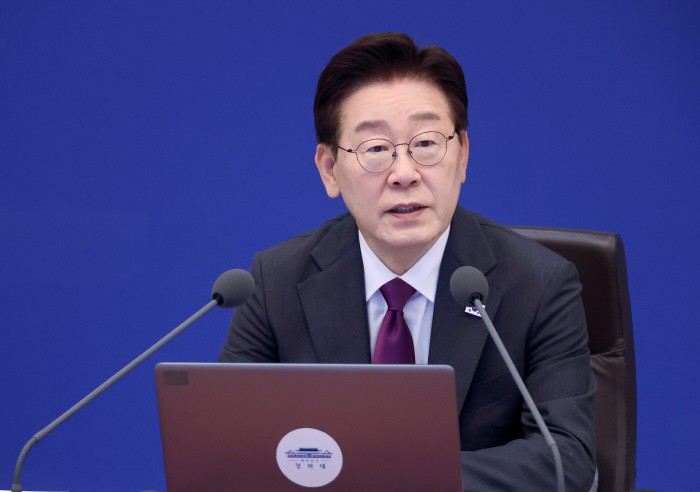 |
| President Lee Jae-myung delivers remarks during a meeting with senior secretaries and aides at the Blue House on May 21. /Yonhap News |
President Lee Jae-myung’s approval rating has halted its downward trajectory, rebounding to 64%. When measured against the historic job performance metrics of his predecessors at the one-year mark of their administrations, Lee’s current score ranks as the second-highest on record, trailing only former President Moon Jae-in.
According to a public opinion poll released by Gallup Korea on May 22, which surveyed 1,002 eligible voters nationwide aged 18 and older from May 12 to 14, President Lee's positive job performance evaluation hit 64%. The figure represents a 3 percentage point uptick from the 61% recorded in the preceding survey cycle.
Lee's approval rating had previously peaked at 67% during the fourth week of last month before logging two consecutive weekly declines. While the metric retraced to 61% in the prior poll, it reversed course and swung back upward in the latest reading.
The negative evaluation held steady at 28%, matching the previous survey's results, while 8% of respondents withheld judgment.
Geographically, positive assessments outpaced negative sentiment across nearly all regions nationwide. Even in the staunchly conservative Daegu-Gyeonggi stronghold, the positive evaluation stood at 53%, comfortably ahead of the 36% negative response. The Busan-Ulsan-Gyeongnam corridor similarly tracked a 59% approval versus a 29% disapproval split.
Among the respondents who approved of Lee’s performance, milestones in the economic and public livelihood sectors topped the justification list at 24%. Foreign policy followed at 12%, while general competence and administrative capability drew 7%, and welfare programs, pro-poor initiatives, and communication strategies accounted for 6%. The data indicates that targeted interventions in economic and livelihood sectors served as the primary catalyst for the rating recovery.
Conversely, critics cited overextended welfare expansion and the distribution of livelihood subsidies as the primary grievance, leading disapproval justifications at 13%. Broader economic issues and high exchange rates tracked at 11%, while ethical controversies and allegations of trial avoidance drew 10%, and foreign policy stood at 9%. The convergence of economic policies in both approval and disapproval columns underscores a polarized public assessment regarding the state’s fiscal interventions and economic efficacy.
When evaluated alongside historical data at the first-anniversary mark of previous administrations, President Lee's standing solidifies at the number two spot. Historical first-year approval benchmarks for past presidents include Roh Tae-woo at 45%, Kim Young-sam at 55%, Kim Dae-jung at 60%, Roh Moo-hyun at 25%, Lee Myung-bak at 34%, Park Geun-hye at 57%, Moon Jae-in at 78%, and Yoon Suk-yeol at 35%.
Under the current polling parameters, Lee’s 64% positive rating sits below Moon Jae-in's 78% peak, but outstrips Kim Dae-jung's 60%, Park Geun-hye's 57%, and Kim Young-sam's 55%.
The survey was conducted via computer-assisted telephone interviewing (CATI) utilizing randomly sampled virtual mobile numbers. The poll carries a margin of error of ±3.1 percentage points at a 95% confidence level, with a response rate of 12.0%. Comprehensive methodological details are accessible via the National Election Survey Deliberation Commission website.
Park Young-hoon
Most Read
-
1
Trump demands rates fall below 1% as Fed hikes for..

-
2
Celltrion seeks rheumatoid arthritis indication ex..

-
3
Chinese e-commerce giants AliExpress, Temu and She..

-
4
Trump warns countries not helping U.S. must pay re..

-
5
Turkish Airlines named main club partner of Liverp..

-
6
China expels No. 2 military official Zhang Youxia..

-
7
Houthi rebels release video claiming downing of Sa..

PEOPLE







-
Address : In-Young Bldg., 34, Uisadang-daero 1-gil, Yeongdeungpo-gu, Seoul
Copyright by ASIATODAY CO., LTD. All rights resereved