



Samsung labor deal highlights Lee's pragmatism
May 22, 2026, 09:30 am


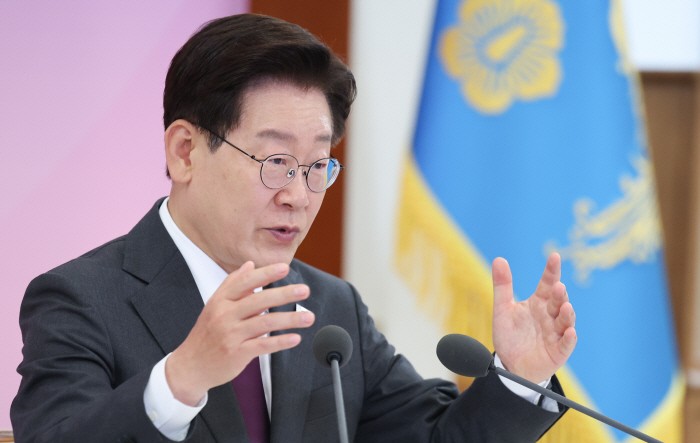 |
| President Lee Jae-myung delivers remarks during a meeting with presidential advisory councils and committees held at the Blue House on May 21. / Photo courtesy of Yonhap News Agency |
The tentative agreement reached between Samsung Electronics' management and labor on May 20, just a day ahead of a scheduled general strike, is being widely credited to a finely calibrated intervention by President Lee Jae-myung. Observers note that the president carefully balanced considerations for the semiconductor sector—a cornerstone of the national economy—with respect for both labor rights and management prerogatives.
In particular, political pundits view the intervention as a definitive showcase of President Lee’s pragmatism. Despite his background as a working-class factory boy and a lawyer who historically championed labor interests, the president chose to validate management's concerns and lean on the union after evaluating the severe, far-reaching repercussions a semiconductor strike could inflict on the broader national economy.
The Blue House expressed gratitude following the breakthrough, stating on May 21, "We are grateful for this magnanimous decision made for the sake of both the country and the public. We highly commend the persistent mediation efforts of the Minister of Employment and Labor and other government officials that brought about this outcome."
President Lee delivered a series of three public messages directly influencing the bonus system negotiations at Samsung Electronics.
On April 30, during a meeting with senior secretaries, President Lee issued an initial warning to the union, stating, "When certain organizations trigger public condemnation through excessive or unjust demands, it damages not only the specific union involved but the entire workforce as well." While he did not explicitly name Samsung Electronics, industry observers widely interpreted the remarks as a direct reference to the union's threat of a general strike over demands for an uncapped 15% share of the company's operating profit.
On May 18, the president intensified his messaging via social media, writing on X, "In the Republic of Korea, which operates under a liberal democratic and capitalist market economy framework, labor must be respected as much as corporate activity, and corporate management rights must be honored just as much as labor rights." Although formulated as a balanced principle, the inclusion of legal and philosophical caveats—such as "under the current Constitution, all fundamental rights are guaranteed but can be restricted for the public welfare" and the idiom gwayubulgeup mulgeukpilban (excess is as bad as deficiency; things reverse when they reach extremes)—led analysts to conclude that the president was tilting his weight toward management.
President Lee directly confronted the union with even more explicit language during a cabinet meeting on May 20, the eve of the threatened strike.
"While it is acceptable for labor unions to utilize their rights to organize and take collective action to pursue their interests, there must be a reasonable limit," President Lee remarked. "The crucial role of the government is to ensure that members of society exercise their rights and expressions within established boundaries, and to enforce accountability for the sake of the community when those lines are crossed." The comments were widely interpreted as hinting at the potential invocation of emergency mediation rights.
The president went on to sharply criticize the union's core financial demands. "Receiving a distribution of operating profits is the domain of investors and shareholders," Lee emphasized. "Demanding a fixed, institutionalized share of operating profits even before taxes—which represent a collective public asset—is something even investors cannot do."
The sustained rhetorical pressure from the president was driven by urgent concerns over the macroeconomic damage a strike could cause, combined with a assessment that the union's position had grown excessive.
"Such messages could never have emerged from a leadership bound strictly by ideology," a senior Blue House official remarked. "The fact that this impending strike did not represent the interests of vulnerable, low-wage workers clearly influenced the president's stance."
Regarding the broader implications for industrial relations, Chief Blue House Spokesperson Kang Yu-jung stated that the government remains committed to supporting rational dispute resolution across sectors. "While labor-management negotiations are, in principle, matters to be resolved autonomously, the recent controversy surrounding Samsung's performance distribution evolved far beyond an internal corporate dispute into a major social debate, with the entire nation witnessing a severe escalation of conflict," Kang noted.
Hong Sun-mi
Most Read
-
1
Trump demands rates fall below 1% as Fed hikes for..

-
2
Celltrion seeks rheumatoid arthritis indication ex..

-
3
Chinese e-commerce giants AliExpress, Temu and She..

-
4
Trump warns countries not helping U.S. must pay re..

-
5
Turkish Airlines named main club partner of Liverp..

-
6
China expels No. 2 military official Zhang Youxia..

-
7
Houthi rebels release video claiming downing of Sa..

PEOPLE







-
Address : In-Young Bldg., 34, Uisadang-daero 1-gil, Yeongdeungpo-gu, Seoul
Copyright by ASIATODAY CO., LTD. All rights resereved