



Interior Ministry calls for Starbucks boycott over ‘Tank Day’ controversy
May 22, 2026, 08:04 am


 |
Starbucks Korea is facing growing backlash after South Korea’s Ministry of the Interior and Safety effectively declared an institutional boycott over the company’s controversial reference to the May 18 democratic uprising as “Tank Day.”
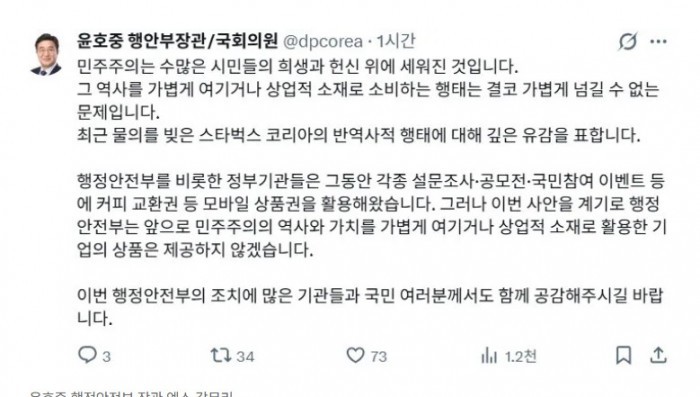
Yoon Ho-jung criticized Starbucks Korea in a post on social media platform X on May 21, expressing “deep regret” over what he described as the company’s “anti-historical behavior.”
Yoon said government agencies, including the Ministry of the Interior and Safety, had long used mobile gift certificates such as coffee vouchers for public surveys, contests, and citizen-participation events. However, he added that the ministry would no longer provide products from companies that “treat the history and values of democracy lightly or use them for commercial purposes.”
The remarks were widely interpreted as an official decision to exclude Starbucks mobile gift cards from government-sponsored events and promotional activities.
Yoon also called for broader participation in the boycott effort, saying, “I hope many institutions and citizens will sympathize with and join the ministry’s decision.”
The controversy erupted after Starbucks allegedly used the expression “Tank Day,” triggering criticism because of its association with the May 18 Gwangju Democratic Uprising, a pivotal pro-democracy movement in South Korea that was violently suppressed by the military in 1980.
In Gwangju, the symbolic center of the May 18 movement, boycott campaigns against Starbucks have already spread rapidly. While no other central government ministries or local governments have formally announced organized boycotts similar to Gwangju’s response, officials say anger is growing within the public sector.
“There are many civil servants and citizens internally expressing outrage,” an anonymous government official said. “There is widespread agreement that Starbucks crossed the line and acted against the spirit of the times.”
Observers believe the ministry’s position could have a significant ripple effect across the broader civil service community, especially since the Ministry of the Interior and Safety oversees public-sector administration and workplace culture.
A senior official from another central government ministry said that even without an official directive, it would become “virtually impossible” for government departments to select Starbucks products for future events involving gift certificates or promotional items.
“With public anger running high, agencies cannot ignore the possibility of complaints or protests,” the official added.
Some analysts also predict that Starbucks stores near major government office complexes, including those around the government district in Seoul’s Gwanghwamun area, could face declining sales if civil servants begin avoiding the coffee chain.
A senior Ministry of the Interior and Safety official said no mandatory internal order had yet been issued but added that the ministry was naturally moving toward excluding Starbucks products and expected other ministries and local governments to follow suit.
#Starbucks Korea #boycott #Ministry of the Interior and Safety #Yoon Ho-jung #Tank Day controversy
Copyright by Asiatoday
Most Read
-
1
Kia Sportage outperforms Mazda CX-5 in German auto..

-
2
Houthis launch successive attacks on Saudi airport..

-
3
Saudi Arabia, Iran hold first diplomatic talks to..

-
4
U.S. deploys carrier, 10,000 more troops to Middle..

-
5
Saudi airport in Riyadh struck again, leaving at l..

-
6
Putin's ally visits China on the 8th ahead of APEC..

-
7
Chinese military support and training center opens..

PEOPLE





HEADLINE NEWS

-
Address : In-Young Bldg., 34, Uisadang-daero 1-gil, Yeongdeungpo-gu, Seoul
Copyright by ASIATODAY CO., LTD. All rights resereved