



Korea, US agree to launch JFS security working group in Seoul
May 21, 2026, 08:50 am


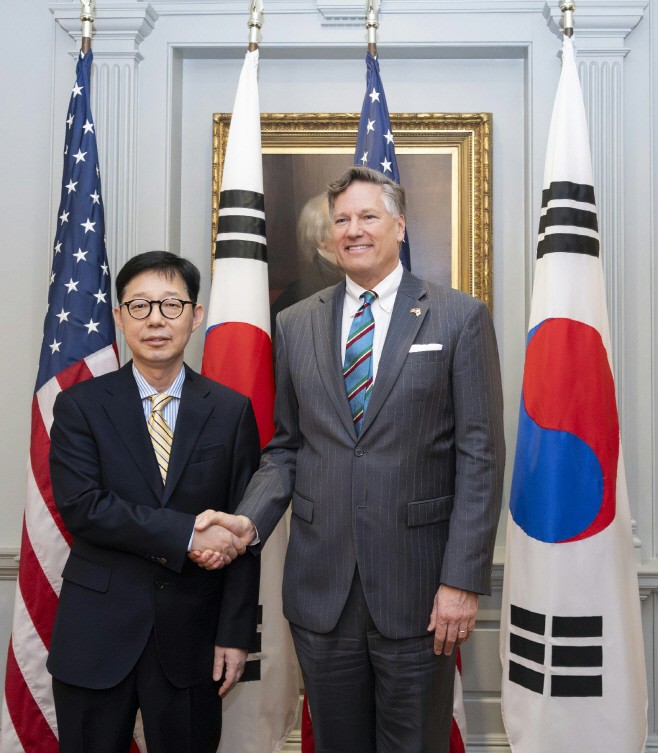 |
| Park Yoon-joo, First Vice Foreign Minister of South Korea (left), shakes hands with Christopher Landau, US Deputy Secretary of State, ahead of their vice ministerial talks at the US State Department in Washington, D.C. on May 20. /Courtesy of South Korea’s Foreign Ministry |
Park Yoon-joo, South Korea’s First Vice Foreign Minister, held a series of high-level meetings with senior US officials from the State Department, Pentagon and White House National Security Council (NSC) during his visit to Washington on May 19-20, with both sides agreeing to launch a kickoff security meeting in Seoul within weeks to implement the Joint Fact Sheet (JFS) agreed upon at last year’s Korea-US summit.
South Korea’s Foreign Ministry said May 20 that the upcoming meeting will focus on implementing security-related provisions in the JFS, including cooperation on nuclear-powered submarines and expanded authority for uranium enrichment and spent fuel reprocessing.
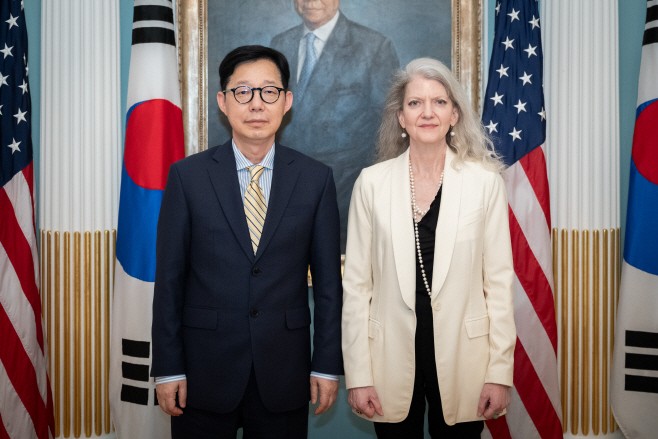 |
| Park Yoon-joo, First Vice Foreign Minister of South Korea (left), poses for a photo with Allison Hooker, US Under Secretary of State for Political Affairs, during their meeting at the US State Department in Washington, D.C. on May 19. /Courtesy of South Korea’s Foreign Ministry |
Allison Hooker, US Under Secretary of State for Political Affairs, is expected to visit Seoul within weeks leading a delegation of officials from relevant US government agencies to begin full-scale discussions on the security package.
According to the Foreign Ministry, Park and Hooker agreed that the JFS represents one of the Lee Jae-myung administration’s most significant diplomatic achievements over the past year and serves as a critical mechanism for addressing shared challenges amid growing global security and economic uncertainty.
The two sides also agreed to maintain close communication on pending issues and coordinate high-level exchanges over the next two to three months.
White House NSC pledges support for implementation talks
Park told reporters at the South Korean Embassy in Washington that his visit came shortly after the US-China summit and was intended to coordinate bilateral issues and global affairs through strategic consultations between Seoul and Washington.
After arriving in Washington on May 18, Park first met with Andrew Baker, Deputy National Security Advisor at the White House NSC, and other NSC officials before holding talks with Hooker. During the meetings, Park explained the outcomes of the recent Korea-Japan summit in Andong and reaffirmed Seoul’s commitment to strengthening Korea-Japan ties and trilateral Korea-US-Japan cooperation.
Baker reportedly pledged active NSC-level support for consultations related to implementing the JFS.
The Foreign Ministry said both sides shared the view that tangible results should be achieved swiftly through early implementation of the JFS and therefore agreed to convene the kickoff security meeting in Seoul.
Park described the agreement to launch the kickoff meeting as “the most important outcome” of his Washington visit.
“JFS is one of the greatest diplomatic achievements made during the first year of the Lee Jae-myung administration and the best tool for addressing the common challenges facing Korea and the United States amid global security and economic uncertainty,” Park said.
The US State Department also noted that Hooker emphasized the importance of fair treatment for American companies and the swift removal of market access barriers.
The JFS, agreed upon by President Donald Trump and President Lee Jae-myung during Trump’s visit to South Korea for the Asia-Pacific Economic Cooperation summit last October, included key security measures such as US cooperation on nuclear-powered submarine construction and expanded South Korean authority over uranium enrichment and spent fuel reprocessing.
The implementation process had faced criticism for delays, but officials now expect the latest agreement to accelerate progress.
A South Korean government official said meaningful consultations would require participation from all relevant agencies, including the NSC, Department of Energy, Department of Defense and State Department.
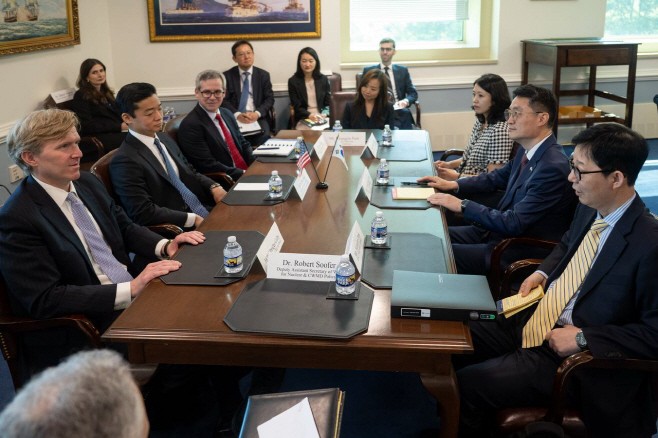 |
| Park Yoon-joo, First Vice Foreign Minister of South Korea (right), meets with Elbridge Colby, US Under Secretary of Defense for Policy, at the Pentagon in Arlington, Virginia, on May 20. /Courtesy of South Korea’s Foreign Ministry |
US praises Korea as key investment partner
Park also held vice ministerial talks with Christopher Landau, US Deputy Secretary of State, discussing bilateral investment cooperation, JFS implementation, visa-related issues for Korean nationals, the Middle East situation, the US-China summit and critical mineral supply chains.
According to the Foreign Ministry, Landau described South Korea as “the best economic, trade and investment partner” for the prosperity of both countries and stressed the need to faithfully implement the JFS to produce substantive results.
Landau also reaffirmed the United States’ defense commitment to South Korea and emphasized the strength of the combined Korea-US defense posture.
Park expressed appreciation for Landau’s strong interest in resolving visa issues affecting Korean nationals and said Seoul hoped both countries would continue making progress.
Landau reportedly promised continued support for Korean companies investing in the United States, noting that such investments contribute significantly to the revival of the US economy and manufacturing sector.
The issue gained attention after about 300 Korean workers were detained in Georgia in September last year, prompting Seoul and Washington to establish a working group to address visa and residency concerns for skilled workers.
A South Korean government official said much of the visa issue had already been resolved through measures such as dedicated desks at the US Embassy in Seoul and separate visa documentation procedures, though additional discussions would continue.
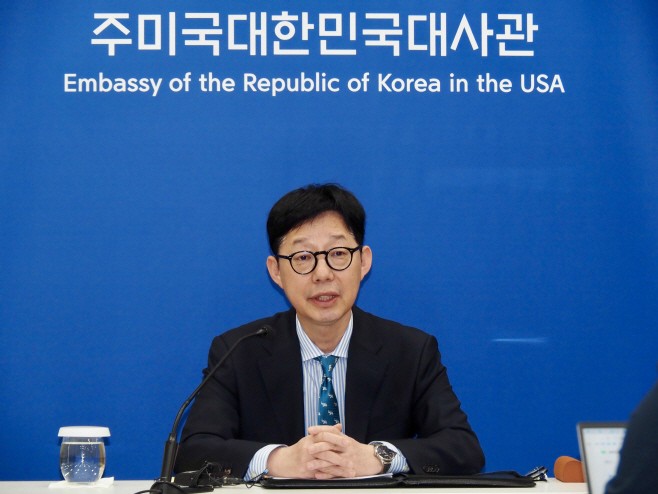 |
| Park Yoon-joo, First Vice Foreign Minister of South Korea (right), speaks during a press briefing at the South Korean Embassy in Washington, D.C. on May 20. / Washington correspondent Ha Man-joo |
Pentagon highlights South Korea’s defense role
Park also met with Elbridge Colby, US Under Secretary of Defense for Policy, to discuss key alliance issues and global affairs including the Middle East.
According to Park, Colby highly evaluated South Korea’s efforts to take greater responsibility for its own defense and reaffirmed that South Korea is a model ally for the United States.
The Foreign Ministry said the two sides discussed securing core military capabilities, maintaining strong deterrence against North Korea and advancing the alliance in a mutually beneficial and future-oriented direction, while also accelerating implementation of the JFS security agreements.
A government official said the upcoming kickoff meeting would establish an interagency working structure to handle issues related to nuclear-powered submarines, nuclear cooperation, uranium enrichment and reprocessing.
Park also said he was working to secure support from the US Congress and policy circles for smooth implementation of the JFS. During his visit, he met with John Walters, president of the Hudson Institute, to discuss the strategic direction of the Korea-US alliance and request support for the security package.
Park is scheduled to meet Rep. Young Kim, chair of the House Foreign Affairs Subcommittee on East Asia and the Pacific, before returning to Seoul.
Seoul says no US troop request related to Middle East
Regarding concerns over regulatory issues involving Coupang, a government official said Washington officials viewed the matter in a “calm and balanced” manner as part of broader discussions on non-tariff barriers.
The official added that the United States had not requested the cancellation of investigations or penalties involving Coupang and emphasized that security cooperation and economic issues maintained separate tracks.
The official also said the Korean government continued explaining that all matters would be handled fairly and non-discriminatorily under domestic law and procedures.
On the recent US-China summit statement reaffirming denuclearization of the Korean Peninsula, the official said it confirmed that Washington and Beijing still shared a common objective regarding denuclearization.
Regarding possible contact between President Trump and North Korean leader Kim Jong Un, the official said Korea-US coordination on North Korea remained extremely close and that there appeared to have been no special contact at this stage.
The official also denied any US request for South Korean troop deployment related to the Middle East, while noting that both sides reaffirmed the importance of safe and free navigation through international waterways including the Strait of Hormuz.
#South Korea #United States #Park Yoon-joo #Allison Hooker #Christopher Landau
Copyright by Asiatoday
Most Read
-
1
Celltrion’s Omlyclo gains ground in major European..

-
2
Trump demands rates fall below 1% as Fed hikes for..

-
3
Trump makes $1 trillion bet ahead of midterm elect..

-
4
Iran resumes ballistic missile production, assembl..

-
5
Samsung Electronics, Mistral AI to jointly develop..

-
6
Trump warns countries not helping U.S. must pay re..

-
7
Apple launches first foldable, 1 million won prici..

PEOPLE





HEADLINE NEWS
- Trump to roll out ‘unprecedented welcome’ for Xi with B-2 bombers, F-22 fighters
- S. Korea, U.S., and Japan form united front on Taiwan and economic coercion..
- Trump administration moves to impose sweeping sanctions on International Cr..
- Xi to make state visit to U.S. Sept. 23-25, dispelling rumors over his heal..

-
Address : In-Young Bldg., 34, Uisadang-daero 1-gil, Yeongdeungpo-gu, Seoul
Copyright by ASIATODAY CO., LTD. All rights resereved