



Chinese imports sold as ‘brands’ spark backlash on Ably
May 21, 2026, 08:37 am


 |
The long-standing controversy over so-called “label swapping” in the fashion distribution industry is now spreading to low- and mid-priced online fashion platforms. Concerns are growing that products sold on Chinese e-commerce platforms are being resold on Korean fashion marketplaces under different seller names or private labels despite having nearly identical designs, photos, and product compositions, potentially misleading consumers about the origin and value of the items. Critics say the issue goes beyond simple retail markups, pointing to a broader lack of transparency in product information as Chinese direct-purchase items are increasingly marketed as “selected,” “brand,” or “self-designed” products by independently operated fashion stores.
Sold at Three to Four Times the Price as “K-Brands” — But Still Chinese-Made
According to the fashion industry on May 20, “label-swapping” practices involving Chinese-made goods have recently become widespread on open-market e-commerce platforms. The practice refers to replacing only the brand labels on products manufactured through the same production process in order to make them appear as independently produced items. The issue has long been considered a chronic problem within Korea’s budget fashion market.
An investigation by this newspaper found that many products sold by open-market sellers on Ably closely resembled items listed on Chinese e-commerce platforms such as Temu and AliExpress in terms of design, product photos, and composition, while being sold under entirely different seller names or proprietary brands. Ably operates under a structure that allows sellers to join the platform freely without prior approval.
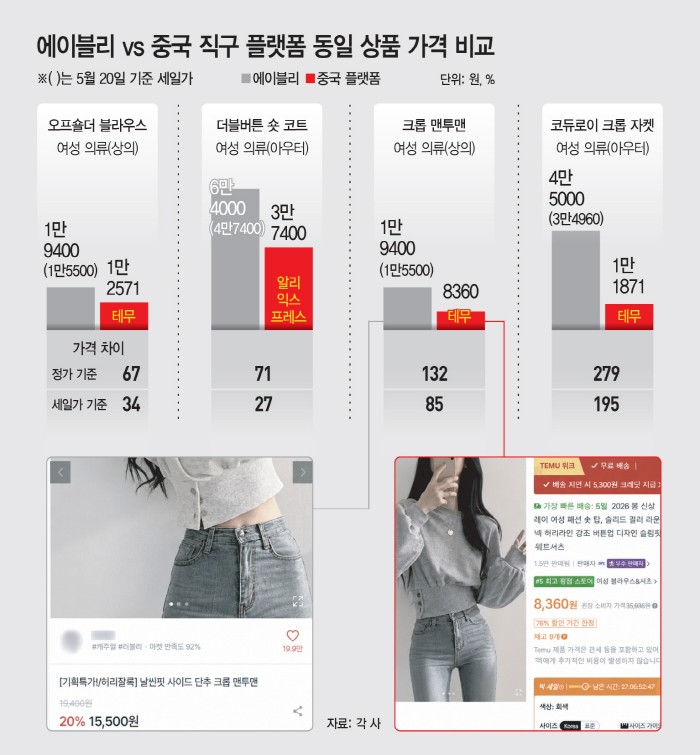
For example, an off-shoulder women’s blouse sold for 11,603 won on Temu was listed on Ably for 19,400 won, roughly 67% higher. A corduroy cropped jacket sold for 11,871 won on Temu was being sold on Ably for 34,960 won, nearly 195% more expensive. Even discounted products remained significantly pricier than their Chinese counterparts. A cropped sweatshirt sold for 8,360 won on Temu was priced at 19,400 won on Ably, about 132% higher, and even the discounted price of 15,500 won was still 85% more expensive.
An anonymous industry official criticized the platform, saying, “As Ably aggressively increased the number of sellers last year amid slowing business performance, it appears to have failed to properly inspect or manage issues such as label swapping and counterfeit products. The continued spread of counterfeit-style relabeling clearly shows the limitations of relying solely on platform self-regulation.”
Information Asymmetry Once Hid the Practice — But the Rise of Chinese E-Commerce Has Increased Transparency
Consumers are increasingly criticizing what they see as excessive markups in Korea’s low- to mid-priced fashion market. Even after accounting for logistics and marketing costs, products that can be purchased for around 10,000 won on Chinese direct-purchase platforms are often being sold on domestic online malls for three to four times the price — around 30,000 to 40,000 won — under labels such as “self-produced,” “curated select items,” or “exclusive brand collections.”
Critics argue that this goes beyond ordinary retail margins. In particular, they point to the persistence of the so-called “label-switching” practice, which was widespread among Dongdaemun wholesale fashion vendors in the mid-to-late 2000s and later migrated to online platforms as e-commerce expanded in the 2010s.
Industry observers say the issue is especially common among small independent fashion sellers operating on open-market platforms such as Ably. Most small-scale fashion shops lack their own manufacturing or design infrastructure, making it difficult to produce original goods independently. Instead, many source products from Dongdaemun wholesalers or Chinese marketplaces such as 1688 and Taobao, then remove the original labels and attach their own branding before reselling the items.
Experts note that in the past, consumers had limited access to wholesale or overseas pricing information, creating significant information asymmetry that made such practices harder to detect. However, the rapid growth of Chinese cross-border commerce platforms such as Temu and AliExpress has made price comparisons far easier, leading to more frequent exposure of deceptive resale practices.
Some industry analysts warn that the continued spread of label-switching could ultimately damage the broader fashion industry. If consumers begin to perceive domestic online fashion products as little more than inexpensive Chinese-made goods with different labels attached, smaller independent brands that genuinely invest in original design work may also lose consumer trust and suffer reputational damage.
E-commerce platforms themselves are also facing growing scrutiny. Until recently, marketplace operators such as Ably largely avoided legal responsibility by identifying themselves as intermediary service providers rather than direct sellers. However, last month, South Korea’s Fair Trade Commission concluded that liability exemption clauses commonly used by open-market platforms may be problematic, prompting companies including Naver, Coupang, and Gmarket to begin revising their terms of service.
Joo Wan-jong, a patent attorney at Taebaek Patent & Law Firm, said falsely labeling a product’s country of origin could constitute a violation of Korea’s Foreign Trade Act as well as the Labeling and Advertising Act. He added that arbitrarily removing or replacing a manufacturer’s trademark could also violate trademark law or unfair competition regulations by misleading consumers about a product’s source or quality.
He further noted that marketplace operators such as Ably could face joint liability if they fail to properly fulfill disclosure obligations or knowingly neglect repeated consumer complaints. According to Joo, broad exemption clauses within platform terms and conditions may also become subject to regulatory correction by the Fair Trade Commission.
Lee Eun-hee, a professor of consumer science at Inha University, likewise stated that inaccurate labeling of product origin or information could violate advertising regulations. She explained that while platforms were previously viewed merely as intermediaries with limited responsibility, regulatory trends are increasingly shifting toward requiring platforms to play a more active role in consumer protection and oversight.
“The Framework Act on Consumers also emphasizes the proactive responsibility of platform operators to protect consumers,” Lee said. “Regardless of profitability, product information must be displayed accurately and transparently.”
In response to the controversy, Ably stated that it has strengthened its monitoring systems to reduce issues related to origin and brand labeling. The company said it imposes measures such as sales restrictions and seller removals when violations are confirmed, though it declined to disclose the number of reports or enforcement cases, describing them as internal operational metrics.
An Ably official said the platform faces limitations in fully verifying sourcing routes for every product in advance, but added that it continuously monitors for inaccurate or false product information through internal oversight systems and user reports. The official said confirmed violations are subject to escalating penalties including sales suspension, service restrictions, and permanent removal from the platform.
Most Read
-
1
Kia Sportage outperforms Mazda CX-5 in German auto..

-
2
Houthis launch successive attacks on Saudi airport..

-
3
Saudi Arabia, Iran hold first diplomatic talks to..

-
4
U.S. deploys carrier, 10,000 more troops to Middle..

-
5
Saudi airport in Riyadh struck again, leaving at l..

-
6
Putin's ally visits China on the 8th ahead of APEC..

-
7
Chinese military support and training center opens..

PEOPLE






HEADLINE NEWS

-
Address : In-Young Bldg., 34, Uisadang-daero 1-gil, Yeongdeungpo-gu, Seoul
Copyright by ASIATODAY CO., LTD. All rights resereved