



Lotte faces liquidity strain after $1.6 billion deal collapse
May 21, 2026, 08:21 am


 |
Lotte Group is facing renewed market concerns over its liquidity after the collapse of its planned sale of Lotte Rental, a deal that was expected to bring in about 1.6 trillion won ($1.16 billion) in cash.
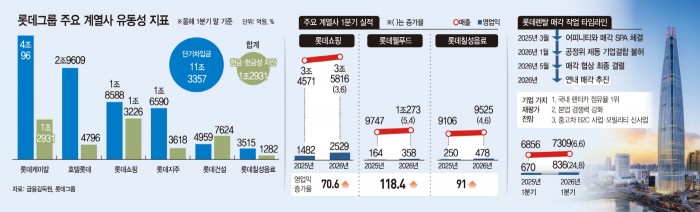
The failed transaction has heightened investor concerns as the group’s major affiliates hold more than 11 trillion won in short-term debt due within a year. Market observers say the financial burden could increase further if a new sale is not completed this year.
Still, improving earnings at key affiliates including Lotte Chemical and Lotte Shopping are being viewed as positive signs for the group’s financial stability. Some analysts also believe the failed deal could ultimately lead to a reevaluation of Lotte Rental’s corporate value.
According to filings with Korea’s Financial Supervisory Service on May 20, Lotte Rental announced that the share purchase agreement involving a change in its largest shareholder had been terminated on May 18. Hotel Lotte and Busan Lotte Hotel, which held major stakes in the company, had been pursuing a sale to Affinity Equity Partners.
However, the transaction was ultimately canceled after Korea’s Fair Trade Commission raised concerns during its antitrust review over possible restrictions on market competition.
For Lotte Group, the collapse of the deal disrupted a major liquidity plan. The market had estimated the transaction value at around 1.6 trillion won. Hotel Lotte alone had expected to secure nearly 1 trillion won in cash, which could have been used to reduce debt and secure investment funding.
The group’s short-term debt burden remains substantial. As of the end of the first quarter, major Lotte affiliates held more than 11 trillion won in short-term borrowings due within one year.
Lotte Chemical accounted for the largest share at 4.09 trillion won, followed by Hotel Lotte with 2.96 trillion won, Lotte Holdings with 1.66 trillion won and Lotte Shopping with 1.06 trillion won.
Meanwhile, available cash and cash equivalents remain relatively limited. Lotte Shopping held 1.32 trillion won in cash and cash equivalents, while Lotte Chemical held 1.29 trillion won. Even including Hotel Lotte, Lotte Engineering & Construction and Lotte Holdings, the group’s major affiliates collectively held only about 4.2 trillion won in liquid assets.
Compared with the end of 2024, the financial burden has worsened. The combined short-term debt of major affiliates increased about 9.5% from 10.35 trillion won, while cash and cash equivalents fell 17.6% from 5.27 trillion won to 4.35 trillion won over the same period.
Despite the debt concerns, analysts say the group’s financial condition cannot be judged solely by borrowings, pointing to clear signs of earnings recovery across core businesses.
Lotte Chemical, which had struggled with prolonged losses, returned to profitability in the first quarter with operating profit of 73.5 billion won. The company ended a streak of quarterly losses through restructuring efforts focused on high-value specialty materials and tighter cost controls.
Lotte Shopping also posted strong earnings improvement. First-quarter operating profit rose 70.6% year-on-year to 252.9 billion won, while operating cash flow turned positive at 31.8 billion won from a negative 13.4 billion won a year earlier.
The group’s food and beverage affiliates also delivered solid performances. Lotte Wellfood posted first-quarter revenue of 1.03 trillion won, up 5.4% from a year earlier, while operating profit surged 118.4% to 35.8 billion won.
Lotte Chilsung Beverage reported revenue growth of 4.6% to 952.5 billion won and a 91% increase in operating profit to 47.8 billion won.
The market is also paying renewed attention to Lotte Rental itself. The company has shifted away from a used-car disposal-focused business model toward long- and short-term auto rental operations, building a more stable earnings structure.
First-quarter operating profit rose 24.8% year-on-year to 83.6 billion won.
Some market participants even see the failed sale as potentially beneficial. Concerns over potential share overhang from the deal have now eased, while the company’s earnings stability and dominant position in Korea’s rental car market are once again drawing attention.
Analysts say continued earnings improvement, leadership in the domestic rental car market and growing new business opportunities could support a future reevaluation of the company’s value.
#Lotte Group #Lotte Rental #Hotel Lotte #Lotte Chemical #Lotte Shopping
Copyright by Asiatoday
Most Read
-
1
Kia Sportage outperforms Mazda CX-5 in German auto..

-
2
Houthis launch successive attacks on Saudi airport..

-
3
Saudi Arabia, Iran hold first diplomatic talks to..

-
4
U.S. deploys carrier, 10,000 more troops to Middle..

-
5
Saudi airport in Riyadh struck again, leaving at l..

-
6
Putin's ally visits China on the 8th ahead of APEC..

-
7
Chinese military support and training center opens..

PEOPLE






HEADLINE NEWS

-
Address : In-Young Bldg., 34, Uisadang-daero 1-gil, Yeongdeungpo-gu, Seoul
Copyright by ASIATODAY CO., LTD. All rights resereved