



Samsung faces new challenge over shareholder rights after labor deal
May 21, 2026, 08:02 am


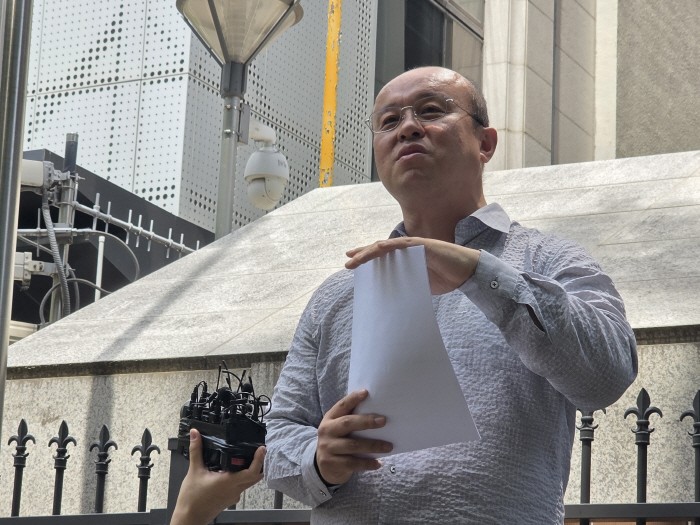 |
| Min Kyung-kwon, head of the Korea Shareholder Activism Headquarters, reads a shareholder statement during a press conference at the Korea Securities Depository in Seoul on May 18. /Yeon Chan-mo |
Samsung Electronics has resolved its prolonged labor dispute and averted the risk of a strike, but the company now faces mounting backlash from shareholders over its tentative bonus agreement with employees.
Minority shareholders argue that formalizing performance bonuses regardless of earnings volatility could undermine shareholder value by increasing fixed costs. The Korea Shareholder Activism Headquarters, a minority shareholder group, plans to stage a protest on May 21 near the residence of Samsung Electronics Executive Chair Lee Jae-yong in Seoul’s Hannam-dong neighborhood, calling for stronger protection of shareholder rights.
According to the shareholder group, the rally was initially organized as a countermeasure against a potential labor strike, but after labor and management reached a tentative agreement, it is expected to focus instead on criticism of the company’s compensation deal with the union.
Min Kyung-kwon, head of the group, said the organization plans to release a statement emphasizing the need to secure shareholders’ standing in future labor-management bonus negotiations.
The protest follows the inclusion in the tentative agreement of a special performance bonus for Samsung Electronics’ Device Solutions (DS) division, funded at 10.5% of business performance and guaranteed for the next 10 years. While shareholders have acknowledged the need for fair compensation for employees, they insist that such arrangements should not come at the expense of shareholder property rights.
In a statement released the previous day, the shareholder group argued that labor-management agreements made without approval at a shareholders’ meeting “cannot constitute a legally valid final agreement under Korea’s Commercial Act and Trade Union Act.” The group warned that if Samsung Electronics signs a wage or collective bargaining agreement forcing profit-linked bonuses without shareholder approval, it would pursue all available legal measures to block related corporate spending.
The group is also preparing to exercise shareholder rights against the company. Using the minority shareholder platform Act, it aims to secure at least a 1% stake, the threshold required under Korean commercial law to initiate shareholder derivative lawsuits.
The organization is additionally preparing letters urging domestic and foreign institutional investors to join efforts to defend shareholder rights. It has also launched a Naver online community to collect shareholder opinions and plans to formally request written explanations from Samsung Electronics regarding the legal basis for bonus calculations, consistency with distributable profits, and board decision-making procedures.
Experts say the labor agreement successfully removed the immediate threat of a strike, but they caution that codifying performance bonuses amid ongoing management uncertainty could provoke further resistance from capital markets.
Hong Ki-yong, a professor at the University of Incheon’s School of Business, said companies could face accusations of breach of trust or shareholder lawsuits if they agree to excessive bonuses at shareholders’ expense.
“There is no shareholder who would agree to reduce shareholder returns in order to pay performance bonuses that are not even part of ordinary wages,” Hong said. “The company may need to seek shareholder approval through an extraordinary general meeting. Mediation or agreements reached without shareholder consent could trigger legal disputes.”
#Samsung Electronics #shareholder rights #labor agreement #performance bonus #minority shareholders
Copyright by Asiatoday
Most Read
-
1
Kia Sportage outperforms Mazda CX-5 in German auto..

-
2
Houthis launch successive attacks on Saudi airport..

-
3
Saudi Arabia, Iran hold first diplomatic talks to..

-
4
U.S. deploys carrier, 10,000 more troops to Middle..

-
5
Saudi airport in Riyadh struck again, leaving at l..

-
6
Putin's ally visits China on the 8th ahead of APEC..

-
7
Chinese military support and training center opens..

PEOPLE






HEADLINE NEWS

-
Address : In-Young Bldg., 34, Uisadang-daero 1-gil, Yeongdeungpo-gu, Seoul
Copyright by ASIATODAY CO., LTD. All rights resereved