



AI to power warships; Hanwha Ocean paints future warfare with MS, Google
May 20, 2026, 11:51 am


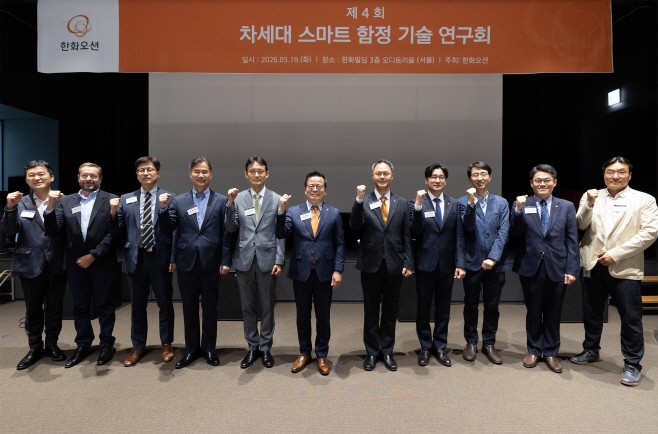 |
| Eo Sung-chul, President of Hanwha Ocean’s Special Ship Business Division (center), poses for a commemorative photo with event speakers at the 4th Next-Generation Smart Naval Vessel Technology Seminar held at the Hanwha Building in Jung-gu, Seoul, on May 19. / Hanwha Ocean |
Hanwha Ocean is accelerating its efforts to secure next-generation naval vessel technologies powered by artificial intelligence. Moving beyond traditional warship construction, the company has entered a full-scale race to build a smart naval defense platform that integrates AI and data-driven combat systems, maintenance, and unmanned automation technologies.
According to industry sources on May 20, Hanwha Ocean hosted the 4th Next-Generation Smart Naval Vessel Technology Seminar the previous day at the Hanwha Building in Jung-gu, Seoul, to discuss future warship technologies and AI-driven naval defense strategies. The event drew over 120 attendees, including Shim Seung-bae, Chairman of the Defense and Security Subcommittee under the Presidential National AI Strategy Committee, alongside representatives from the military, academia, and the defense industry.
Rather than serving as a conventional technical seminar, the event focused on the architectural framework for building an AI-based future naval system. With experts from major global and domestic tech and defense entities—such as Microsoft, Google Cloud, Seoul National University, and Hanwha Systems—gathering in one place, observers note that Hanwha Ocean is spearheading a digital transformation in the naval vessel industry.
Industry analysts observe that the core competitive edge in the global defense market is shifting away from mere hardware platform performance toward AI-based combat systems, autonomous operations, and data integration capabilities. Following the war in Ukraine, the critical importance of unmanned systems and AI-powered battlefield management has surged, driving the evolution of naval vessels into mobile data platforms.
"Hanwha Ocean has moved forward with the conviction that naval vessels must evolve beyond simple steel structures into massive, living organisms breathing with cutting-edge technology," Eo Sung-chul, President of Hanwha Ocean’s Special Ship Business Division, stated in his welcoming remarks. "We will sustain our research and development to ensure our warships stand as strategic assets leading the global naval defense paradigm."
Indeed, the seminar featured intensive discussions on innovating warship design, operations, and maintenance through AI and data technologies. Kim Han-gyul, a team leader at Microsoft, introduced innovation strategies for AI-powered smart warships and MRO (maintenance, repair, and overhaul), emphasizing that the core challenge lies in how to trust, control, and monetize AI. He also highlighted that AI agent-based systems are poised to become the new standard for defense and manufacturing infrastructure.
Park Nam-ok, Managing Director of Google Cloud Korea, introduced the concepts of Physical AI, which links directly with naval vessel systems, and Sovereign AI, which pertains to national data sovereignty. She emphasized the critical need to build robust security frameworks alongside advancing AI technologies.
Professor Noh Myung-il from Seoul National University’s Department of Naval Architecture and Ocean Engineering pointed out that AI-driven design and simulation technologies are shifting the ship design paradigm. "To boost competitiveness in naval ship design, we must move past legacy methods and actively embrace AI-driven innovations," Professor Noh remarked, highlighting the necessity of industry-academia-research collaboration.
Hanwha Systems also unveiled its concept for a smart combat vessel designed to reduce crew requirements. The framework offers a direct solution to the navy's personnel shortages in an era of demographic decline through advanced AI and unmanned automation.
Market observers note that Hanwha Ocean is ramping up its technological competitiveness at a strategic time, as it pursues the acquisition of the Philly Shipyard in the United States and taps into the expanding U.S. Navy MRO market. While competition in shipbuilding was once defined by construction capacity, it is pivoting toward smart defense platforms encompassing AI-driven maintenance, autonomous operations, and data-integrated combat systems.
Meanwhile, Hanwha Ocean previously unveiled its concept for a next-generation strategic surface ship at the October seminar last year. Designed as an export-oriented platform vessel capable of responding to multi-domain battlefields across sea, air, space, and cyber, it is regarded as a key strategic asset to capture the future naval defense market.
Most Read
-
1
Doosan nears full acquisition of SK Siltron

-
2
Hyundai premium push lifts global vehicle pricing

-
3
Trump says Iran deal ‘very likely’ as US, Iran fin..

-
4
Trump ally: “Likelihood of China invading Taiwan w..

-
5
China‘s Defense Ministry blasts Washington over la..

-
6
Court halts Samsung union‘s general strike; 100 mi..

-
7
Trump begins China visit as world watches US-China..

PEOPLE







-
Address : In-Young Bldg., 34, Uisadang-daero 1-gil, Yeongdeungpo-gu, Seoul
Copyright by ASIATODAY CO., LTD. All rights resereved