



Hanwha Ocean teams up with MS, Google for AI warships
May 20, 2026, 11:17 am


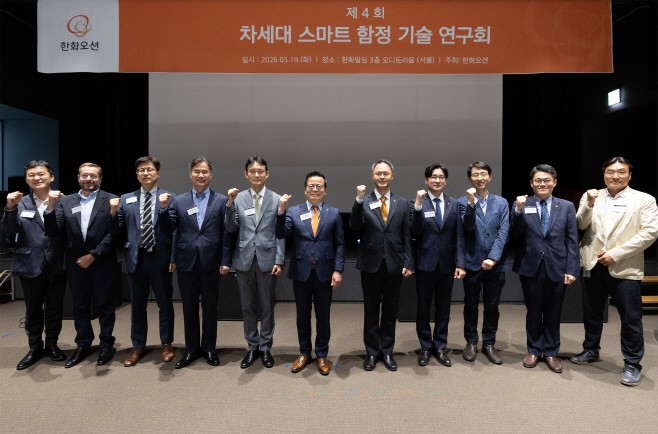 |
| Participants pose for a commemorative photo during the 4th Next-Generation Smart Naval Vessel Technology Forum held at Hanwha Building in central Seoul on May 19. At center is Eo Seong-cheol, president and head of the Special Ship Business Unit at Hanwha Ocean. /Hanwha Ocean |
Hanwha Ocean is accelerating efforts to secure next-generation naval technologies powered by artificial intelligence, as the shipbuilder moves beyond conventional warship construction into AI-driven combat systems, maintenance and autonomous maritime defense platforms.
According to industry sources on Wednesday, Hanwha Ocean held the “4th Next-Generation Smart Naval Vessel Technology Forum” at Hanwha Building in central Seoul a day earlier to discuss future naval technologies and AI-based maritime defense strategies.
The event brought together around 120 participants from the military, academia and the defense industry, including Shim Seung-bae, chair of the defense and security division at South Korea’s Presidential National AI Strategy Committee.
The forum focused on how to build an “AI-based future naval system” rather than serving as a simple technology seminar. Industry observers said the participation of experts from Microsoft, Google Cloud, Seoul National University and Hanwha Systems demonstrated Hanwha Ocean’s accelerating push toward digital transformation in the naval shipbuilding sector.
Analysts say the global defense industry’s competitive edge is increasingly shifting from hardware performance alone toward AI-enabled combat systems, autonomous operation and integrated data capabilities. Following the war in Ukraine, the strategic importance of unmanned systems and AI-driven battlefield operations has surged, with naval vessels evolving into “moving data platforms.”
Eo Seong-cheol, president and head of Hanwha Ocean’s Special Ship Business Unit, said during his welcoming remarks that the company believes warships must evolve beyond simple steel structures into “massive living systems powered by cutting-edge technologies.”
“We will continue research and development efforts so our naval vessels can become strategic assets leading the global maritime defense paradigm,” he said.
Discussions at the forum centered on AI- and data-driven innovation in ship design, operation and maintenance.
Kim Han-gyeol, a Microsoft team manager, introduced AI-powered smart vessel and MRO (maintenance, repair and overhaul) innovation strategies, stressing that the key challenge will be “how to trust, control and monetize AI.” He also suggested that AI agent-based systems could become a new standard for future defense and manufacturing infrastructure.
Park Nam-ok, chief executive of Google Cloud Korea, introduced the concepts of “Physical AI,” which directly connects AI with vessel systems, and “Sovereign AI,” referring to national control over data infrastructure. He also emphasized the growing importance of security systems alongside advances in AI technology.
Noh Myung-il, a professor in the Department of Naval Architecture and Ocean Engineering at Seoul National University, said AI-based design and simulation technologies are fundamentally reshaping ship design paradigms.
“To strengthen naval design competitiveness, we must actively embrace AI-based new technologies instead of remaining tied to traditional methods,” he said, calling for closer industry-academia-research cooperation.
Hanwha Systems also unveiled a concept for an AI-powered smart combat vessel designed to reduce manpower requirements through autonomous and unmanned technologies, addressing military personnel shortages caused by South Korea’s demographic decline.
Industry watchers said Hanwha Ocean is moving quickly to strengthen future naval capabilities amid efforts to acquire the Philadelphia Shipyard in the United States and expand into the U.S. Navy’s MRO market.
While traditional competition in shipbuilding focused on construction capacity, the industry is increasingly transitioning toward competition in AI-powered maintenance, autonomous operation and integrated data combat systems, they added.
Last October, Hanwha Ocean unveiled its concept for a “next-generation strategic surface vessel,” an export-oriented platform designed to respond to multi-domain battlefields spanning maritime, air, space and cyberspace operations. The company sees the platform as a key strategic asset in securing leadership in the future maritime defense market.
#Hanwha Ocean #Microsoft #Google Cloud #AI warships #smart naval vessels
Copyright by Asiatoday
Most Read
-
1
Kia Sportage outperforms Mazda CX-5 in German auto..

-
2
Houthis launch successive attacks on Saudi airport..

-
3
Saudi Arabia, Iran hold first diplomatic talks to..

-
4
U.S. deploys carrier, 10,000 more troops to Middle..

-
5
Saudi airport in Riyadh struck again, leaving at l..

-
6
Putin's ally visits China on the 8th ahead of APEC..

-
7
Chinese military support and training center opens..

PEOPLE






HEADLINE NEWS

-
Address : In-Young Bldg., 34, Uisadang-daero 1-gil, Yeongdeungpo-gu, Seoul
Copyright by ASIATODAY CO., LTD. All rights resereved