



Japan revamps ethics education for AI era, teaching limits of its use
May 20, 2026, 10:54 am


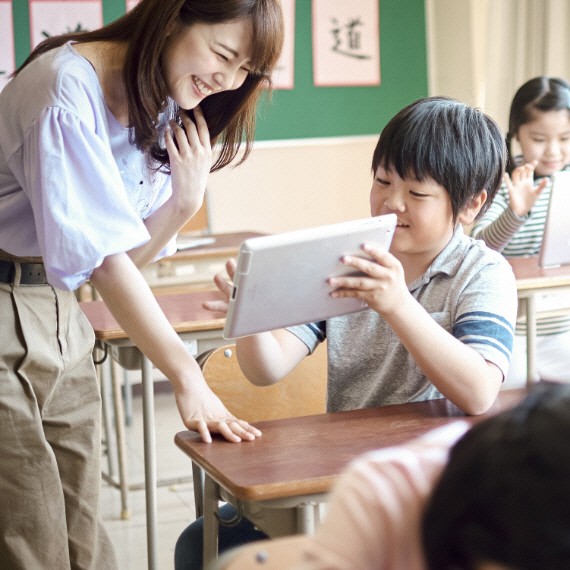 |
| A Japanese elementary school classroom session. / Screenshot from the official website of Japan's Ministry of Education, Culture, Sports, Science and Technology (MEXT). |
The Japanese government is set to revamp its school curriculum to teach the value judgments and responsibilities required in the era of generative AI during elementary and junior high school ethics classes. Rather than treating AI merely as a learning tool or a branch of information technology, the initiative aims to bring questions of human judgment and the boundaries of personal responsibility into the core of ethics education.
The Yomiuri Shimbun reported on May 20 that the Ministry of Education, Culture, Sports, Science and Technology (MEXT) presented a proposal to a specialized subcommittee of the Central Council for Education the previous day to improve information ethics education. Reflecting the widespread adoption of generative AI and the lowering age of social media users, the proposal intends to incorporate themes regarding value judgments, responsibility, and ways of living in the AI era into the next national curriculum guidelines, which are scheduled to take effect in the 2030 academic year. Japan's curriculum guidelines serve as the national educational standard and are revised roughly once every decade.
MEXT is particularly concerned that students are finding it increasingly difficult to discern the authenticity of the vast amounts of information generated by AI. The decision is also driven by an awareness that even young students face a growing risk of spreading misinformation, harming others, or becoming entangled in cybercrimes through simple online actions. Consequently, Japan is seeking to restructure its existing information ethics education, moving past basic warnings like "be careful on the internet" to focus on deeper ethical questions regarding human judgment in the age of AI.
Responsibility Before Utility
The classroom examples provided by MEXT are highly concrete. The framework suggests having students debate topics such as "the psychological weakness that prevents someone from stopping cyberbullying even when they know it is wrong," or confronting complex issues where right and wrong are not easily defined, such as the viral spread of unverified information. The ministry also cited sample lessons where students ponder questions like "for what purpose and to what extent should AI be used" when working on school assignments or creative projects.
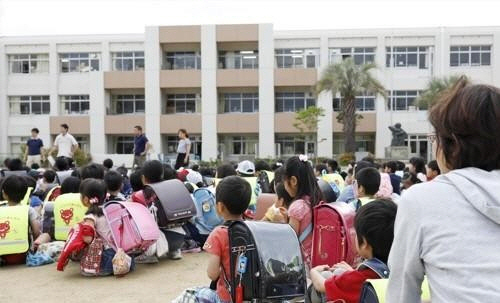 |
| Elementary school students gather on a playground in Osaka, Japan. / Photo by Yonhap News |
Japan is also expanding its information technology education across the board. Under the next curriculum guidelines, the government is considering restructuring the current "Technology and Home Economics" subject in junior high schools to establish a newly minted "Information and Technology" subject. In elementary schools, MEXT plans to introduce a dedicated "Information Domain" within the "Period for Integrated Studies." Concurrently, given the rapid pace of technological change, the ministry proposed a framework to review textbook supplementary manuals in line with the four-year textbook authorization cycle to keep AI-related content up to date.
South Korea is equally aware of the pressing need for AI ethics education. The country reinforced digital foundational literacy within its 2022 Revised National Curriculum, and regional offices of education have been distributing AI ethics learning materials. On the ground, however, school-level AI education is still widely perceived as focusing primarily on digital competencies, coding, and the practical application of edutech tools.
Japan's latest reform blueprint poses a critical question for South Korea. It suggests that determining how fast AI should be integrated into classrooms is only half the battle; equally vital is how schools will teach students questions like "to what extent is it acceptable to use AI?", "who bears the responsibility for AI-generated outcomes?", and "what behaviors must be curbed to avoid harming others online?"
Ultimately, the core of education in the AI era extends far beyond mere technological proficiency. With generative AI deeply embedded in students' daily routines—assisting with homework, essay writing, image generation, and social media content creation—classrooms must address issues such as the spread of misinformation, plagiarism, hate speech, and cyberbullying. As a next step in expanding its digital education infrastructure, South Korea also needs to elevate AI-era ethics and digital citizenship to the center of its national educational agenda.
Most Read
-
1
Celltrion’s Omlyclo gains ground in major European..

-
2
Trump demands rates fall below 1% as Fed hikes for..

-
3
Trump makes $1 trillion bet ahead of midterm elect..

-
4
Iran resumes ballistic missile production, assembl..

-
5
Samsung Electronics, Mistral AI to jointly develop..

-
6
Trump warns countries not helping U.S. must pay re..

-
7
Apple launches first foldable, 1 million won prici..

PEOPLE






HEADLINE NEWS
- Trump to roll out ‘unprecedented welcome’ for Xi with B-2 bombers, F-22 fighters
- S. Korea, U.S., and Japan form united front on Taiwan and economic coercion..
- Trump administration moves to impose sweeping sanctions on International Cr..
- Xi to make state visit to U.S. Sept. 23-25, dispelling rumors over his heal..

-
Address : In-Young Bldg., 34, Uisadang-daero 1-gil, Yeongdeungpo-gu, Seoul
Copyright by ASIATODAY CO., LTD. All rights resereved