



Wider interest margins offset by securities drag: Q1 bank net profit drops
May 20, 2026, 10:26 am


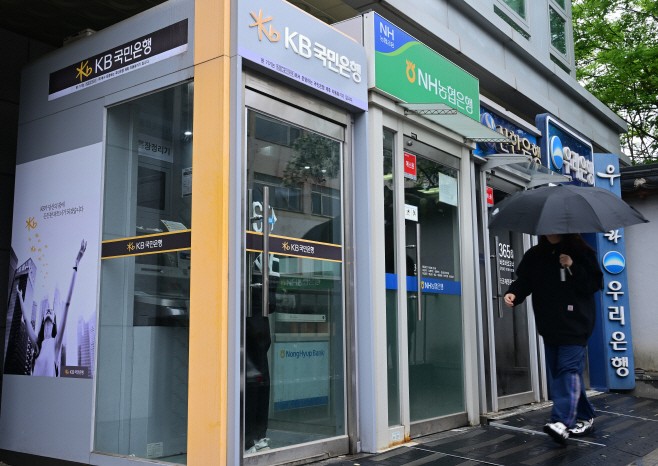 |
| An ATM installed in downtown Seoul. / Photo by Reporter Lee Byung-hwa |
Net profit of domestic banks in South Korea edged down in the first quarter of this year compared to the same period last year. While interest income grew on the back of expanding loan assets and improved net interest margins (NIM), valuation losses on securities driven by rising market interest rates dragged down non-interest income, weighing on overall performance.
According to preliminary data for the "Q1 2026 Operating Results of Domestic Banks" released by the Financial Supervisory Service (FSS) on May 20, domestic banks posted a combined net profit of 6.7 trillion won for the first quarter, down 300 billion won from 6.9 trillion won a year earlier. Commercial banks saw their net profit rise by 100 billion won to 4.3 trillion won during the same period; internet-only banks and regional banks logged increases, whereas nationwide commercial banks saw a decline of around 20 billion won. Specialized banks recorded a net profit of 2.4 trillion won, down 300 billion won.
Profitability indicators generally trended downward. The return on assets (ROA) of domestic banks for the first quarter stood at 0.64%, down 0.07 percentage points year-on-year. The return on equity (ROE) fell by 0.89 percentage points to 8.68% during the same period.
Interest income continued its upward trajectory. In the first quarter, interest income reached 15.8 trillion won, up 1 trillion won from a year earlier. This growth was largely fueled by a 4.8% increase in interest-bearing assets, such as loan bonds, which totaled 3,556 trillion won, alongside a 0.03 percentage point rise in NIM to 1.56%. Conversely, non-interest income plunged sharply, tumbling by 700 billion won year-on-year to 1.3 trillion won in the first quarter. This steep drop came as profits related to securities shifted into a deficit of 1.2 trillion won due to widening valuation losses triggered by rising market interest rates.
In fact, the yield on three-year Treasury bonds rose by 0.606 percentage points from 2.951% at the end of last year to 3.557% at the end of March this year. This spike in interest rates led to bond valuation losses, acting as a primary factor pulling down non-interest income across the banking sector.
On the other hand, the commission and trust sectors showed improvement. Commission income rose 10.1% year-on-year to 1.5 trillion won, while trust-related profits surged 48.6% to 500 billion won. Foreign exchange and derivative-related profits also turned around to post a profit of 2.3 trillion won.
Expenses grew slightly higher. Selling, general, and administrative (SG&A) expenses for the first quarter stood at 7.2 trillion won, up 400 billion won from the same period last year. Within this category, labor costs increased by 100 billion won to 4.3 trillion won, and material expenses rose by 200 billion won to 2.8 trillion won.
Credit losses showed a downward trend. Provisions for credit losses recorded 1.4 trillion won in the first quarter, down 300 billion won from the first quarter of last year. Commercial banks accounted for 1 trillion won of the total, while specialized banks accounted for 400 billion won.
As macro uncertainties intensify, the FSS plans to encourage the banking sector to expand its loss-absorption capacity to maintain financial soundness against external shocks. "Based on robust profitability, we will continue to prompt banks to faithfully fulfill their social and public responsibilities, such as productive and inclusive financing," an FSS official stated.
Most Read
-
1
Doosan nears full acquisition of SK Siltron

-
2
Hyundai premium push lifts global vehicle pricing

-
3
Trump says Iran deal ‘very likely’ as US, Iran fin..

-
4
Trump ally: “Likelihood of China invading Taiwan w..

-
5
China‘s Defense Ministry blasts Washington over la..

-
6
Court halts Samsung union‘s general strike; 100 mi..

-
7
Trump begins China visit as world watches US-China..

PEOPLE







-
Address : In-Young Bldg., 34, Uisadang-daero 1-gil, Yeongdeungpo-gu, Seoul
Copyright by ASIATODAY CO., LTD. All rights resereved