



Hidden ‘blue gold’: water energy rises as urban power solution
May 20, 2026, 08:43 am


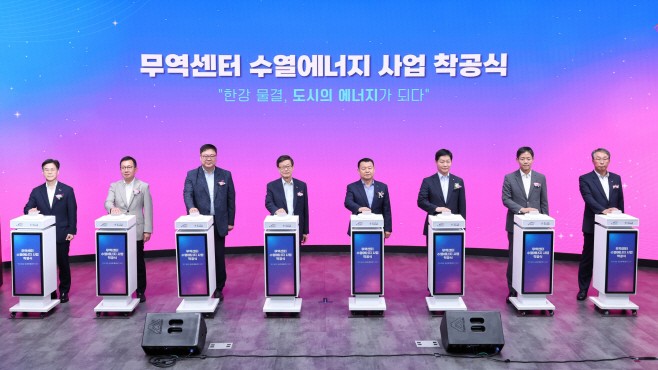 |
| Officials pose for a commemorative photo during the groundbreaking ceremony for the Trade Center water thermal energy project held at COEX in Seoul’s Samseong-dong on July 30, 2025. Yoon Suk-dae, president of Korea Water Resources Corporation, is fourth from right. /Korea Water Resources Corporation |
As carbon neutrality goals and the artificial intelligence (AI) era drive a sharp increase in electricity demand, South Korea is searching for new ways to power cities more efficiently. While solar and wind energy continue to expand, stable cooling and heating systems remain essential for large urban buildings and data centers. Against this backdrop, water thermal energy — using rivers and water supply networks as energy sources — is gaining attention as a potential game changer for Seoul’s urban energy structure, earning the nickname “hidden blue gold.”
According to industry officials on May 19, the Ministry of Climate, Energy and Environment and Korea Water Resources Corporation are expanding water thermal energy projects around major commercial districts near the Han River, including the Korea World Trade Center, Lotte World Tower and Hyundai Motor Group’s Global Business Complex (GBC).
At the Trade Center complex in Seoul, a 7,000RT-scale water thermal energy facility is being developed using 125,000 cubic meters of raw water per day from the metropolitan water supply system. The government estimates the project could replace the cooling capacity of about 7,000 air conditioners.
The principle behind water thermal energy is relatively simple. Water remains cooler than air in summer and relatively warmer in winter, allowing it to be used efficiently for cooling and heating. In the Trade Center project, Han River water temperatures ranging from about 5 to 25 degrees Celsius throughout the year are connected to heat pump systems to supply building energy.
Conventional cooling and heating systems consume large amounts of electricity and release waste heat back into the atmosphere. Water thermal systems, however, use water as a heat source, significantly improving energy efficiency. While conventional boilers require about 4.2 units of energy to produce four units of heat, water thermal systems can generate the same amount of heat using just one unit of energy. Cooling efficiency is also improved because water absorbs heat instead of cooling towers releasing it outside.
The effectiveness of the technology has already been demonstrated. Lotte World Tower became the first commercial building in South Korea to adopt a large-scale water thermal system in 2014, with a capacity of 3,000RT installed by Korea Water Resources Corporation. By 2021, the building’s energy consumption had been reduced by 32.6% compared with conventional systems.
Water thermal energy is attracting particular attention as an “urban renewable energy” source because it can utilize existing water infrastructure such as metropolitan water pipelines and rivers without requiring additional large-scale transmission lines. In effect, underground water networks can double as energy infrastructure.
Following the Lotte World Tower project, the government plans to expand water thermal energy supplies to the Trade Center complex, Hyundai GBC and the Yeongdong Transit Center. By 2029 and 2030, a total of 18,660RT of water thermal energy is expected to be supplied across five locations in the Gangnam and Songpa districts. Officials believe the Han River commercial corridor could effectively transform into an “RE100 industrial zone.”
The government’s broader goal is to supply 1GW of water thermal energy nationwide by 2030, which officials say could match the output of one nuclear power plant.
A Korea Water Resources Corporation official said, “Because water thermal energy can utilize existing metropolitan water supply networks, it can spread quickly as an urban renewable energy source without conflicts over transmission line construction. We expect strong potential for applications in AI data centers, industrial complexes and new city developments.”
#water thermal energy #blue gold #AI power demand #renewable energy #RE100
Copyright by Asiatoday
Most Read
-
1
Kia Sportage outperforms Mazda CX-5 in German auto..

-
2
Houthis launch successive attacks on Saudi airport..

-
3
Saudi Arabia, Iran hold first diplomatic talks to..

-
4
U.S. deploys carrier, 10,000 more troops to Middle..

-
5
Saudi airport in Riyadh struck again, leaving at l..

-
6
Putin's ally visits China on the 8th ahead of APEC..

-
7
Chinese military support and training center opens..

PEOPLE




HEADLINE NEWS

-
Address : In-Young Bldg., 34, Uisadang-daero 1-gil, Yeongdeungpo-gu, Seoul
Copyright by ASIATODAY CO., LTD. All rights resereved