



US and Hong Kong drive earnings surge for Korean securities firms
May 18, 2026, 09:14 am


 |
| /Financial Supervisory Service |
Overseas operations of South Korean securities firms posted sharp earnings growth last year, driven by strong performances from subsidiaries in the United States and Hong Kong amid a rally in U.S. equity markets.
According to a report released on May 15 by the Financial Supervisory Service, overseas subsidiaries of domestic securities companies recorded combined net profits of $455.8 million, or about 654 billion won, in 2025, up 67.8% from a year earlier.
As of the end of last year, 16 Korean securities firms operated a total of 93 overseas offices, including 83 local subsidiaries and 10 representative offices. The number increased by 13 from the previous year.
Asia, including Hong Kong, China and Singapore, accounted for 66 offices, representing 71% of the total, while the United States had 18 offices.
The report noted that overseas expansion strategies, previously centered largely on Southeast Asia, have recently become more diversified with increased entry into India.
During the year, Korean securities firms established 14 new overseas offices, including four in the United States, three in Hong Kong and two in India. One office in China was closed.
By company, Mirae Asset Securities operated the largest overseas network with 29 offices, followed by Korea Investment & Securities with 11, NH Investment & Securities with eight and KB Securities with seven.
Total assets of overseas subsidiaries reached $35.74 billion, or about 51.3 trillion won, up 4.3% from the previous year. Total equity rose 7.8% to $8.77 billion.
Among the 83 overseas subsidiaries, 51 reported profits.
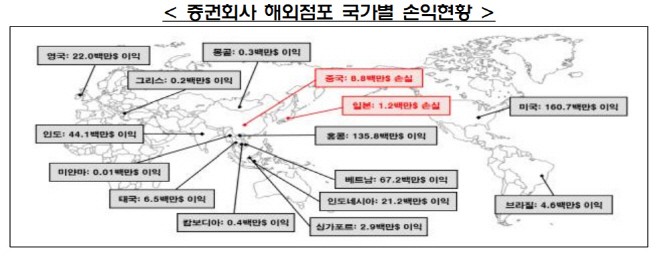
By country, subsidiaries in 13 markets including the United States, Hong Kong and Vietnam posted gains, while operations in China and Japan recorded losses. U.S. subsidiaries generated the largest share of profits.
An FSS official said subsidiaries in the United States, Hong Kong and Vietnam were leading overall performance growth and noted that Korean securities firms were diversifying overseas business regions through expansion in established markets and new entries into countries such as India.
The regulator added that it plans to strengthen monitoring of potential risks, including earnings volatility at overseas branches, amid growing geopolitical uncertainties such as prolonged instability in the Middle East.
#South Korean securities firms #overseas subsidiaries #Financial Supervisory Service #Mirae Asset Securities #Korea Investment & Securities
Copyright by Asiatoday
Most Read
-
1
Celltrion’s Omlyclo gains ground in major European..

-
2
Trump demands rates fall below 1% as Fed hikes for..

-
3
Trump makes $1 trillion bet ahead of midterm elect..

-
4
Iran resumes ballistic missile production, assembl..

-
5
Samsung Electronics, Mistral AI to jointly develop..

-
6
Trump warns countries not helping U.S. must pay re..

-
7
Apple launches first foldable, 1 million won prici..

PEOPLE






HEADLINE NEWS
- Trump to roll out ‘unprecedented welcome’ for Xi with B-2 bombers, F-22 fighters
- S. Korea, U.S., and Japan form united front on Taiwan and economic coercion..
- Trump administration moves to impose sweeping sanctions on International Cr..
- Xi to make state visit to U.S. Sept. 23-25, dispelling rumors over his heal..

-
Address : In-Young Bldg., 34, Uisadang-daero 1-gil, Yeongdeungpo-gu, Seoul
Copyright by ASIATODAY CO., LTD. All rights resereved