



White-collar defendants dominated bail approvals at Seoul Southern court
May 14, 2026, 08:25 am


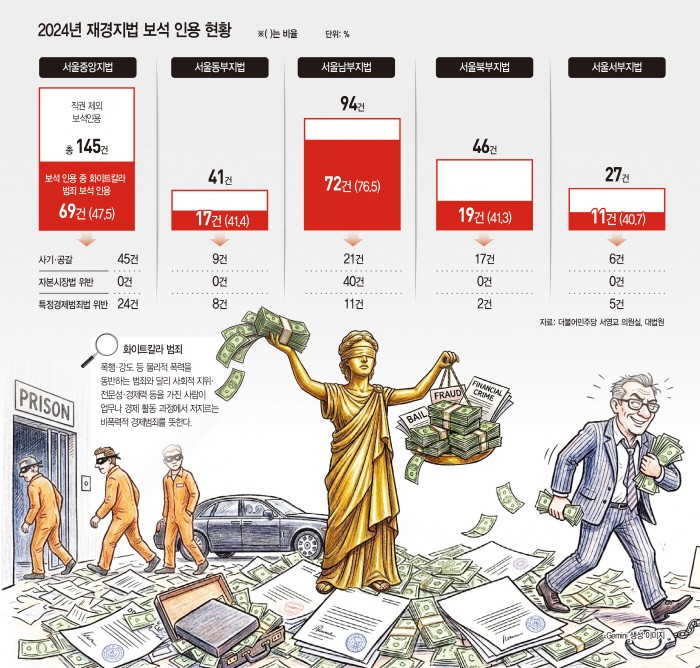 |
White-collar defendants accounted for more than three-quarters of approved bail cases at the Seoul Southern District Court last year, highlighting growing concerns that financially powerful suspects in complex economic crimes are disproportionately benefiting from South Korea’s bail system.
An analysis conducted by Asia Today’s legal affairs team in cooperation with Rep. Seo Young-kyo, chair of the National Assembly’s Legislation and Judiciary Committee, found that over half of approved bail cases across major Seoul district courts in 2024 involved white-collar crimes such as fraud, capital markets law violations and major economic crimes.
The findings marked the first comprehensive breakdown of bail approvals by crime category and reinforced long-standing public criticism surrounding “wealth without punishment” in the judicial system.
Among Seoul courts, the Seoul Southern District Court — which handles many finance and securities crime cases — showed the highest concentration of white-collar bail approvals.
According to the analysis, the court approved 94 out of 192 bail applications last year, a 48.9% approval rate. Of those approved cases, 72, or 76.5%, involved white-collar crimes, including 21 fraud or extortion cases, 40 capital markets law violations and 11 major economic crime cases.
Capital markets law violations alone accounted for more than half of the approved white-collar bail cases.
The court’s jurisdiction includes cases investigated by the Seoul Southern District Prosecutors’ Office’s Joint Financial and Securities Crime Investigation Division, leading to a heavy concentration of high-profile market crime prosecutions.
The proportion of white-collar bail approvals was significantly lower at other Seoul courts. Seoul Northern District Court recorded 19 white-collar cases among 46 approved bail applications, while Seoul Eastern District Court approved 17 such cases out of 41. Seoul Western District Court approved 11 white-collar cases among 27 approvals.
At Seoul Central District Court, 69 of 145 approved bail cases involved white-collar crimes, though the ratio remained well below that of Seoul Southern District Court.
Rep. Seo criticized the trend, arguing that financial crime suspects accused of stock manipulation and investor fraud were continuing daily life outside detention after indictment.
“Applying the same standards used in ordinary criminal cases to economic crimes involving overseas asset concealment and extensive accomplice networks effectively leaves room for evidence destruction,” she said.
The report highlighted the case of former Star Mobility chairman Kim Bong-hyun, a central figure in the Lime Asset Management scandal, as a prominent example of alleged abuse of the bail system.
Kim was arrested and indicted in 2020 on charges including embezzling roughly 100 billion won tied to Star Mobility and Lime Asset Management funds. After about a year in detention, he was released on bail pending trial.
Although prosecutors later sought new arrest warrants after detecting signs he was preparing to flee to China, the court rejected the requests, citing his compliance with court appearances. Kim eventually cut off his electronic monitoring device and fled before being recaptured 48 days later at a hideout in Hwaseong.
Legal experts say many white-collar defendants strategically exploit South Korea’s six-month first-trial detention limit.
Under the Criminal Procedure Act, defendants can generally remain detained for a maximum of six months during first-instance trials. In complicated financial crimes involving extensive evidence review and accomplice investigations, courts often struggle to complete proceedings within that period.
Prosecutors argue that defendants use expensive legal teams to intentionally delay trials through tactics such as replacing defense attorneys, disputing evidence and requesting large numbers of witnesses.
A lawyer specializing in financial crimes at a major law firm said many white-collar defendants treat release on bail after roughly five months in detention as “a standard formula.”
Some judges and prosecutors are now calling for broader reform of detention and bail rules, arguing that current limits are unrealistic for highly complex financial cases.
A Ministry of Justice official said the government recognizes concerns that increasingly lengthy trials and stricter evidentiary procedures have exposed weaknesses in the current detention system.
“The need to review the overall detention-period framework, including bail standards, is being comprehensively considered,” the official said.
#South Korea #white-collar crime #bail #Seoul Southern District Court #financial crime
Copyright by Asiatoday
Most Read
-
1
Celltrion’s Omlyclo gains ground in major European..

-
2
Trump demands rates fall below 1% as Fed hikes for..

-
3
Hyundai Motor Group breaks ground on integrated st..

-
4
U.S. strikes 3 Iranian oil tankers, Iran vows reta..

-
5
Trump makes $1 trillion bet ahead of midterm elect..

-
6
Iran resumes ballistic missile production, assembl..

-
7
Samsung Electronics, Mistral AI to jointly develop..

PEOPLE







-
Address : In-Young Bldg., 34, Uisadang-daero 1-gil, Yeongdeungpo-gu, Seoul
Copyright by ASIATODAY CO., LTD. All rights resereved