



Boston Dynamics exits raise concerns over Hyundai robot push
May 12, 2026, 07:44 pm


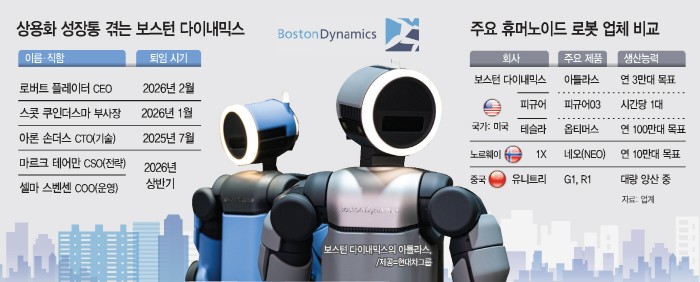 |
A series of executive departures at Boston Dynamics is fueling concerns over possible internal friction with parent company Hyundai Motor Group as the automaker accelerates commercialization of humanoid robots.
According to the robotics industry on May 12, several key C-suite executives at Boston Dynamics left the company during the first half of this year.
Among them were former CEO Robert Playter, who had led the company for more than three decades and was widely regarded as the symbolic leader of Boston Dynamics, along with Vice President Scott Kuindersma, the chief technology officer (CTO), and the chief strategy officer (CSO).
The departing executives were core figures involved in the development of the humanoid robot Atlas since the company’s early days.
Their exits come as Atlas approaches commercialization, leading some industry observers to question whether Boston Dynamics’ research-focused culture is clashing with Hyundai Motor Group’s manufacturing- and profitability-driven business model.
Hyundai Motor Group is already moving forward with a concrete roadmap for robot mass production. The group plans to deploy Atlas robots capable of repetitive industrial tasks by 2028 and distribute more advanced general-purpose robots by 2030. It is also pursuing plans to build a robot factory capable of producing 30,000 units annually by 2028.
The challenge comes amid intensifying competition in the humanoid robotics market.
Tesla CEO Elon Musk has said the company’s humanoid robot Optimus will soon be deployed at Tesla factories, while Figure AI is reportedly already capable of producing one robot per hour.
As rivals aggressively ramp up production targets and pressure market leadership, some analysts believe demands from the board may have become the decisive trigger behind the management departures.
Jung Tae-kyung, a robotics engineering professor at Hallym University, said companies such as Tesla that possess proprietary AI operating systems are accelerating humanoid commercialization, though discussions surrounding Atlas commercialization may still be premature.
“Humanoid robots are likely to be deployed in manufacturing sites within three to five years,” Jung said. “To achieve that, AI systems must be trained using company-specific manufacturing data, and customization for each production process will be essential.”
Following Hyundai’s acquisition, Boston Dynamics now faces a clear mission: turning Atlas into a profitable industrial worker capable of generating revenue in real-world production environments.
With speculation also growing over a possible IPO this year, Boston Dynamics faces the dual challenge of maintaining its technological edge while proving it can execute quickly enough to satisfy market expectations.
Industry attention is now focused on who will fill the vacant CEO position.
Earlier, Hyundai said during its first-quarter earnings conference call that the board is currently leading the process of selecting Boston Dynamics’ next CEO.
Analysts expect the new chief executive to be someone capable of combining technological expertise with Hyundai Motor Group’s manufacturing DNA to establish an efficient mass-production system.
Lee Hang-gu, a research fellow at the Korea Automotive Technology Institute, said Tesla and Chinese robotics companies are already moving into mass production while Boston Dynamics remains in the early stages.
“The most important factor is precise hand movement,” Lee said. “That is where the focus should be.”
#Hyundai Motor Group #Boston Dynamics #Atlas #humanoid robot #Tesla
Copyright by Asiatoday
Most Read
-
1
Kia Sportage outperforms Mazda CX-5 in German auto..

-
2
Houthis launch successive attacks on Saudi airport..

-
3
Saudi Arabia, Iran hold first diplomatic talks to..

-
4
U.S. deploys carrier, 10,000 more troops to Middle..

-
5
Saudi airport in Riyadh struck again, leaving at l..

-
6
Putin's ally visits China on the 8th ahead of APEC..

-
7
Chinese military support and training center opens..

PEOPLE





HEADLINE NEWS

-
Address : In-Young Bldg., 34, Uisadang-daero 1-gil, Yeongdeungpo-gu, Seoul
Copyright by ASIATODAY CO., LTD. All rights resereved