



HMM cargo ship arrives in Dubai as cause of Hormuz blast disputed
May 08, 2026, 08:25 am


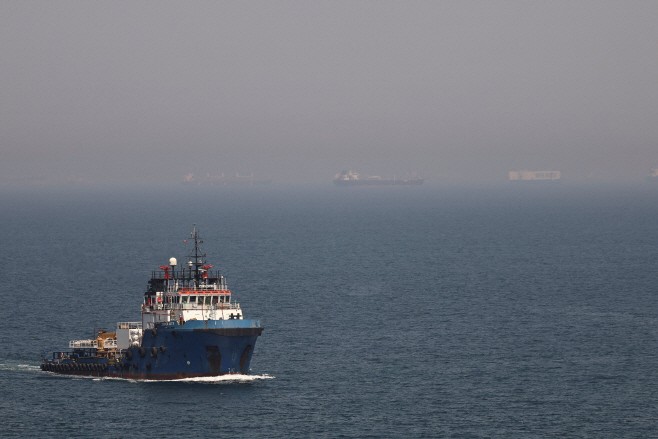 |
| A marine work vessel, ‘Zakher Duty,’ is anchored at Fujairah Port in the United Arab Emirates (UAE) on May 6, as maritime traffic through the Strait of Hormuz faces disruptions amid escalating tensions between the United States, Israel and Iran. /Reuters-Yonhap |
South Korean-operated cargo vessel HMM Namu arrived at a Dubai port early Thursday for an investigation into the cause of an explosion and fire that broke out in the Strait of Hormuz, amid escalating accusations between the United States and Iran.
According to HMM and local sources, the vessel entered Dubai port at 12:20 a.m. UAE time after being towed for around 12 hours from the accident site.
The ship was guided into a berth at Drydocks World Dubai, one of the Middle East’s largest ship repair facilities. Docking procedures reportedly took an additional three hours.
A South Korean government investigation team, consisting of three investigators from the Central Maritime Safety Tribunal and four forensic fire experts from the National Fire Agency, is set to launch a full-scale probe starting May 8.
The cause of the accident has become the center of an intensifying diplomatic dispute.
President Donald Trump claimed the vessel was attacked by Iran after separating from a protected convoy, while Iranian authorities strongly denied any involvement. The South Korean government has maintained that the cause has not yet been confirmed.
All 24 crew members, including six South Koreans, remain aboard the vessel. A South Korean consular official in Dubai said no decision has been made regarding disembarkation or repatriation.
“In ordinary maritime accidents, crew members usually remain onboard unless repairs are expected to take several months,” the official said.
Speaking at a White House event on May 5, Trump said, “The Korean ship was not in the convoy and decided to act alone,” adding that “the ship was blown apart, while ships protected by the United States were not attacked.”
Trump also wrote on Truth Social that Iran had fired at vessels from unrelated countries, including a South Korean cargo ship, in connection with a maritime “liberation project.” He urged South Korea to join the operation.
Defense Secretary Pete Hegseth echoed the criticism during a Pentagon briefing, calling the incident an example of Iran’s “indiscriminate behavior” and urging South Korea, Japan, Australia and European countries to contribute to securing the strait.
The Iranian Embassy in Seoul issued a statement “firmly rejecting and completely denying” the allegations.
Iranian Parliament Speaker Mohammad Bagher Ghalibaf accused Washington of attempting to force Iran into submission through maritime blockades, economic pressure and media campaigns.
However, conflicting reports have also emerged within Iran, with some local media suggesting the fire may have been caused by an Iranian military attack while military authorities denied such claims.
The South Korean government has continued to stress that the exact cause remains unverified.
Officials noted that no evidence of hull penetration associated with drone or mine attacks had been found, and the ship reportedly neither tilted nor took on water during the incident.
At the same time, some circumstances have raised suspicions of external involvement. Crew members reportedly heard an unusually loud explosion inconsistent with an internal mechanical accident, and warnings had been issued about drifting naval mines in the area.
The fire aboard HMM Namu broke out on May 4, shortly after the United States launched an operation aimed at helping vessels leave the Strait of Hormuz. The blaze reportedly started on the port side of the engine room and was extinguished about four hours later using the ship’s carbon dioxide firefighting system.
#HMM #HMM Namu #Strait of Hormuz #Dubai #Donald Trump
Copyright by Asiatoday
Most Read
-
1
Trump shares map on social media labeling Strait o..

-
2
Kia Sportage outperforms Mazda CX-5 in German auto..

-
3
Houthis launch successive attacks on Saudi airport..

-
4
U.S. deploys carrier, 10,000 more troops to Middle..

-
5
Trump rejects Iran's offer to open Strait of Hormu..

-
6
N. Korea conducts first swarm attack drill with dr..

-
7
U.S.-China summit falls short on substance as Trum..

PEOPLE






HEADLINE NEWS
- Seoul dismisses Ukraine's claim of 'S. Korean support for Russia' as "inaccurate and inappropriate"
- S. Korea, Japan race to develop nuclear-powered submarines
- Henri Kagan, Kenso Soai win Nobel Prize in Chemistry for uncovering how mol..
- Vance says Alaska LNG cooperation will move forward with Seoul's current or..

-
Address : In-Young Bldg., 34, Uisadang-daero 1-gil, Yeongdeungpo-gu, Seoul
Copyright by ASIATODAY CO., LTD. All rights resereved