



Korea, US and Japan call for tighter industrial alliance
May 07, 2026, 11:15 am


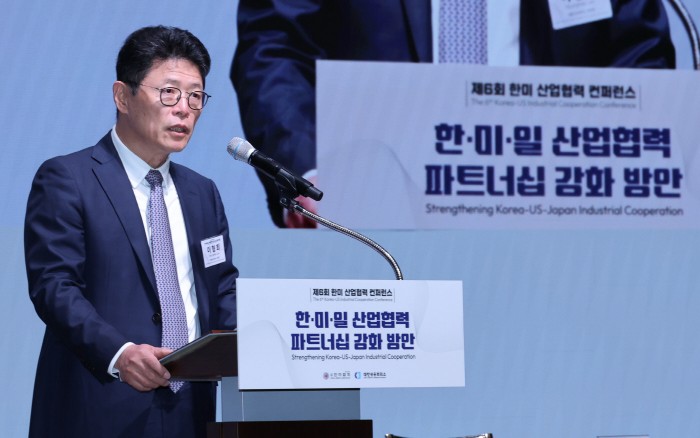 |
| Korea Chamber of Commerce and Industry Vice Chairman Lee Hyung-hee emphasized the need to significantly strengthen private-sector cooperation among Korea, the United States and Japan. /KCCI |
Amid mounting global uncertainties including supply chain restructuring and prolonged instability in the Middle East, experts from Korea, the United States and Japan called for the creation of an “ultra-close industrial alliance” to lead future industries such as artificial intelligence and energy.
Industry and academic leaders stressed the need for practical cooperation measures, including joint development of power-efficient and cost-effective AI semiconductors for data centers and fast-track approval systems for small modular reactors (SMRs), to strengthen industrial competitiveness and stabilize supply chains.
Korea Chamber of Commerce and Industry and the Korea-US Association held the sixth Korea-US Industrial Cooperation Conference on Wednesday at the KCCI building in Seoul, where participants discussed future trilateral cooperation among Korea, the US and Japan.
Experts said the global AI ecosystem is shifting beyond raw performance toward power efficiency and cost competitiveness. During a keynote speech, Kwon Seok-jun said the three countries should establish a joint research and development platform for high-efficiency AI computing infrastructure.
“They should build a joint research center similar to Europe’s IMEC and jointly develop data center systems and memory semiconductors,” Kwon said.
Participants also highlighted the importance of shared infrastructure to support innovation ecosystems. Lee Se-young proposed establishing a trilateral AI infrastructure hub for promising startups, while Ahn Hong-jun suggested creating a “physical AI testbed” combining Korea’s manufacturing data, US AI models and Japan’s control technologies.
Speakers also warned that fragmented regulations could hinder industrial development and called for greater interoperability in private-sector-led regulatory systems.
Energy security emerged as another key issue as geopolitical tensions in the Middle East continue to disrupt global energy supply chains. Experts said stable energy supplies are becoming essential for industrial survival in the AI era, where electricity demand is rapidly increasing.
Jane Nakano said Korea and Japan should jointly invest in US liquefied natural gas export terminals and related infrastructure to secure stable energy supplies.
Cho Hong-jong proposed a fast-track approval system for SMRs to reduce overlapping certification reviews among countries.
“There is a need for joint overseas expansion that combines US core technologies, Japan’s precision components and financing capabilities, and Korea’s construction expertise,” Cho said.
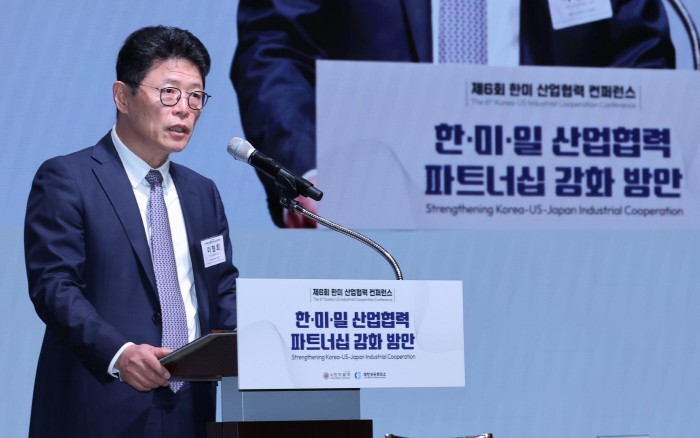 |
| From left, Kwon Seok-jun, Lee Se-young, Kim Kwang-seok and Ahn Hong-jun take part in a discussion on Korea-US-Japan AI venture ecosystem and AI infrastructure cooperation. /KCCI |
Industry leaders also voiced support for stronger trilateral private-sector cooperation. Lee Hyung-hee said Korea and Japan, both export-driven economies, now have stronger incentives to cooperate amid the restructuring of the global trade order.
“Such cooperation will gain greater stability and sustainability within the Korea-US-Japan alliance framework,” Lee said. “We will significantly strengthen private-sector cooperation so the industrial ecosystems of the three countries become more closely connected.”
Choi Joong-kyung also said trilateral industrial cooperation could become “the strongest industrial alliance in human history,” calling for sophisticated supply chain cooperation based on mutual benefits and balance.
The KCCI said it plans to continue working-level consultations with Japanese business groups and further develop concrete trilateral industrial cooperation frameworks based on proposals discussed at the conference.
#Korea #United States #Japan #AI chips #SMR
Copyright by Asiatoday
Most Read
-
1
Kia Sportage outperforms Mazda CX-5 in German auto..

-
2
Houthis launch successive attacks on Saudi airport..

-
3
Saudi Arabia, Iran hold first diplomatic talks to..

-
4
U.S. deploys carrier, 10,000 more troops to Middle..

-
5
Saudi airport in Riyadh struck again, leaving at l..

-
6
Putin's ally visits China on the 8th ahead of APEC..

-
7
Chinese military support and training center opens..

PEOPLE





HEADLINE NEWS

-
Address : In-Young Bldg., 34, Uisadang-daero 1-gil, Yeongdeungpo-gu, Seoul
Copyright by ASIATODAY CO., LTD. All rights resereved