



Hyundai expands hydrogen transport and infrastructure
Apr 28, 2026, 09:42 am


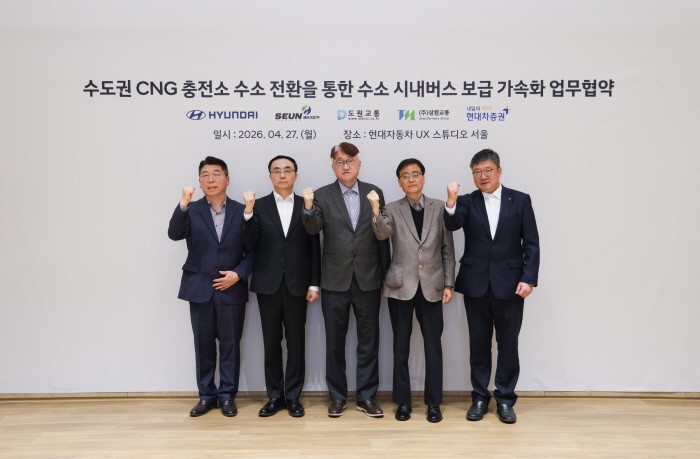 |
| Participants pose for a commemorative photo at the signing ceremony for the agreement on accelerating the deployment of hydrogen city buses through the conversion of CNG stations in the Seoul metropolitan area, held at UX Studio Seoul in Hyundai Motor Company Gangnam-daero Office on April 27. /Courtesy of Hyundai Motor Company |
Hyundai Motor Company is accelerating efforts to decarbonize transportation by expanding hydrogen mobility and infrastructure in the Seoul metropolitan area through partnerships with major transport operators.
The company announced it signed a memorandum of understanding (MOU) with regional bus operators — Dowon Transportation, Samhwan Transportation, and Sewoon Industrial — along with Hyundai Motor Securities to promote the deployment of hydrogen-powered city buses.
A key component of the initiative is converting existing compressed natural gas (CNG) fueling stations into hydrogen refueling stations, laying the groundwork for wider adoption of hydrogen buses.
The partners aim to introduce a total of 400 hydrogen fuel cell buses within five years on routes operated by Dowon and Samhwan Transportation. Hyundai will supply its Elec City hydrogen buses and provide specialized maintenance training to support smooth operations.
The Elec City hydrogen bus features a 180kW hydrogen fuel cell system, a motor delivering up to 4,500 N·m of torque, and a 78.4kWh high-capacity lithium-ion battery.
It can travel up to 751.2 kilometers on a single charge under certified efficiency standards, making it particularly suitable for high-energy-demand urban bus routes.
Transport operators will replace aging CNG buses with hydrogen models, while Sewoon Industrial plans to convert existing fueling hubs and build 10 new hydrogen stations in Seoul and Incheon by 2029.
Hyundai Motor Securities will provide advisory and investment support for the project.
Hyundai said the initiative will contribute to expanding hydrogen transport infrastructure and help achieve South Korea’s national target of reducing greenhouse gas emissions in the transportation sector by up to 37.8% by 2030 compared to 2018 levels.
#Hyundai Motor Company #hydrogen bus #hydrogen infrastructure #CNG conversion #Seoul metropolitan area
Copyright by Asiatoday
Most Read
-
1
Kia Sportage outperforms Mazda CX-5 in German auto..

-
2
Houthis launch successive attacks on Saudi airport..

-
3
Saudi Arabia, Iran hold first diplomatic talks to..

-
4
U.S. deploys carrier, 10,000 more troops to Middle..

-
5
Saudi airport in Riyadh struck again, leaving at l..

-
6
Putin's ally visits China on the 8th ahead of APEC..

-
7
Chinese military support and training center opens..

PEOPLE






HEADLINE NEWS

-
Address : In-Young Bldg., 34, Uisadang-daero 1-gil, Yeongdeungpo-gu, Seoul
Copyright by ASIATODAY CO., LTD. All rights resereved