



Koo pushes AI shift, global AI hub
Apr 17, 2026, 09:05 am


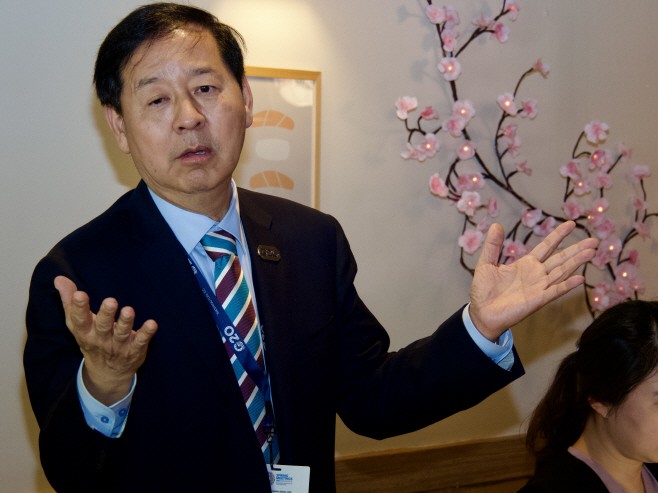 |
| Koo Yun-cheol, Deputy Prime Minister and Minister of Economy and Finance, speaks during a meeting with Korean correspondents at a restaurant in Arlington, Virginia, near Washington, D.C., on April 16. / Washington correspondent Ha Man-joo |
Deputy Prime Minister and Minister of Economy and Finance Koo Yun-cheol said Thursday that Korea is moving to attract artificial intelligence hubs from multiple international organizations, adding that the country could eventually become home to a U.N.-level AI headquarters.
Speaking at a press meeting with Korean correspondents in Arlington, Virginia, near Washington, D.C., Koo said AI is the key tool that can address both growth and inequality, the two main issues on the agenda at the Group of 20 finance ministers and central bank governors meeting.
He also outlined Korea’s strategy to strengthen its AI competitiveness, saying the country should focus not on competing with U.S.-led large language models, or LLMs, but on applying small language models, or SLMs, to key industries such as shipbuilding, automobiles and home appliances.
Korea seeks AI hubs from World Bank and other global institutions
Koo said the World Bank has already set up an AI hub in Korea, while six U.N. agencies as well as the Asian Development Bank and the Inter-American Development Bank have also decided to establish AI hubs there.
He added that Korea plans to ask the International Monetary Fund and the European Bank for Reconstruction and Development to set up similar hubs as well.
“International organizations are building AI hubs in Korea and creating AI campuses there, with Korea providing the platform,” Koo said. “There is strong interest in this structure.”
He said he was scheduled to meet the World Bank president later in the day and the IMF managing director the following day to directly present AI as a solution to growth and inequality.
Koo also said that during an earlier stop in New York, he met executives from global investment institutions including Apollo, Pimco and BlackRock, and found their interest in Korea’s AI transformation, semiconductors, defense industry and shipbuilding had grown significantly.
According to Koo, BlackRock expressed interest in investing in Korea’s shipbuilding industry, while Carlyle’s leadership also showed willingness to invest in Korean initiatives.
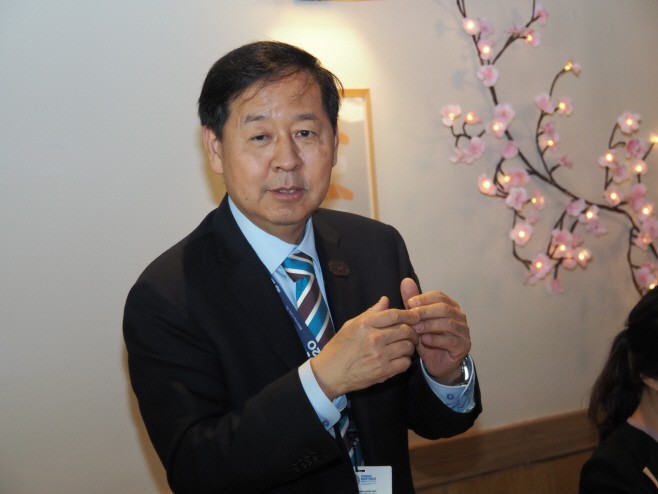 |
| Koo Yun-cheol, Deputy Prime Minister and Minister of Economy and Finance, speaks during a meeting with Korean correspondents at a restaurant in Arlington, Virginia, near Washington, D.C., on April 16. / Washington correspondent Ha Man-joo |
“Korea has no edge in LLMs”
Koo said Korea has little chance of securing competitiveness by following the U.S.-style LLM path, citing the enormous costs involved in building data centers and meeting power demand.
Instead, he proposed using Korea’s own data-based SLMs in core manufacturing sectors. In shipbuilding, for example, he said companies could combine seabed, location, weather and wave data to map optimal shipping routes.
He added that executives at HD Hyundai Heavy Industries had told him that such technology could cut energy use by 30 percent per voyage. He said shipbuilders are already developing their own SLMs, and Hyundai Motor is also pursuing automotive SLM technology.
Koo said, “If only the Middle East war ends quickly, the Korean economy is ready to move rapidly into AI transformation, green transformation and energy transformation,” describing an end to the conflict as a key variable for accelerating those shifts.
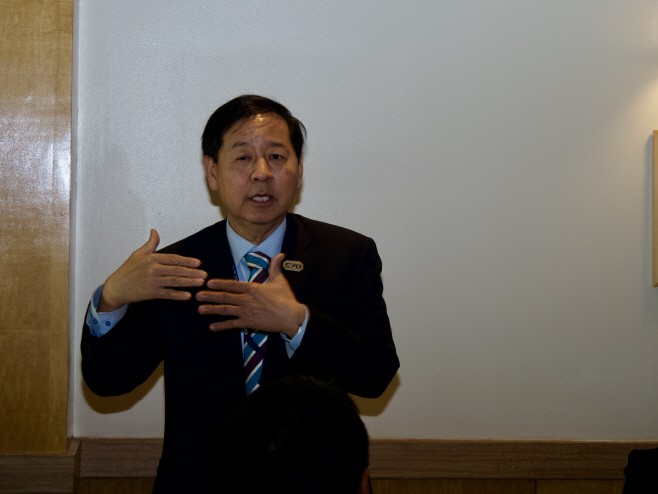 |
| Koo Yun-cheol, Deputy Prime Minister and Minister of Economy and Finance, speaks during a meeting with Korean correspondents at a restaurant in Arlington, Virginia, near Washington, D.C., on April 16. / Washington correspondent Ha Man-joo |
“AI for all” and a 150 trillion won growth fund
Koo said “AI for all” can help solve both growth and inequality, arguing that productivity depends on how well everyone uses AI.
As an example, he cited a case in which junior finance ministry officials underwent one week of full-time AI training and then significantly improved work efficiency by incorporating agent AI into their tasks.
To support AI startups, Koo said the government will create a 150 trillion won 국민성장펀드, or National Growth Fund, and spend 30 trillion won this year.
“We will make sure no one says they could not pursue a business simply because they lacked funding, as long as they have the technology,” he said.
Digital currency proposal for international aid
Koo also discussed the pilot use of central bank digital currency, or CBDC, for subsidy programs.
“When aid money is sent to developing countries, we often do not know where it is actually spent,” he said. “If it is distributed through CBDC or digital coins, everything can be tracked.”
He cited cases in which purchases of rebar and cement at construction sites could be monitored, and said a U.N. official who heard the proposal had requested a presentation at the United Nations next year.
U.S. investment talks and WGBI inflows
On Korea’s proposed $350 billion investment in the United States, Koo said work is under way to clarify details based on a fact sheet. Referring to issues such as restrictions involving Google Maps, he said there were no serious differences between Seoul and Washington.
Regarding the U.S. Trade Representative’s Section 301 investigation, Koo said the labor ministry had adequately explained and submitted documents on the long-running issue of forced labor allegations involving salt farms in South Jeolla Province.
He also said Korea’s inclusion in the World Government Bond Index, or WGBI, had already brought in $5.1 billion over the past two weeks, and projected inflows of $50 billion by the end of the year.
#Koo Yun-cheol #AI hub #Korea #World Bank #United Nations
Copyright by Asiatoday
Most Read
-
1
Celltrion’s Omlyclo gains ground in major European..

-
2
Trump demands rates fall below 1% as Fed hikes for..

-
3
Hyundai Motor Group breaks ground on integrated st..

-
4
U.S. strikes 3 Iranian oil tankers, Iran vows reta..

-
5
Trump makes $1 trillion bet ahead of midterm elect..

-
6
Iran resumes ballistic missile production, assembl..

-
7
Samsung Electronics, Mistral AI to jointly develop..

PEOPLE







-
Address : In-Young Bldg., 34, Uisadang-daero 1-gil, Yeongdeungpo-gu, Seoul
Copyright by ASIATODAY CO., LTD. All rights resereved