



1990s tech giants revive on soaring AI demand
Jun 01, 2026, 01:36 pm


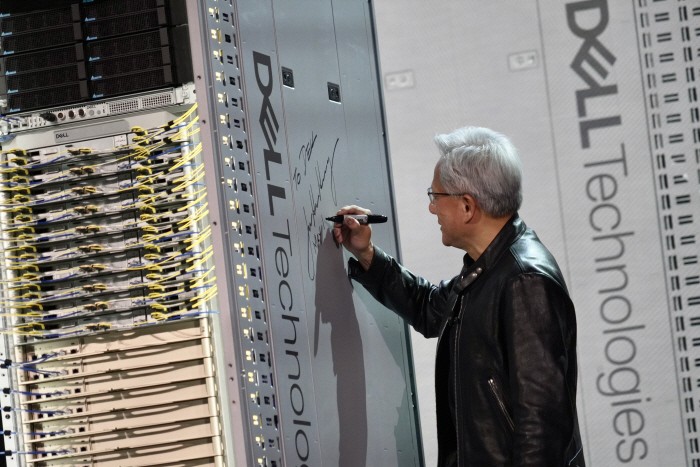 |
| Nvidia CEO Jensen Huang signs a Dell machine during the Dell Technologies World event held in Las Vegas on the 18th (local time). / Photo via AP |
Legacy tech stalwarts of the 1990s, including Dell Technologies, Nokia, and Lenovo Group, are experiencing a powerful resurgence driven by the artificial intelligence (AI) investment boom, Bloomberg News reported on May 31 (local time).
According to Bloomberg, the explosive increase in infrastructure demand for building AI data centers—spanning servers, storage units, network gear, and legacy chips—has sent the stock prices of these corporations skyrocketing.
The share prices of seven tech giants—Dell, Nokia, Lenovo, Micron, Intel, Texas Instruments, and Cisco—surged by an average of 158 percent this year, collectively reaching a combined market capitalization of $1.7 trillion.
Dell, a primary beneficiary of the skyrocketing demand for AI servers, announced on May 28 that its first-quarter revenue reached $43.8 billion, a stellar 87.5 percent increase compared to the same period last year. This performance thoroughly beat Wall Street consensus estimates of $35.7 billion. Following the earnings release, Dell's stock price surged 33 percent, registering its largest single-day percentage gain on record.
Emmanuel Balabanis, an analyst at the London-based global financial group Forte Securities, evaluated, "Dell's earnings announcement is not merely a rebound, but demonstrates its rebirth as a foundational enterprise of the AI era."
Lenovo, where AI-related products and services now account for 40 percent of total revenue, has seen its stock price climb 159 percent on the Hong Kong stock exchange this year, hitting an all-time high in May.
Nokia strategically reorganized its business model around network infrastructure after divesting its mobile handset division. By acquiring the U.S. optical networking enterprise Infinera in 2025, Nokia has actively positioned itself to capture AI data center demand. Its share price has climbed 124 percent this year, marking a triumphant return to the top tiers of European equity markets.
Cisco successfully pivoted from a traditional network hardware supplier into an AI infrastructure enterprise. Its stock price advanced 56 percent this year, finally eclipsing its previous record set during the height of the dot-com bubble in 2000.
Intel secured a pivotal chip fabrication contract with Apple, propelling its stock price up by 211 percent this year. Meanwhile, Texas Instruments saw its share price rise 76 percent as its data center segment revenue breached the $1 billion milestone.
Micron witnessed its market capitalization expand from $500 billion to $1 trillion in a mere 48 trading days, riding the wave of exponential demand for High Bandwidth Memory (HBM). Its stock price has registered a jaw-dropping 903 percent rally over the past year.
"Over the last six months, investments in AI infrastructure have broadened drastically, leading to a landscape where hardware supply is severely constrained while demand continues to scale boundlessly," said Yam Tau Boon, a portfolio manager at U.S. global asset management firm Neuberger Berman. "This demand-supply imbalance across AI infrastructure goes beyond a mere market anomaly; it acts as a massive investment catalyst for firms like Dell, Nokia, and Cisco."
Park Jin-sook
Most Read
-
1
Kia Sportage outperforms Mazda CX-5 in German auto..

-
2
Houthis launch successive attacks on Saudi airport..

-
3
Saudi Arabia, Iran hold first diplomatic talks to..

-
4
U.S. deploys carrier, 10,000 more troops to Middle..

-
5
Saudi airport in Riyadh struck again, leaving at l..

-
6
Putin's ally visits China on the 8th ahead of APEC..

-
7
Chinese military support and training center opens..

PEOPLE






HEADLINE NEWS

-
Address : In-Young Bldg., 34, Uisadang-daero 1-gil, Yeongdeungpo-gu, Seoul
Copyright by ASIATODAY CO., LTD. All rights resereved