



China’s Foreign Minister Wang Yi expected to visit S. Korea on Aug. 19-20
Jul 30, 2026, 10:39 am


Wang Yi, Member of the Political Bureau of the CPC Central Committee, Foreign Minister, and Director of the Office of the Foreign Affairs Commission, is expected to visit South Korea on the 19th and 20th of next month.
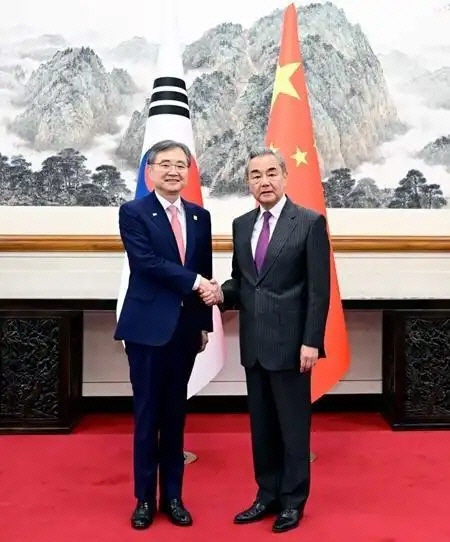 |
| South Korea's Foreign Minister Cho Hyun and Wang Yi, Member of the Political Bureau of the CPC Central Committee and Foreign Minister of China, during the South Korea-China Foreign Ministers' Meeting held in Beijing on September 17 last year. They are expected to meet again on the 19th and 20th of next month. / Ministry of Foreign Affairs of the People's Republic of China |
According to Beijing diplomatic sources familiar with bilateral relations on July 28, South Korea and China have been coordinating the schedule for the visit of Member and Director Wang Yi. Recently, it was confirmed that both sides reached a consensus on a two-day, one-night visit.
During his visit, Director Wang is certain to exchange views on pending bilateral issues and Korean Peninsula matters, including North Korea-China relations, through a South Korea-China Foreign Ministers' Meeting with Foreign Minister Cho Hyun. Additionally, visits to the Blue House, a courtesy call on President Lee Jae-myung, and a meeting with Minister of Unification Chung Dong-young are reportedly being reviewed.
Director Wang's visit to South Korea marks the first time a top-level Chinese foreign policy and security official has visited the country since President Lee Jae-myung's state visit to China in January and the South Korea-China summit with General Secretary and President Xi Jinping.
According to sources, Minister Cho previously stated in January that a South Korea-China Foreign Ministers' Meeting was being pursued for the first quarter of this year. However, it failed to materialize due to various factors. Instead, Director Wang visited North Korea first in April, putting South Korea in an awkward position.
Negative analysis and outlooks proliferated. Concerns arose that China was leaning toward restoring its influence over North Korea amid global strategic competition with the U.S., rather than playing the constructive role South Korea desired on Korean Peninsula issues. Apprehensions were also raised that China might be turning a blind eye to the North Korean nuclear issue.
Furthermore, these concerns materialized after President Xi visited North Korea last month following Director Wang. In response, South Korea reportedly conveyed to China that the spread of allegations regarding tacit approval of North Korea's nuclear program was undesirable.
Against this backdrop, if Director Wang visits South Korea, the South Korean side is expected to request that China actively play a constructive role to stabilize the situation on the Korean Peninsula. South Korea is also certain to convey its position urging continued efforts toward the denuclearization of the Korean Peninsula, peace and stability, and resolving issues through dialogue and cooperation.
The Taiwan issue is also highly likely to be on the agenda for the South Korea-China Foreign Ministers' Meeting. Given that the issue was raised during director-level consultations between South Korea and China last month, such an outcome appears inevitable. This is even more so if South Korea reaffirmed its position of respecting the "One China" principle stated in the 1992 South Korea-China Joint Communiqué on the Establishment of Diplomatic Relations. For South Korea, recognizing "One China" would not be unfavorable if it can draw China into playing an active role in Korean Peninsula issues.
Hong Soon-do
Most Read
-
1
Celltrion’s Omlyclo gains ground in major European..

-
2
Trump demands rates fall below 1% as Fed hikes for..

-
3
Trump makes $1 trillion bet ahead of midterm elect..

-
4
Iran resumes ballistic missile production, assembl..

-
5
Samsung Electronics, Mistral AI to jointly develop..

-
6
Trump warns countries not helping U.S. must pay re..

-
7
Seoul faces triple squeeze over troop deployment t..

PEOPLE






-
Address : In-Young Bldg., 34, Uisadang-daero 1-gil, Yeongdeungpo-gu, Seoul
Copyright by ASIATODAY CO., LTD. All rights resereved