



SK Hynix secures five years of orders, easing industry downturn risks
Jul 30, 2026, 10:26 am


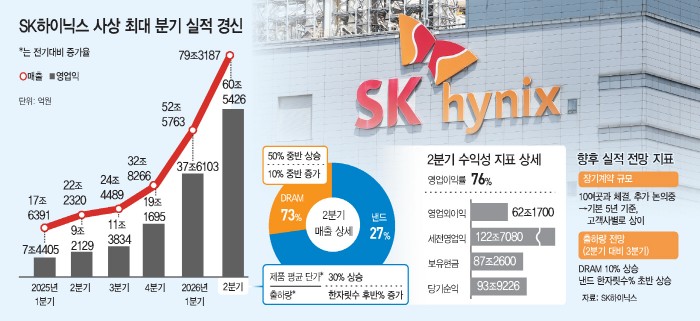 |
SK Hynix, having shattered its own records for highest quarterly revenue, operating profit, and operating profit margin, announced that it has signed long-term agreements (LTAs) averaging five years or more with over 10 client companies. As the contract structure centers around LTAs—particularly within the artificial intelligence (AI) memory market—forecasts suggest a potential shift in the memory industry's chronic boom-and-bust cycle.
On July 29, SK Hynix revealed during its post-earnings conference call that it has finalized LTAs with over 10 clients and is currently negotiating contracts with additional customers. LTAs are typically structured over approximately five years, designing supply volumes and price mechanisms based on customer purchase commitments. The company explained that utilizing mechanisms such as deposits enhances contract enforceability while securing predictability for production and investment plans.
Industry observers view the expansion of LTAs as a signal flare that could reshape the memory sector's structure. In the past, high reliance on spot prices and short-term contracts led to sharp earnings volatility depending on market conditions; however, as long-term contracts expand across the AI memory market, the likelihood of maintaining more stable pricing and supply is growing.
"Through customer purchase commitments and deposits, we are reducing uncertainties stemming from short-term market fluctuations while enhancing demand visibility," SK Hynix stated. "Based on this, we will also be able to operate our investment and production plans more efficiently."
The company added, "While it is difficult to disclose the exact proportion of LTAs relative to total sales, we will operate at an appropriate level considering market environments and customer demand. We are pursuing strategic cooperation with clients and advancing capacity expansion based on confirmed demand visibility." Consequently, the likelihood of mid-to-long-term investment expansion translating directly into oversupply is considered limited.
During the Q2 earnings announcement on the same day, SK Hynix disclosed record-high quarterly revenue and operating profit. First-half revenue reached 132 trillion won, and operating profit hit 98 trillion won, demonstrating earnings capacity approaching 100 trillion won. Its operating profit margin reached 76%, marking the highest level in the global memory industry.
Song Hyun-jong, president of the Corporate Center at SK Hynix, said, "In the case of PCs and mobile APs, sales adjustments are appearing due to difficulties in securing memory volume, but as supply constraints ease and AI services spread broadly moving forward, growth momentum will recover." He added, "DRAM and NAND demand are expected to grow in the mid-20% and late-10% ranges, respectively, and if supply constraints ease further, the growth margin will expand even more."
The company projected that growth momentum will continue into the second half of the year as investments in AI infrastructure expand. In the third quarter, DRAM shipments are expected to grow by about 10% quarter-on-quarter, while NAND shipments are projected to rise in the low single-digit percentage range.
Furthermore, the company indicated no immediate plans to add new production bases. During the briefing, executives remarked, "While supply stability serves as a crucial competitive edge for us as a supplier, we will maximize the utilization of current production bases while leveraging recently announced large-scale domestic investments for long-term infrastructure." SK Hynix previously shared plans to pursue the establishment of a new semiconductor cluster in the southwestern region alongside fab expansions in Yongin and Cheongju.
In particular, the company plans to maintain its leadership in the HBM market by expanding shipment volumes of HBM4 while developing and supplying next-generation products such as HBM4E and HBM5 as scheduled. Confidence was expressed as SK Hynix noted, "We believe our HBM4 combines the performance required by clients with mass supply capabilities supported by stable yields and quality. Having consistently proven our capabilities since the HBM2E generation, our accumulated competitiveness across time-to-market, product performance, mass-production yields, quality, and customer trust forms a differentiated advantage that cannot be easily replicated in a short period."
The company added, "HBM4 has begun mass-production supply for key clients and is displaying yield levels close to previous-generation products in mature yield and quality stages. Ramp-up is proceeding stably, and sample delivery of the next-generation HBM4E to clients has been completed, with full-scale mass production targeted for 2027."
Additionally, the company disclosed that it is developing packaging cooling technologies to control heat issues for subsequent generations such as HBM5. SK Hynix anticipated, "As the AI market expands and accelerator performance becomes more advanced, clients will increasingly prefer suppliers with proven mass-production capabilities, quality, and supply capacity. Based on early co-development and long-term collaboration experience with clients, we will supply products at the right time and lead next-generation technologies to maintain our leadership."
Lee Ji-sun
Most Read
-
1
Celltrion’s Omlyclo gains ground in major European..

-
2
Trump demands rates fall below 1% as Fed hikes for..

-
3
Hyundai Motor Group breaks ground on integrated st..

-
4
U.S. strikes 3 Iranian oil tankers, Iran vows reta..

-
5
Trump makes $1 trillion bet ahead of midterm elect..

-
6
Iran resumes ballistic missile production, assembl..

-
7
Samsung Electronics, Mistral AI to jointly develop..

PEOPLE







-
Address : In-Young Bldg., 34, Uisadang-daero 1-gil, Yeongdeungpo-gu, Seoul
Copyright by ASIATODAY CO., LTD. All rights resereved