



63% of Americans fear AI could wipe out humanity
Sep 17, 2026, 01:06 pm


 |
| David Zapolsky (right), Senior Vice President and Chief Global Affairs & Legal Officer at Amazon, speaks with Cally Baute, Chief Commercial Officer at Politico, at the Politico Decoded Summit held in Washington, D.C., U.S., on the 16th (local time). / AFP-Yonhap |
A new local survey shows that about six in 10 Americans believe artificial intelligence could eventually cause human extinction.
U.S. political outlet Politico released the findings on the 16th from a survey conducted from the 13th to 15th (local time) among 2,064 U.S. adults (margin of error plus or minus 2.2 percentage points), revealing the depth of public anxiety over rapidly advancing technology and prevailing negative sentiment toward AI.
Regarding the likelihood of human extinction caused by AI, 17% of respondents described it as "almost certain," 20% considered it a "significant risk," and 26% viewed it as "somewhat of a risk." Meanwhile, 15% said there is "very little risk," 7% saw "no risk," and 15% were unsure.
Supporters of U.S. President Donald Trump were divided. While 44% favored pausing AI development, 40% believed development should continue because the technology can still deliver substantial benefits.
President Trump described AI and data centers as set to become "the greatest economic development engine in history," asserting that development will not stop during his term.
Concerns over the unchecked advancement of AI technology gained public traction recently after Anthropic CEO Dario Amodei, OpenAI CEO Sam Altman, and Tesla CEO Elon Musk advocated slowing down the development of advanced AI models.
With executives of fiercely competing firms displaying rare alignment, the dangers of AI have emerged as a central debate across American society.
As warnings from top AI leaders clash with President Trump's position, U.S. policymakers face a dilemma: mitigating the potential risks of AI while ensuring the nation does not fall behind rival China in the technology race.
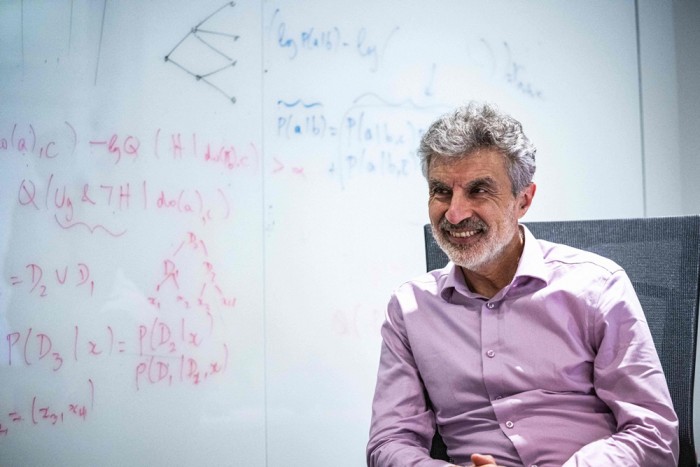 |
| Yoshua Bengio, a professor at the University of Montreal in Canada, speaks during an interview with AFP at his office in Montreal, Quebec, on the 15th (local time). / AFP-Yonhap |
Some Democratic lawmakers in the U.S. Congress are considering establishing a House select committee on AI if they regain the majority in the House of Representatives in the upcoming November midterm elections.
Other Democrats had already publicly called for a ban on artificial superintelligence even before the latest debate emerged.
Yoshua Bengio, a professor at the University of Montreal in Canada who is widely regarded as one of the three godfathers of AI, also voiced concern over the advancement of AI technology.
In an interview with AFP published on the 16th, Professor Bengio argued that "humanity is losing control of AI technology" and called for safeguards similar to nuclear arms control.
"There is a reason why companies are saying 'the pace is too fast' and 'we are losing control,'" he said. "People like me have long anticipated that this would happen."
He went on to point out that security discussions surrounding AI have so far lacked sufficient depth.
Professor Bengio, who pioneered deep learning technology that forms the foundation of modern AI, is recognized alongside University of Toronto Professor Emeritus Geoffrey Hinton and New York University Professor Yann LeCun as one of the world's three AI godfathers.
In 2018, he received the Turing Award, widely considered the Nobel Prize of computing, alongside Professor Hinton.
Kim Hyun-min
Most Read
-
1
Celltrion’s Omlyclo gains ground in major European..

-
2
Hyundai Motor Group breaks ground on integrated st..

-
3
U.S. strikes 3 Iranian oil tankers, Iran vows reta..

-
4
S. Korea seeks redemption from World Cup setback w..

-
5
Trump makes $1 trillion bet ahead of midterm elect..

-
6
Iran resumes ballistic missile production, assembl..

-
7
Samsung Electronics, Mistral AI to jointly develop..

PEOPLE






-
Address : In-Young Bldg., 34, Uisadang-daero 1-gil, Yeongdeungpo-gu, Seoul
Copyright by ASIATODAY CO., LTD. All rights resereved