



[Asia Issue] Diplomatic dexterity of Xi and Wang Yi puzzles US
Jun 01, 2026, 03:00 pm


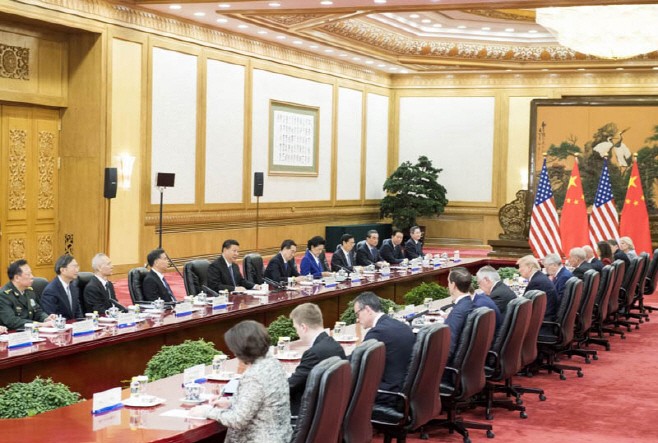 |
| A U.S.-China summit is held at the Great Hall of the People in Beijing during U.S. President Donald Trump's first official visit to China on November 9, 2016, a decade ago. It was during this event that Chinese General Secretary and President Xi Jinping (center left) and Wang Yi, Member of the Political Bureau of the CPC Central Committee and Minister of Foreign Affairs (third from the right on the left side), first formed a unified team to counter the United States—a collaborative framework dubbed a "dream team" by the Beijing diplomatic community that endures to this day. / Photo via Xinhua News Agency |
The global diplomatic offensive orchestrated by the formidable tag team of General Secretary and President Xi Jinping and Wang Yi, Member of the CPC Central Committee Political Bureau and Minister of Foreign Affairs, is reportedly leaving the United States deeply unsettled. Observers note that unless Washington repeatedly deliberates and devises extraordinary countermeasures, this geopolitical dynamic is bound to persist long-term without significant alteration.
According to Beijing diplomatic sources well-versed in U.S.-China relations on June 1, several foreign media outlets have recently begun frequent discussions of a potential "Pax Sinica" to replace "Pax Americana"—the U.S.-led global peace order that has prevailed for nearly a century. This trend suggests that the dawn of a Chinese-led international order is transitioning from a distant scenario into an immediate reality.
Indeed, an examination of the major China-centric diplomatic events led by President Xi and Minister Wang this year lends substantial weight to this conclusion. Most notably, a succession of leaders from 21 nations, including German Chancellor Friedrich Merz, traveled to China for bilateral summits with President Xi. Financial Times coverage likened these visits to leaders of neighboring tributary states hastening to seek an audience with an emperor.
Building on this momentum, President Xi went on to hold a summit with U.S. President Donald Trump, an encounter evaluated by analysts as heavily tilted in China's favor. His subsequent meeting in Beijing with Russian President Vladimir Putin requires little further elaboration. Given this trajectory, the rampant rumors circulating within Beijing that President Xi will visit North Korea early this month to hold a summit with Chairman Kim Jong Un appear well-founded. This expansive clout also illustrates why the public in China frequently refers to him as "Emperor Xi."
The strategic maneuvers of Minister Wang, whose activities are evaluated as carrying the weight of a state president or premier—effectively matching the second or third highest ranks in the party-state hierarchy—are equally noteworthy. Setting aside his relentless domestic schedule, one need look no further than his performance late last month: after chairing a United Nations Security Council meeting, he held a rapid succession of bilateral talks with foreign ministers from over 20 countries to champion the defense of multilateralism.
When pairing these efforts with his recent visit to Canada—the first by a Chinese foreign minister in a decade—which yielded an agreement to fundamentally overhaul bilateral relations, comparisons to Zhou Enlai, who served as premier for 26 years, appear entirely justified. The current climate has even prompted Canadian political circles and media outlets to suggest that Canada should look to Europe for security but partner with China for its economic future.
The offensive does not stop there. Following British Prime Minister Keir Starmer's engagement in late January, UK Foreign Secretary Yvette Cooper is visiting Beijing from June 1 to 3 to discuss cooperative frameworks. Through his upcoming talks with Cooper, Minister Wang is certain to assertively pitch China's positions regarding the containment of U.S. hegemony and the preservation of multilateralism.
Furthermore, should President Xi's visit to North Korea be finalized, Minister Wang is highly likely to meet with Foreign Minister Choe Son Hui in Pyongyang to coordinate on Korean Peninsula issues. Consequently, the Beijing diplomatic community's assessment of Wang as a foreign minister operating at the head-of-state or premier level seems far from an exaggeration.
Hong Soon-do
Most Read
-
1
Celltrion’s Omlyclo gains ground in major European..

-
2
Trump demands rates fall below 1% as Fed hikes for..

-
3
Trump makes $1 trillion bet ahead of midterm elect..

-
4
Iran resumes ballistic missile production, assembl..

-
5
Samsung Electronics, Mistral AI to jointly develop..

-
6
Trump warns countries not helping U.S. must pay re..

-
7
Apple launches first foldable, 1 million won prici..

PEOPLE





HEADLINE NEWS
- Trump to roll out ‘unprecedented welcome’ for Xi with B-2 bombers, F-22 fighters
- S. Korea, U.S., and Japan form united front on Taiwan and economic coercion..
- Trump administration moves to impose sweeping sanctions on International Cr..
- Xi to make state visit to U.S. Sept. 23-25, dispelling rumors over his heal..

-
Address : In-Young Bldg., 34, Uisadang-daero 1-gil, Yeongdeungpo-gu, Seoul
Copyright by ASIATODAY CO., LTD. All rights resereved