



Korean builders eye post-war Middle East reconstruction boom
Apr 10, 2026, 09:21 am


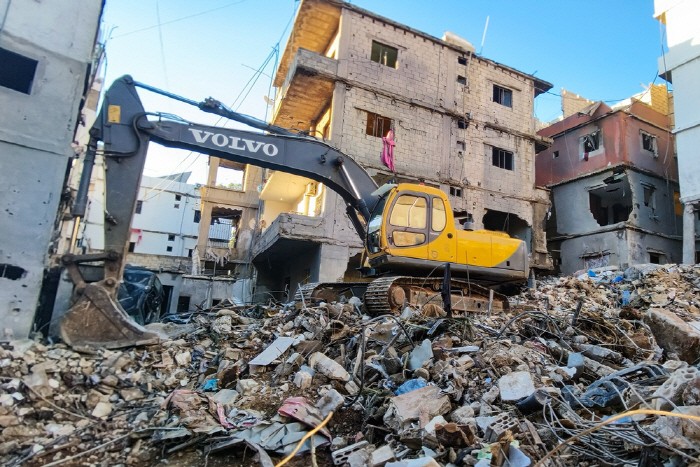 |
| Debris from buildings damaged by airstrikes lies scattered near Rafik Hariri University Hospital in Beirut on April 7. / TASS-Yonhap |
As prospects for a ceasefire between the United States and Iran emerge, expectations are rising that the Middle East reconstruction market could become a major opportunity for construction companies, with five leading South Korean firms drawing particular attention.
Industry observers point to Hyundai Engineering & Construction, Daewoo Engineering & Construction, GS Engineering & Construction, DL E&C, and Samsung E&A as potential beneficiaries, given their extensive experience in plant and energy infrastructure projects across the Middle East.
According to Norway-based energy research firm Rystad Energy, the cost of repairing and restoring energy infrastructure in the region is estimated at a minimum of $25 billion. NH Investment & Securities estimates that Korean companies could secure contracts worth around $12.5 billion, assuming a 50% participation rate.
The optimism stems from expectations that large-scale reconstruction projects will follow any potential end to hostilities. Companies with prior experience in the region are seen as having an advantage in securing contracts.
Each of the five firms brings distinct strengths. Hyundai E&C has experience in Saudi Arabia’s power grid and energy infrastructure as well as nuclear projects in the United Arab Emirates. Daewoo E&C has worked on port and marine civil engineering projects in Iraq. GS E&C has carried out EPC (engineering, procurement and construction) projects in refining, gas and petrochemicals in Qatar and the UAE. Samsung E&A has focused on gas and petrochemical EPC projects in Saudi Arabia, while DL E&C has experience in ammonia, refining and petrochemical projects in the region.
Market analysts note that Samsung E&A’s involvement in Bahrain’s BAPCO and the UAE’s Ruwais refinery projects, along with GS E&C’s past work on the Ruwais refinery—including an $800 million fire restoration project in 2017—could provide a competitive edge.
However, industry insiders urge caution against overly optimistic expectations. They note that few construction firms have successfully secured large-scale reconstruction contracts following conflicts, and even when contracts are awarded, profitability is not guaranteed.
For example, Hyundai E&C participated in discussions at the “Rebuild Ukraine” exhibition in Warsaw in 2023 to explore post-war reconstruction opportunities, but no concrete contracts have materialized to date. Other firms face similar uncertainties.
“Reconstruction projects are typically carried out through intergovernmental cooperation, often involving consortiums of multiple companies under a ‘Team Korea’ framework,” an industry official said. “Even if companies win contracts, profitability may fall short of expectations, and in some cases, losses are possible.”
While the Middle East reconstruction market presents significant opportunities, experts emphasize that risks remain high, and a cautious approach is necessary.
#Middle East reconstruction #Hyundai E&C #Daewoo E&C #GS E&C #DL E&C
Copyright by Asiatoday
Most Read
-
1
Kia Sportage outperforms Mazda CX-5 in German auto..

-
2
Houthis launch successive attacks on Saudi airport..

-
3
Saudi Arabia, Iran hold first diplomatic talks to..

-
4
U.S. deploys carrier, 10,000 more troops to Middle..

-
5
Saudi airport in Riyadh struck again, leaving at l..

-
6
Putin's ally visits China on the 8th ahead of APEC..

-
7
Chinese military support and training center opens..

PEOPLE






HEADLINE NEWS

-
Address : In-Young Bldg., 34, Uisadang-daero 1-gil, Yeongdeungpo-gu, Seoul
Copyright by ASIATODAY CO., LTD. All rights resereved