



Ruling, opposition spar on extra budget
Apr 09, 2026, 09:48 am


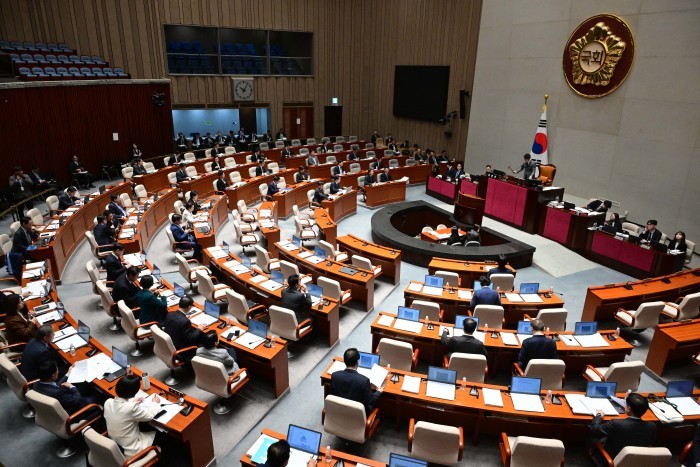 |
| Jin Sung-joon, chair of the National Assembly Budget and Accounts Committee, bangs the gavel during a plenary session on April 8. / Lee Byung-hwa |
South Korea’s ruling and opposition parties clashed for a second day on April 8 over a proposed 26 trillion won supplementary budget during a parliamentary review session.
Members of the Democratic Party of Korea argued the budget was an emergency response to economic instability triggered by Middle East tensions, while lawmakers from the People Power Party criticized it as election-driven spending.
During the session of the National Assembly’s Budget and Accounts Committee, Democratic Party lawmaker Lee Jae-gwan said the proposal was “an emergency prescription to minimize economic shocks caused by rising oil prices,” stressing that it would be financed without issuing government bonds, relying instead on excess tax revenue and funds.
He also criticized opposition calls to cut export support programs, saying it was “hard to understand such claims,” while Rep. Lee Hoon-ki added that proactive measures such as oil price caps and fuel tax cuts were helping stabilize the situation.
In contrast, People Power Party lawmaker Kim Wi-sang acknowledged the need to address supply chain instability but argued that several items—such as renewable energy financing, tax delinquency management, and tourism loan support—did not align with the purpose of the supplementary budget.
Rep. Seo Beom-soo also criticized a 19.5 billion won youth job experience pilot program, questioning whether such projects should be included in what he described as a “wartime budget.” He raised concerns that income- and region-based support measures could be seen as cash handouts ahead of elections.
The debate also extended to a 10 billion won program aimed at attracting tourists from Greater China. Culture Minister Choi Hwi-young said the initiative was intended to encourage charter flights and did not include direct subsidies of 400,000 won per Chinese tourist.
However, People Power Party lawmaker Cho Eun-hee disputed the explanation, insisting that support for Chinese tourists did exist and urging the government to redirect the funds toward caregiving support for middle-aged families.
Budget Minister Park Hong-geun rejected the claim, saying there was no evidence to support it and describing it as politically motivated. Choi acknowledged that adjustments during inter-ministerial coordination may have caused confusion, expressing regret over the misunderstanding.
#supplementary budget #Korea politics #Democratic Party #People Power Party #oil prices
Copyright by Asiatoday
Most Read
-
1
Trump demands rates fall below 1% as Fed hikes for..

-
2
Celltrion seeks rheumatoid arthritis indication ex..

-
3
Chinese e-commerce giants AliExpress, Temu and She..

-
4
Trump warns countries not helping U.S. must pay re..

-
5
Turkish Airlines named main club partner of Liverp..

-
6
China expels No. 2 military official Zhang Youxia..

-
7
Houthi rebels release video claiming downing of Sa..

PEOPLE







-
Address : In-Young Bldg., 34, Uisadang-daero 1-gil, Yeongdeungpo-gu, Seoul
Copyright by ASIATODAY CO., LTD. All rights resereved