



Lee to meet rival leaders over Middle East crisis
Apr 06, 2026, 09:00 am


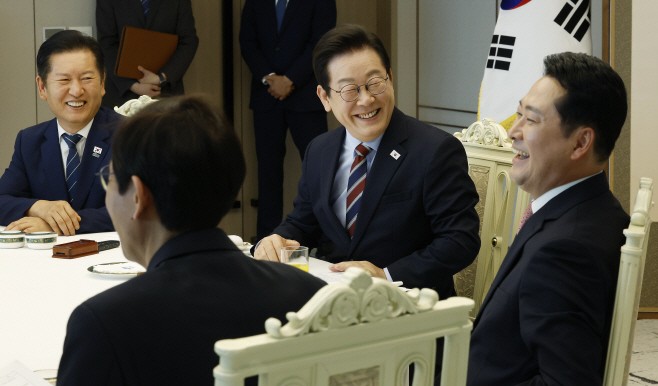 |
| President Lee Jae-myung holds a luncheon meeting with ruling and opposition leaders at the presidential office in this file photo. From left: Jung Cheong-rae, Lee Jae-myung, and Jang Dong-hyuk. /Yonhap |
President Lee Jae-myung will meet leaders of both ruling and opposition parties on April 7 to discuss joint responses to the economic fallout from the Middle East crisis.
According to the presidential office on April 5, Lee will host a luncheon meeting at 11:30 a.m. at the presidential office, bringing together key political leaders for a “livelihood and economic consultative meeting.”
Attendees will include Jung Cheong-rae, leader of the ruling Democratic Party of Korea, and Jang Dong-hyuk, leader of the People Power Party, along with their respective floor leaders. Prime Minister Kim Min-seok and presidential chief of staff Kang Hoon-sik are also expected to attend.
This will mark the first meeting between the president and opposition leaders in about seven months, following their last encounter in September at the presidential office. A similar attempt in February was canceled after the opposition declined to participate.
Lee is expected to urge swift passage of a supplementary budget worth 26.2 trillion won, which was approved by the Cabinet on March 31 after about three weeks of deliberation. The government is seeking rapid parliamentary approval to secure what it calls a “golden time” for stabilizing people’s livelihoods.
The president is also likely to address opposition concerns over specific budget items, including funding for renewable energy and startup support programs, which have faced calls for cuts.
In addition, Lee is expected to call for bipartisan cooperation to address the economic impact of prolonged instability in the Middle East. Even if the conflict ends soon, officials warn that recovery of damaged energy infrastructure could take considerable time, prolonging economic uncertainty.
A presidential official said key agenda items will include responses to domestic economic challenges and global uncertainties stemming from the Middle East conflict. No decision has been made on whether to institutionalize the consultative body.
#Lee Jae-myung #bipartisan meeting #Jung Cheong-rae #Jang Dong-hyuk
Copyright by Asiatoday
Most Read
-
1
Trump shares map on social media labeling Strait o..

-
2
Kia Sportage outperforms Mazda CX-5 in German auto..

-
3
Houthis launch successive attacks on Saudi airport..

-
4
U.S. deploys carrier, 10,000 more troops to Middle..

-
5
Trump rejects Iran's offer to open Strait of Hormu..

-
6
N. Korea conducts first swarm attack drill with dr..

-
7
U.S.-China summit falls short on substance as Trum..

PEOPLE






HEADLINE NEWS
- Seoul dismisses Ukraine's claim of 'S. Korean support for Russia' as "inaccurate and inappropriate"
- S. Korea, Japan race to develop nuclear-powered submarines
- Henri Kagan, Kenso Soai win Nobel Prize in Chemistry for uncovering how mol..
- Vance says Alaska LNG cooperation will move forward with Seoul's current or..

-
Address : In-Young Bldg., 34, Uisadang-daero 1-gil, Yeongdeungpo-gu, Seoul
Copyright by ASIATODAY CO., LTD. All rights resereved