



Rival campaign paths hint at election outcome
Apr 02, 2026, 09:21 am


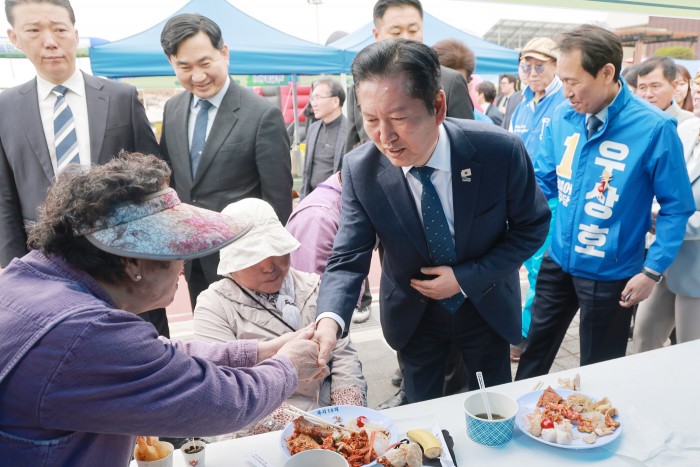 |
| Jung Cheong-rae, leader of the Democratic Party, greets residents during a local festival in Cheorwon, Gangwon Province, on April 1. / Yonhap |
With the June 3 local elections approaching, leaders of South Korea’s two major parties are showing sharply contrasting campaign styles, drawing attention to how their strategies may shape the outcome.
Jung Cheong-rae, head of the Democratic Party, has focused on nationwide outreach, visiting 13 regions outside the capital area over roughly 40 days. His schedule has included local meetings, field visits, and community events, reflecting his belief that “answers lie in the field.”
On April 1, Jung attended a local unity festival in Cheorwon, Gangwon Province, continuing his effort to connect with voters across the country and expand the party’s support base.
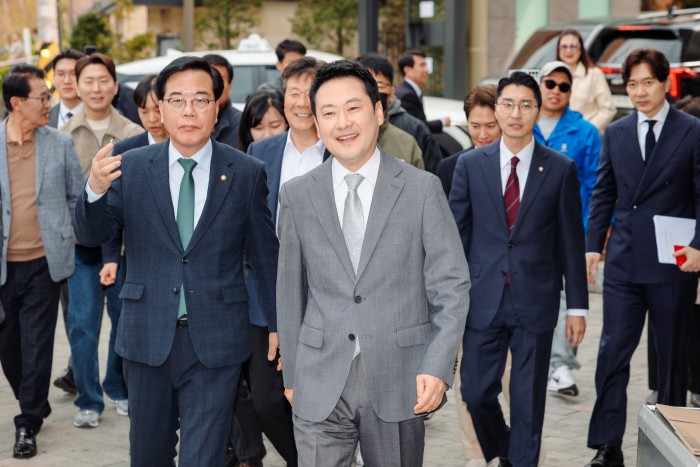 |
| People Power Party leader Jang Dong-hyuk visits an apartment complex in Mapo, Seoul, on April 1 to inspect the real estate market. / Reporter Song Eui-joo |
In contrast, Jang Dong-hyuk, leader of the People Power Party, has concentrated his public activities in Seoul. His recent engagements have centered on meetings in districts such as Yangcheon, Yeongdeungpo, and Mapo, with a particular focus on real estate issues.
Jang recently unveiled key housing pledges, including “half-price jeonse” housing in Seoul and the metropolitan area, as well as mortgage loans linked to childbirth, positioning real estate policy as a central campaign strategy.
However, his relatively limited outreach beyond the capital has drawn scrutiny. Observers suggest that ongoing internal conflicts within the party — including factional disputes and tensions over candidate nominations — may be constraining his broader campaign efforts.
Political analysts say the contrasting approaches highlight differing priorities: while Jung is expanding grassroots engagement nationwide, Jang appears focused on addressing metropolitan issues and stabilizing party dynamics.
Some analysts argue that the gap in campaign activity could signal an advantage for the Democratic Party. Political commentator Park Sang-byung said, “The People Power Party faces internal nomination issues and factional conflict, and Jang himself appears somewhat isolated within the party. This inevitably leads to a more passive campaign. If this trend continues without major variables, the Democratic Party is likely to win by a large margin.”
#Jung Cheong-rae #Jang Dong-hyuk #local elections Korea #Democratic Party #People Power Party
Copyright by Asiatoday
Most Read
-
1
Trump demands rates fall below 1% as Fed hikes for..

-
2
Celltrion seeks rheumatoid arthritis indication ex..

-
3
Chinese e-commerce giants AliExpress, Temu and She..

-
4
Trump warns countries not helping U.S. must pay re..

-
5
Turkish Airlines named main club partner of Liverp..

-
6
China expels No. 2 military official Zhang Youxia..

-
7
Houthi rebels release video claiming downing of Sa..

PEOPLE





-
Address : In-Young Bldg., 34, Uisadang-daero 1-gil, Yeongdeungpo-gu, Seoul
Copyright by ASIATODAY CO., LTD. All rights resereved