



Lee to deliver budget speech on April 2 ahead of vote
Apr 01, 2026, 10:03 am


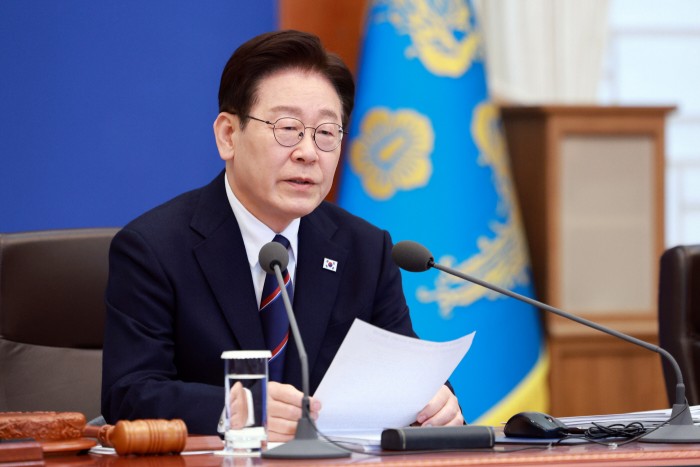 |
| President Lee Jae-myung speaks during a Cabinet meeting at the presidential office in Seoul on March 31. / Yonhap News |
President Lee Jae-myung will deliver a policy speech at the National Assembly on April 2 regarding a proposed 26.2 trillion won supplementary budget, with lawmakers aiming to pass the bill at a plenary session on April 10.
According to the presidential office on March 31, Lee plans to visit the Assembly in person to explain the budget proposal.
Rival parties reached an agreement on the processing schedule a day earlier. Floor leaders of the Democratic Party and the People Power Party jointly announced that the supplementary budget bill would be handled by April 10.
Under the agreed timetable, Lee’s speech on April 2 will be followed by interpellation sessions on April 3, 6, and 13, and comprehensive policy reviews and ministry-level examinations by the budget committee on April 7 and 8.
The proposed budget is aimed at addressing risks stemming from the Middle East crisis, focusing on stabilizing energy supplies, supporting livelihoods, minimizing industrial damage, and securing supply chains. It marks the second supplementary budget under Lee’s administration.
The total 규모 amounts to 26.2 trillion won, financed by 25.2 trillion won in excess tax revenue and 1 trillion won from funds, with no additional government bond issuance expected. The government cited increased corporate tax revenue from a semiconductor recovery and higher securities transaction taxes due to an active stock market as key funding sources.
A major component of the plan is direct support to households affected by high oil prices. The government will allocate 4.8 trillion won to provide between 100,000 and 600,000 won per person to about 35.8 million people, including the bottom 70% income group and near-poor households.
Additionally, around 200,000 low-income households using kerosene or LPG will receive an extra 50,000 won in energy vouchers. The package also includes about 5 trillion won in contingency funds to respond to naphtha supply issues and to implement a price cap on petroleum products.
#Lee Jae-myung #supplementary budget #extra budget bill
Copyright by Asiatoday
Most Read
-
1
Trump shares map on social media labeling Strait o..

-
2
Kia Sportage outperforms Mazda CX-5 in German auto..

-
3
Houthis launch successive attacks on Saudi airport..

-
4
U.S. deploys carrier, 10,000 more troops to Middle..

-
5
Trump rejects Iran's offer to open Strait of Hormu..

-
6
N. Korea conducts first swarm attack drill with dr..

-
7
U.S.-China summit falls short on substance as Trum..

PEOPLE






HEADLINE NEWS
- Seoul dismisses Ukraine's claim of 'S. Korean support for Russia' as "inaccurate and inappropriate"
- S. Korea, Japan race to develop nuclear-powered submarines
- Henri Kagan, Kenso Soai win Nobel Prize in Chemistry for uncovering how mol..
- Vance says Alaska LNG cooperation will move forward with Seoul's current or..

-
Address : In-Young Bldg., 34, Uisadang-daero 1-gil, Yeongdeungpo-gu, Seoul
Copyright by ASIATODAY CO., LTD. All rights resereved