



Blue House says Lee’s emergency order remark was illustrative
Apr 01, 2026, 09:13 am


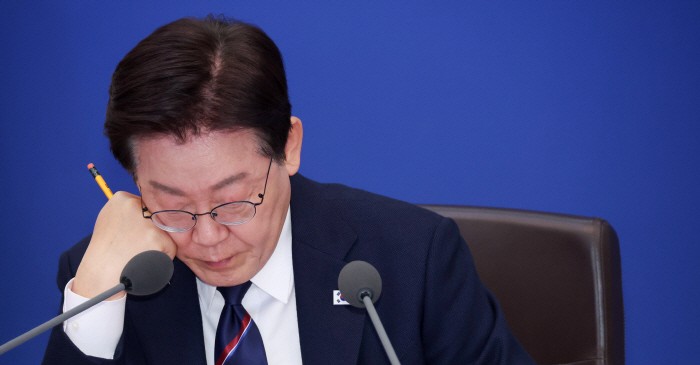 |
| President Lee Jae-myung received a briefing on the Middle East war during a Cabinet meeting at the presidential office on March 31. / Yonhap News |
The presidential office downplayed remarks by President Lee Jae-myung referencing an “emergency financial order” during a Cabinet meeting on March 31, cautioning against overinterpretation.
Presidential spokesperson Kang Yoo-jung said in a briefing that Lee’s mention of the emergency financial order was “only an example.”
“It means that in times of economic crisis or emergency, all available policy tools can be mobilized,” Kang explained. “In context, the president was urging officials not to be bound by bureaucratic practices but to actively and autonomously come up with solutions. The emergency financial order was cited as one possible example among such measures.”
The remarks are interpreted as emphasizing the need to avoid missing the “golden time” for economic response due to lengthy legal procedures, rather than indicating an immediate review or implementation of such an order.
An emergency financial order is a presidential authority stipulated under Article 76 of the Constitution. It allows the president to issue orders with the force of law when urgent action is required due to internal or external crises, natural disasters, or severe financial and economic emergencies, and when there is no time to wait for parliamentary procedures.
The measure has not been used for over 30 years since former President Kim Young-sam invoked it in 1993 to implement the real-name financial transaction system.
Kang also addressed the government’s decision to postpone a proposed emergency supply adjustment for urea and urea solution, stating that “recent procurement has stabilized supply conditions.”
The government had initially considered passing the measure during the Cabinet meeting but decided to hold off as the supply situation improved.
#Lee Jae-myung #emergency financial order #Blue House #urea supply
Copyright by Asiatoday
Most Read
-
1
Trump demands rates fall below 1% as Fed hikes for..

-
2
Celltrion seeks rheumatoid arthritis indication ex..

-
3
Chinese e-commerce giants AliExpress, Temu and She..

-
4
Trump warns countries not helping U.S. must pay re..

-
5
Turkish Airlines named main club partner of Liverp..

-
6
China expels No. 2 military official Zhang Youxia..

-
7
Houthi rebels release video claiming downing of Sa..

PEOPLE






-
Address : In-Young Bldg., 34, Uisadang-daero 1-gil, Yeongdeungpo-gu, Seoul
Copyright by ASIATODAY CO., LTD. All rights resereved