



Seoul to supply 130,000 homes for non-homeowners by 2031
Apr 01, 2026, 08:57 am


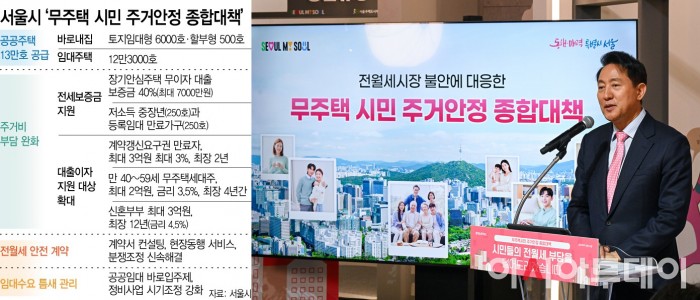 |
| Seoul Mayor Oh Se-hoon announced a comprehensive housing stability plan for non-homeowners at the Seoul Hall of Urbanism and Architecture in Jung-gu, Seoul, on March 31. / Jung Jae-hoon & AsiaToday Design Team |
The Seoul Metropolitan Government has moved to build a housing safety net for non-homeowners. The core of the plan is to supply 130,000 public rental and public-sale housing units over the mid- to long-term and directly reduce the financial burden on tenants.
With 53.4% of Seoul citizens living in rental households, the city judged that effective countermeasures are urgently needed and will invest 3.86 trillion won.
Mayor Oh Se-hoon announced the “Comprehensive Housing Stability Plan for Non-homeowners” at a press briefing held at the Seoul Housing Policy Communication Center in the Seoul Hall of Urbanism and Architecture on March 31.
Oh said, “The Seoul housing market has been shaken daily due to shortages of jeonse and rental listings and sharp price increases triggered by government real estate regulations,” adding, “At the beginning of this year, the number of jeonse listings fell to 18,000, about one-third of the level three years ago.”
He continued, “Market instability caused by supply shortages and policy gaps is being fully passed on to the many non-homeowners in Seoul.”
He added, “We will establish a strong housing safety net so that non-homeowners in Seoul can escape anxiety caused by rental difficulties, regain stability in their daily lives, and move closer to realizing their dream of owning a home.”
The city plans to supply 130,000 public housing units by 2031. Of these, 123,000 units will be provided through existing programs such as long-term jeonse housing, while 6,500 units will be introduced under a new model called “Right Away Home.”
“Right Away Home” is divided into two types. In the land-lease model (6,000 units), the public sector owns the land and residents pay only for the building, allowing them to purchase homes at about half the market price. In the installment model (500 units), buyers pay only 20% of the sale price upfront and repay the remaining balance over 20 years at low interest after moving in, enabling faster homeownership for non-homeowners. The installment model will be supplied starting at the end of this year.
Support will also be strengthened for citizens who need to move due to lease expiration. The city will introduce an “immediate move-in system” for public rental housing, allowing all tenant recruitment announcements to be conducted in advance so that pre-selected applicants can move in as soon as vacancies occur.
Additionally, the timing of relocations in redevelopment projects across 253 districts (310,000 units) will be more strictly managed to minimize shocks to the rental market. The management threshold will be temporarily expanded from projects with more than 2,000 households to those with more than 1,000 households.
To help middle-aged non-homeowners build assets, a “matching savings account” program will also be introduced. A total of 5,000 non-homeowners aged 40 to 64 with income at or below 100% of the median will receive monthly rent support of 200,000 won for 12 months. If participants save 250,000 won per month for two years, the city will add an additional 150,000 won.
The plan also aims to reduce anxiety during rental contracts. Experts, including lawyers at the jeonse and rental support center, will provide pre-contract consultations on risks such as deposit fraud and special contract clauses. In case of disputes, the resolution period will be shortened from an average of 60 days to within 40 days.
The “safe rental contract assistance service,” in which licensed real estate agents accompany tenants during contracts, will be expanded to all non-homeowners, and the number of supported cases will increase from 7,000 to 10,000 per year.
Oh emphasized the importance of supply, stating, “The answer is simple: supply more housing. Supply is the best solution. Once the government and Seoul clearly demonstrate their commitment to increasing supply, speculative demand will inevitably decrease, and once the real estate market becomes predictable, the sharply rising housing price curve will begin to flatten.”
He concluded, “For citizens, a home is not just real estate but the starting point of a peaceful daily life. We will protect the housing safety net for non-homeowners so that no one’s life in Seoul is shaken by housing concerns.”
#Oh Se-hoon #Seoul housing policy #public housing supply #non-homeowners
Copyright by Asiatoday
Most Read
-
1
Celltrion’s Omlyclo gains ground in major European..

-
2
Trump demands rates fall below 1% as Fed hikes for..

-
3
Hyundai Motor Group breaks ground on integrated st..

-
4
U.S. strikes 3 Iranian oil tankers, Iran vows reta..

-
5
Trump makes $1 trillion bet ahead of midterm elect..

-
6
Iran resumes ballistic missile production, assembl..

-
7
Samsung Electronics, Mistral AI to jointly develop..

PEOPLE







-
Address : In-Young Bldg., 34, Uisadang-daero 1-gil, Yeongdeungpo-gu, Seoul
Copyright by ASIATODAY CO., LTD. All rights resereved