



Opposition ramps up pressure with “two messages a day” strategy
Mar 31, 2026, 09:38 am


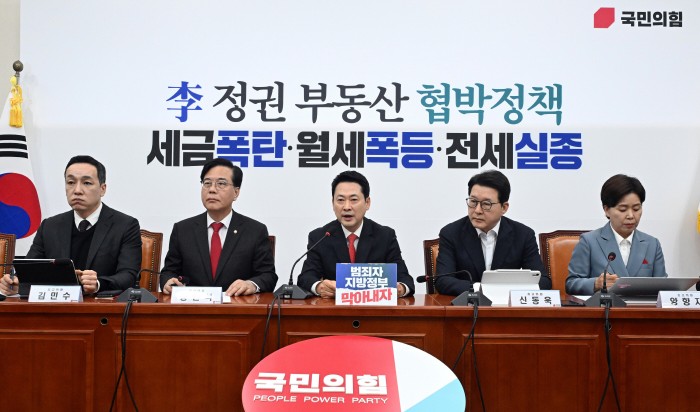 |
| Jang Dong-hyeok, leader of the People Power Party, speaks at a Supreme Council meeting at the National Assembly on March 30. Recently, he has launched a strategy of issuing two messages a day combining livelihood issues with criticism of the government. / Song Ui-joo |
Jang Dong-hyeok, leader of the People Power Party, has launched an aggressive messaging campaign ahead of the June 3 local elections, issuing at least two policy and political statements per day.
The strategy combines livelihood issues with criticism of the government, aiming to seize the initiative in public discourse and boost the party’s visibility. Observers say it is a calculated move to strengthen leadership presence, ease internal conflicts, and rally conservative supporters.
According to political sources on March 30, Jang has intensified his messaging through social media in recent days. Since March 27, he has formalized the so-called “two messages a day” tactic, delivering statements in both the morning and afternoon.
Once Jang releases messages, party spokespersons and affiliated organizations amplify them across social media, broadcasts, and interviews.
Expanding attacks across key issues
Jang has addressed a wide range of topics, including income support for national veterans in connection with West Sea Defense Day, criticism of real estate policies, remarks by President Lee Jae-myung on North Korea, concerns over a war-related supplementary budget, judicial risks facing ruling party figures, and the issue of prosecutors leaving the service.
By alternating between policy and political attacks, he is attempting to sustain momentum and maintain control over the narrative.
Exploring broader conservative alliance
The opposition leader has also met with Lee Jun-seok, leader of the Reform Party, over a luncheon, raising the possibility of broader cooperation in opposing the government.
At the same time, Jang is expanding his on-site activities. Starting with attendance at the Jeju April 3 memorial ceremony, he plans to hold Supreme Council meetings and policy events in the Seoul metropolitan area and other regions.
Strategy to boost visibility ahead of elections
By combining frequent messaging with field activities, Jang aims to counter criticism that he has been absent from the political spotlight. The approach is also seen as an effort to create a “convention effect” by increasing overall party exposure as local election primaries gain momentum.
The shift follows a period of low visibility after his controversial stance distancing the party from former President Yoon Suk Yeol. During that time, the party’s approval rating fell to the 10% range, its lowest since Jang took office.
Risks remain within the party
Despite the renewed offensive, challenges persist. Internal disagreements over Jang’s leadership and political direction have not been fully resolved, and some candidates reportedly feel burdened by potential campaign appearances.
Critics also warn that as the volume of messaging increases, so do the associated political risks.
#Jang Dong-hyeok #People Power Party #opposition strategy #South Korea politics #local elections
Copyright by Asiatoday
Most Read
-
1
Trump shares map on social media labeling Strait o..

-
2
Kia Sportage outperforms Mazda CX-5 in German auto..

-
3
Houthis launch successive attacks on Saudi airport..

-
4
U.S. deploys carrier, 10,000 more troops to Middle..

-
5
Trump rejects Iran's offer to open Strait of Hormu..

-
6
N. Korea conducts first swarm attack drill with dr..

-
7
U.S.-China summit falls short on substance as Trum..

PEOPLE





HEADLINE NEWS
- Seoul dismisses Ukraine's claim of 'S. Korean support for Russia' as "inaccurate and inappropriate"
- S. Korea, Japan race to develop nuclear-powered submarines
- Henri Kagan, Kenso Soai win Nobel Prize in Chemistry for uncovering how mol..
- Vance says Alaska LNG cooperation will move forward with Seoul's current or..

-
Address : In-Young Bldg., 34, Uisadang-daero 1-gil, Yeongdeungpo-gu, Seoul
Copyright by ASIATODAY CO., LTD. All rights resereved