



Rival parties clash over timing of extra budget bill
Mar 30, 2026, 10:07 am


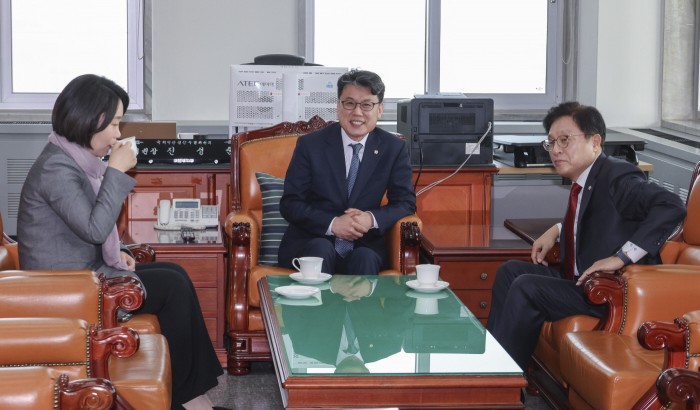 |
| National Assembly Budget Committee Chair Jin Sung-joon (center), Democratic Party lawmaker Lee So-young (left), and People Power Party lawmaker Park Hyung-soo discuss a supplementary budget in Seoul on March 27. / Yonhap News |
South Korea’s rival parties are locked in a standoff over the timing of approving a 25 trillion won supplementary budget, highlighting deep divisions over economic priorities and legislative strategy.
The ruling Democratic Party of Korea has proposed passing the budget by April 9, emphasizing urgency amid rising oil prices and economic pressures. In contrast, the opposition People Power Party is calling for a later timeline around April 14, insisting on a thorough review first.
The issue is expected to be discussed at a meeting of floor leaders on March 30, chaired by National Assembly Speaker Woo Won-shik.
The Democratic Party argues that swift passage is essential to address the economic fallout from Middle East tensions and surging global energy prices. Party leader Jung Cheong-rae said the “golden time” for economic support must not be missed, warning that delays would increase costs.
On the other hand, the People Power Party insists that a question-and-answer session with the government should come first, followed by detailed scrutiny in the budget committee before any plenary vote.
Rep. Park Hyung-soo said passing the budget before questioning the government would undermine meaningful oversight, adding that the party could accept negotiations if a plenary session is scheduled around April 14.
The opposition’s cautious stance is partly driven by concerns over inflation and currency instability triggered by geopolitical tensions, including risks surrounding the Strait of Hormuz.
People Power Party leader Jang Dong-hyeok criticized the government’s approach as excessive liquidity injection, warning it could worsen inflation and exchange rate volatility rather than stabilize livelihoods.
Meanwhile, the supplementary budget is expected to be one of several key items on the April plenary agenda, alongside constitutional amendments and revisions to the Public Official Election Act.
A plenary session scheduled for March 31 is likely to prioritize non-controversial bills, including measures related to exchange rate stability and regional development initiatives.
#supplementary budget #South Korea politics #Democratic Party #People Power Party #National Assembly
Copyright by Asiatoday
Most Read
-
1
Trump shares map on social media labeling Strait o..

-
2
Kia Sportage outperforms Mazda CX-5 in German auto..

-
3
Houthis launch successive attacks on Saudi airport..

-
4
U.S. deploys carrier, 10,000 more troops to Middle..

-
5
Trump rejects Iran's offer to open Strait of Hormu..

-
6
N. Korea conducts first swarm attack drill with dr..

-
7
U.S.-China summit falls short on substance as Trum..

PEOPLE






HEADLINE NEWS
- Seoul dismisses Ukraine's claim of 'S. Korean support for Russia' as "inaccurate and inappropriate"
- S. Korea, Japan race to develop nuclear-powered submarines
- Henri Kagan, Kenso Soai win Nobel Prize in Chemistry for uncovering how mol..
- Vance says Alaska LNG cooperation will move forward with Seoul's current or..

-
Address : In-Young Bldg., 34, Uisadang-daero 1-gil, Yeongdeungpo-gu, Seoul
Copyright by ASIATODAY CO., LTD. All rights resereved