



Property tax threshold eyed for high-value home rule
Mar 30, 2026, 09:59 am


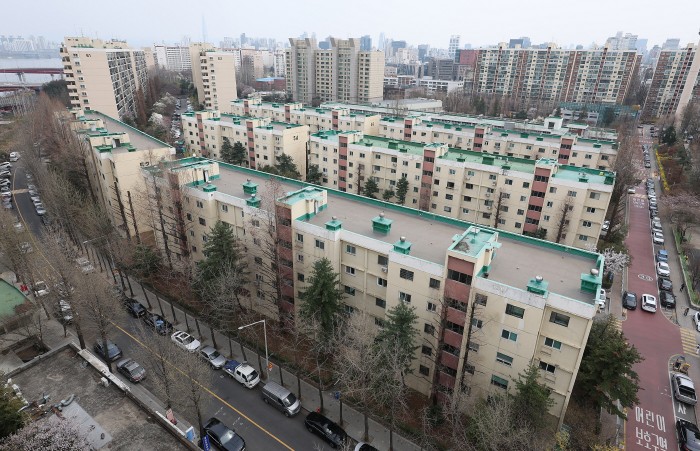 |
| An apartment complex in Gangnam District, Seoul, is seen on March 29, as housing prices showed mixed trends. / Yonhap News |
The South Korean government is considering using the comprehensive real estate tax as the key benchmark to define “non-resident high-value homes,” which could be excluded from real estate policy discussions.
The move follows remarks by President Lee Jae-myung, though no official criteria have yet been announced.
According to government officials on March 29, the presidential office has not formally delivered specific guidelines to relevant ministries. However, many within the government believe that the threshold for the comprehensive real estate tax offers the clearest and most practical standard.
“Although no official 기준 has been communicated, it is likely to be at least at the level of the comprehensive real estate tax,” a Ministry of Land, Infrastructure and Transport official said, adding that it remains the most straightforward yardstick.
The comprehensive real estate tax is calculated annually based on government-assessed property values, making it administratively feasible as a policy standard. Currently, the tax applies to single-home owners whose officially assessed property value exceeds 1.2 billion won.
Given that official property values typically represent 60–70% of market prices, homes valued at approximately 1.7 billion to 2 billion won or higher are subject to the tax.
The discussion comes as the government intensifies its push for real estate normalization, prompting senior public officials with multiple properties to sell off their holdings.
Several presidential office staff members and policy-related officials have already begun disposing of their homes. Among them are spokesperson Kang Yoo-jung, Chun Choo-gwan head Kim Sang-ho, senior secretary Moon Jin-young, and personnel secretary Cho Sung-joo, who have sold or are in the process of selling properties in regions including Seoul, Busan, Sejong, and Gyeonggi Province.
Officials directly involved in housing policy are also taking similar steps. Lee Sung-hoon, presidential secretary for land and transport, has reportedly listed properties in Sejong City and Seoul’s Gangnam District for sale, including assets under his spouse’s name.
A presidential office official said the government is currently reviewing property ownership among policy-related officials and is considering when to implement exclusion measures from relevant duties based on the findings.
Observers say that once a clear definition of non-resident high-value homes is established, it will provide a more concrete basis for determining whether officials must divest their properties or be excluded from policymaking roles.
#real estate policy #Lee Jae-myung #comprehensive real estate tax #property tax #non-resident high-value homes
Copyright by Asiatoday
Most Read
-
1
Trump shares map on social media labeling Strait o..

-
2
Kia Sportage outperforms Mazda CX-5 in German auto..

-
3
Houthis launch successive attacks on Saudi airport..

-
4
U.S. deploys carrier, 10,000 more troops to Middle..

-
5
Trump rejects Iran's offer to open Strait of Hormu..

-
6
N. Korea conducts first swarm attack drill with dr..

-
7
U.S.-China summit falls short on substance as Trum..

PEOPLE






HEADLINE NEWS
- Seoul dismisses Ukraine's claim of 'S. Korean support for Russia' as "inaccurate and inappropriate"
- S. Korea, Japan race to develop nuclear-powered submarines
- Henri Kagan, Kenso Soai win Nobel Prize in Chemistry for uncovering how mol..
- Vance says Alaska LNG cooperation will move forward with Seoul's current or..

-
Address : In-Young Bldg., 34, Uisadang-daero 1-gil, Yeongdeungpo-gu, Seoul
Copyright by ASIATODAY CO., LTD. All rights resereved