



Lee to hold Indonesia, France summits on energy security
Mar 30, 2026, 09:58 am


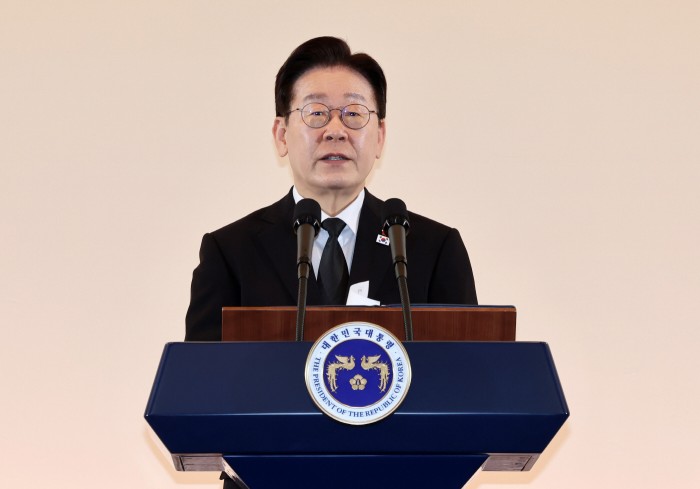 |
| President Lee Jae-myung speaks during a luncheon with bereaved families of the Jeju April 3 victims at a hotel in Jeju City on March 29. / Yonhap News |
President Lee Jae-myung will hold consecutive summit talks with leaders of Indonesia and France to discuss energy security and supply chain stability, amid escalating tensions in the Middle East.
According to the presidential office on March 29, Lee will meet Indonesian President Prabowo Subianto during his visit to South Korea from March 31 for three days. He will then host French President Emmanuel Macron for a state visit from April 2 to 3.
The upcoming summits are expected to cover a wide range of cooperation areas, including artificial intelligence (AI), defense, infrastructure, nuclear energy, and space technology.
However, with rising instability in the Middle East and increasing tensions around the Strait of Hormuz, the focus of discussions is shifting toward energy security and supply chain resilience, rather than solely industrial cooperation.
In talks with Indonesia, resource-based cooperation and defense collaboration are likely to be key agenda items. The two countries have previously worked together on projects such as the KF-21 fighter jet development. Recently, energy supply and supply chain stability have emerged as urgent shared concerns.
The summit with France is expected to involve broader multilateral considerations. France, which holds the presidency of the Group of Seven this year, will host the G7 summit in Evian from June 15 to 17.
Amid growing global concerns over maritime security and energy markets, discussions between South Korea and France may also address nuclear cooperation, advanced technologies, space industries, and the stability of international sea lanes.
The South Korean government is currently placing greater emphasis on diplomatic solutions, international cooperation, and non-military responses, rather than direct military involvement.
Observers say the back-to-back summits will serve as a test of South Korea’s ability to balance industrial cooperation with energy security diplomacy, as prolonged tensions in the Strait of Hormuz could significantly impact global oil transport and supply chains.
#Lee Jae-myung #Indonesia summit #France summit #Prabowo Subianto #Emmanuel Macron
Copyright by Asiatoday
Most Read
-
1
Trump shares map on social media labeling Strait o..

-
2
Kia Sportage outperforms Mazda CX-5 in German auto..

-
3
Houthis launch successive attacks on Saudi airport..

-
4
U.S. deploys carrier, 10,000 more troops to Middle..

-
5
Trump rejects Iran's offer to open Strait of Hormu..

-
6
N. Korea conducts first swarm attack drill with dr..

-
7
U.S.-China summit falls short on substance as Trum..

PEOPLE






HEADLINE NEWS
- Seoul dismisses Ukraine's claim of 'S. Korean support for Russia' as "inaccurate and inappropriate"
- S. Korea, Japan race to develop nuclear-powered submarines
- Henri Kagan, Kenso Soai win Nobel Prize in Chemistry for uncovering how mol..
- Vance says Alaska LNG cooperation will move forward with Seoul's current or..

-
Address : In-Young Bldg., 34, Uisadang-daero 1-gil, Yeongdeungpo-gu, Seoul
Copyright by ASIATODAY CO., LTD. All rights resereved