



Govt to draft 25 trillion won supplementary budget using extra tax revenue
Mar 23, 2026, 09:42 am


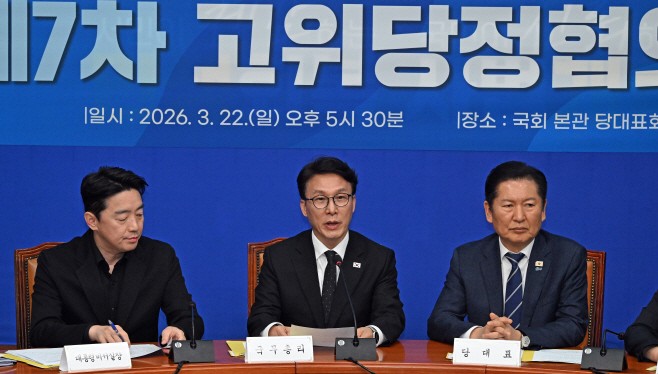 |
| Prime Minister Kim Min-seok spoke during the 7th high-level party-government meeting held at the National Assembly on March 22. /Song Eui-joo |
South Korea’s ruling party, government, and presidential office agreed on March 22 to draft a 25 trillion won ($18.8 billion) supplementary budget to respond to mounting economic risks stemming from the Middle East crisis.
The plan avoids issuing additional government bonds, instead relying on higher-than-expected tax revenues to minimize the impact on the foreign exchange market.
The budget will focus on easing logistics and fuel costs, supporting small businesses and farmers, and stabilizing exports hit by the prolonged regional instability. Officials said a “targeted support” approach would be adopted, with more resources directed toward vulnerable groups and regional economies.
Prime Minister Kim Min-seok emphasized the urgency of action, citing what he described as a “triple wave” of high oil prices, a weak currency, and inflation.
“A swift and structural response is essential. An emergency supplementary budget to protect livelihoods and stabilize the economy is not optional—it is necessary,” Kim said.
Presidential Chief of Staff Kang Hoon-sik described the plan as a “wartime budget,” calling for bipartisan cooperation in light of the crisis.
“In times of crisis, the vulnerable must be protected more strongly,” Kang said, urging the National Assembly to act quickly to avoid missing the policy “golden time.”
Ruling party leader Jung Chung-rae also stressed speed, comparing the supplementary budget to “an oxygen mask for the economy,” and pledged to pass it at a record pace once submitted.
The government aims to prioritize the bill at a plenary session in early April.
In addition to fiscal measures, authorities plan to intervene in energy markets to stabilize supply and prices. A price cap system for petroleum products will be introduced on March 27, alongside potential fuel tax cuts.
The government is also preparing contingency measures in case of disruptions in the Strait of Hormuz, including securing alternative supplies, coordinating strategic oil releases with the International Energy Agency (IEA), and supporting imports of substitute feedstocks such as naphtha.
Separately, officials reviewed follow-up steps for establishing a state investment corporation under the Korea-U.S. strategic investment law and pledged to finalize related regulations for the planned launch of the integrated Gwangju–South Jeolla metropolitan city on July 1.
#supplementary budget #South Korea economy #Middle East crisis #extra tax revenue
Copyright by Asiatoday
Most Read
-
1
Trump demands rates fall below 1% as Fed hikes for..

-
2
Celltrion seeks rheumatoid arthritis indication ex..

-
3
Chinese e-commerce giants AliExpress, Temu and She..

-
4
Trump warns countries not helping U.S. must pay re..

-
5
Turkish Airlines named main club partner of Liverp..

-
6
China expels No. 2 military official Zhang Youxia..

-
7
Houthi rebels release video claiming downing of Sa..

PEOPLE







-
Address : In-Young Bldg., 34, Uisadang-daero 1-gil, Yeongdeungpo-gu, Seoul
Copyright by ASIATODAY CO., LTD. All rights resereved