



Powell warns on energy shock, rates unchanged
Mar 19, 2026, 08:51 am


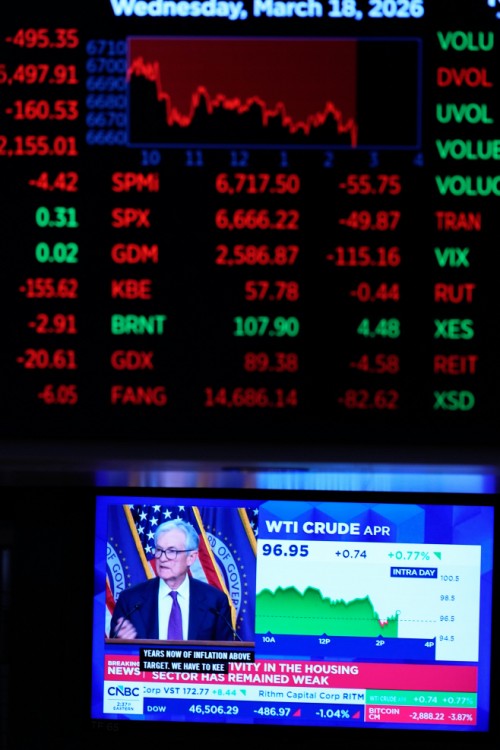 |
| A video of Federal Reserve Chair Jerome Powell speaking at a press conference at the Fed headquarters in Washington, D.C. on March 18 is broadcast on a monitor at the New York Stock Exchange. |
The Federal Reserve kept its benchmark interest rate unchanged for a second consecutive meeting, citing uncertainty stemming from the Middle East conflict and rising energy prices.
The Federal Open Market Committee voted 11–1 to maintain rates at 3.50–3.75%, following three consecutive cuts late last year and a pause in January. While officials maintained expectations for one rate cut later this year, they revised up both inflation and growth forecasts.
Jerome Powell warned that the conflict could push inflation higher in the short term, particularly through rising oil prices, but said it remains too early to assess the full economic impact.
“Recent increases in short-term inflation expectations appear to reflect rising oil prices due to supply disruptions in the Middle East,” Powell said. He added that the scope and duration of the impact remain uncertain.
The Fed’s updated projections showed U.S. economic growth at 2.4% for the year, slightly higher than previous estimates, while the personal consumption expenditures (PCE) inflation forecast was raised to 2.7%. Core inflation was also revised upward.
Policymakers signaled caution, emphasizing that further progress on inflation is necessary before any rate cuts. “If we do not see that progress, there will be no rate cuts,” Powell said, highlighting the delicate balance between cooling inflation and supporting the labor market.
Markets reacted negatively to the Fed’s stance. U.S. stocks fell sharply, with the Dow Jones Industrial Average dropping 1.63%, the S&P 500 declining 1.36%, and the Nasdaq Composite losing 1.46%. Treasury yields rose, with the 10-year yield climbing above 4.27%.
Global financial media interpreted the decision as a “wait-and-see” approach, noting that persistent inflation, geopolitical risks and energy price volatility are complicating the Fed’s policy path. Some market participants have even begun pricing in the possibility that rate cuts could be delayed until 2027.
Powell also addressed leadership uncertainty, stating he would remain in his role until the conclusion of an ongoing investigation and could continue serving in an acting capacity if a successor is not confirmed by the end of his term.
Despite concerns about stagflation, Powell dismissed comparisons to the 1970s, noting that unemployment remains near normal levels and inflation is only moderately above target.
The Fed’s cautious stance underscores the growing challenge of navigating inflation risks amid geopolitical shocks, with policymakers signaling that future decisions will depend heavily on incoming data.
#Federal Reserve #Jerome Powell #interest rates #Middle East war #inflation
Copyright by Asiatoday
Most Read
-
1
Celltrion’s Omlyclo gains ground in major European..

-
2
Trump demands rates fall below 1% as Fed hikes for..

-
3
Trump makes $1 trillion bet ahead of midterm elect..

-
4
Iran resumes ballistic missile production, assembl..

-
5
Samsung Electronics, Mistral AI to jointly develop..

-
6
Trump warns countries not helping U.S. must pay re..

-
7
Apple launches first foldable, 1 million won prici..

PEOPLE






HEADLINE NEWS
- Trump to roll out ‘unprecedented welcome’ for Xi with B-2 bombers, F-22 fighters
- S. Korea, U.S., and Japan form united front on Taiwan and economic coercion..
- Trump administration moves to impose sweeping sanctions on International Cr..
- Xi to make state visit to U.S. Sept. 23-25, dispelling rumors over his heal..

-
Address : In-Young Bldg., 34, Uisadang-daero 1-gil, Yeongdeungpo-gu, Seoul
Copyright by ASIATODAY CO., LTD. All rights resereved